HSF #0: Waistcoat, Bloody Waistcoat

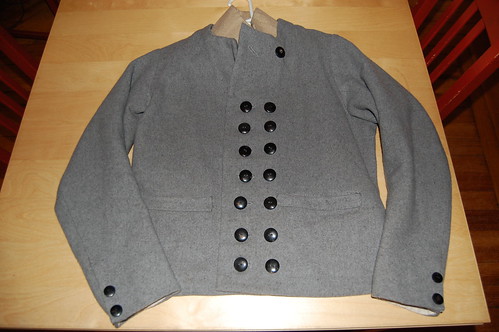
Challenge garment peers from jacket. Calm thyselves, fellow authenticity hounds. New buttons for jacket are on order.

(Actually, the jacket was bloody where I jabbed myself with the needle inserting the sleeve, but that’s fun for another day. And how you know your historical sewing project is complete. I bled for this, man.)

The Challenge: #0, Starting Simple

Fabric: Body: ¾ yard remnant from Wm Booth Draper WWB816 Broadcloth, light brown. Lining: Left over heavy-weight linen. Might also have come from Booth, I forget.

Pattern: Kannik’s Korner Man’s Waistcoats, 1790-1815

Year: Call it 1799. That’s the year where it will be worn.

Notions: 9 brass buttons from Wm Booth Draper
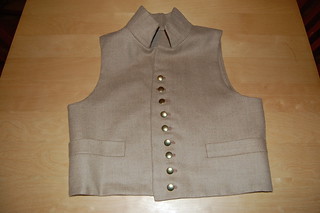
What monkey did those buttonholes?

How historically accurate is it? Well…the pattern has good documentation and the fabric is within reason for the period. The waistcoat is entirely hand-sewn, but the button holes were apparently accomplished by drunken crack-headed monkeys, which is what you get for trying to finish a garment on New Year’s Eve. I was neither drunk, nor on crack, and have no helper monkeys, but all the same…thank god for jackets to hide the sins of my buttonholes.
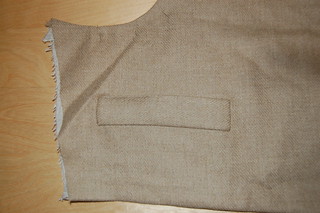
Best welt I ever made–aside from butting heads with a colleague once.

Hours to complete: Don’t ask. It’s a soul-robbing number. The buttons and buttonholes alone took 1 full and two half Abbot & Costello movies, and two “Monarchy” episodes. Probably 25 hours total (I started in November, but stopped sewing after December 2). Total time may include naps taken when I fell asleep while sewing.

First worn: To be worn by the new owner (Mr S) January 19, at the Winter Frolic.

Total cost: Blood, sweat, tears… sorry, wrong war. Buttonholes bring that out in me.

  • Fabric:  $13.50
  • Lining: Leftover, hence not factored in.
  • Buttons: Used 9, but bought 10 because I’m not as simple as I look, so $12.50
  • Pattern: Also from Wm Booth, $16.

That puts the cash outlay at $26 for materials, and $16 for pattern, which I will use again starting yesterday. Yes, sports fans, another bloody waistcoat to sew. Lucky for me, it’s red, so the blood won’t show. Checking the HSF schedule, I can see that the only 1813 garment I can make is another waistcoat (1790-1815, remember?) for the Young Mr, who needs a full set of clothes made by January 19. Waistcoat underway, pattern pieces assembled and two more pieces of broadcloth remnant order for a jacket, leaving trousers to wrestle with. At least I have fabric. 
Start Your Needles!

LAPL- Casey Collection

I haven’t sewn anything in nearly a month, and it has been delicious. Really. No buttonholes, no hems, no seams. Nothing! I ripped a button off my winter coat and pocketed it, people. I didn’t sew it back on. That’s cold turkey.

But spring beckons, or so I’m told it will, eventually, and the sewing must start again. There are many, many things I want to make and several I need to make. Wants and needs…and more meditation.

I’ve been watching the Historical Sew Fortnightly that The Dreamstress is running, and I’m in. What the heck! I need another kick in the pants,  breeches, what-have-you, to get back to sewing. I really do enjoy it, so why not?

To start with something simple due by midnight? Hmm. I have at least two ideas already, but one garment under construction might allow me to meet the deadline. Well, the North American midnight, anyway. I’ll have to cheat to start, and that isn’t usually the Calash way…

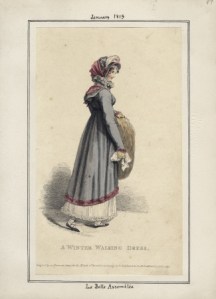
Looking ahead, I see a possible 1813 garment in my future. How about this 1813 Winter Walking Dress? I could make it just for fun, which would be a good task for me.

Portrait of a Waistcoat

RIHS-Robert Jenkins

Meet Mr. Jenkins. There are references to a Robert Jenkins, Vestryman of Christ Church, Boston and merchant of Salem, MA and Newport, RI. A Robert Jenkins married Elizabeth Champlin of Newport, and we have a pendant portrait of Betsey Jenkins, suggesting stronger ties to Newport. The records are confusing, but one thing is clear: that’s his waistcoat and he’s happy to have you see it.

This 1748 portrait by John Greenwood shows a man associated with a port city, perhaps connected with shipping and mercantile trade (see the ships in the background), and who has made enough money to a) commission a portrait and b) either own that sweet silk velvet waistcoat or to have one painted. It is entirely possible that he owned it.

Met-Waistcoat

And it probably looked a lot like this 1750-1755 one from the Met, but without the sleeves. There is fragment (two fronts) of one very like this in the collection at work. It’s not Robert Jenkins’, but it is Rhode Island, so we know these kind of garments were available and worn. The last piece to track down would be an account book, to get some idea of what this might have cost.

What I like in particular about the Met’s waistcoat is the cuff detail. The sleeve, which would be heavy if fully made of velvet, is not. Only the cuff is the velvet, while the sleeve itself is lighter weight silk.

Caps and Randomness

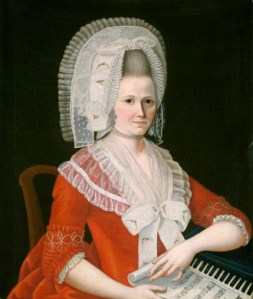
NGA- Lady Wearing a Large White Cap

Sweet cap, right? It all started because it’s cold this morning here in RI and I thought about skating when I went out to get the Times, and that led to Gilbert Stuart, which led to the National Gallery.

They have a fun search option, similar to the Tate Britain’s subject-search, but not quite as elegant.
You can start with a subject search, and then add a sub category. Results (stability not guaranteed) show you things you would not have otherwise expected, and that’s one more reason to love online catalogs & databases.

NGA Screenshot
NGA Screenshot

The results give you little unexpected galleries, and the juxtaposition or similarities of the thumbnails help you see the work differently. Black dresses and white collars are prevalent on this page: why? Is this fashion alone, or are these mourning garments? they’re earlier than the Civil War, but maybe it’s time to re-read This Republic of Suffering.

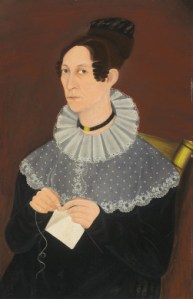
NGA- Sarah Cook Arnold knitting

But wait–who is this? It’s Probably Sarah Cook Arnold, Knitting. (Probably is not her name, smartypants, it’s an adverb.)

She’s knitting in the round, by the way, on three incredibly tiny pins from an invisible ball of yarn, possibly swallowed by the cat hidden in her skirts. (I know a woman who can knit with these skinny quadruple-ought pins, but they are a hazard in my hands.)

I would not have found Sarah Cook Arnold knitting without using the random subject search, nor would I have found Fabulous Cap at the top. Sometimes you need to enjoy the journey as much as the destination.