

- Canton: The upper hoist corner of a flag
- Field:The background of a flag
- Hoist: The edge of a flag nearest to the flagpole
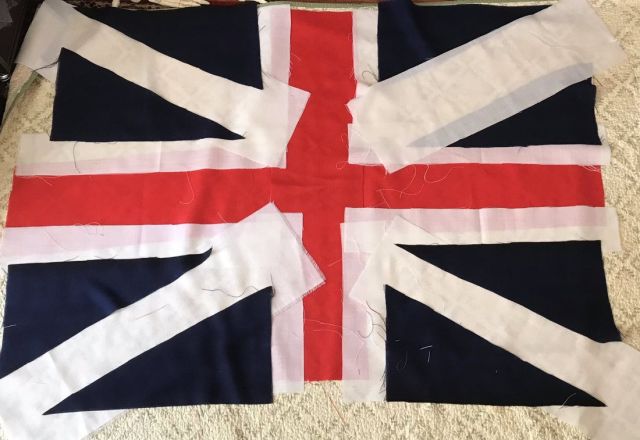
The (thankfully) pre-cut pieces are all cut with a 1” seam allowance, larger than the ½” finished seams will be. This margin of error takes into account the bunting’s extreme willingness to unweave itself at every opportunity and the difficulty of cutting very large pieces of fabric. (I am really grateful I didn’t have to cut all of these — there are many flags being made– and can only imagine the hand cramps!) But to the business at hand: I had to guess a little bit, since there isn’t a construction manual. It looks a fright, I know: all those overlapping bits! The disorganization! If you like things just so, as I do, this project needs some corralling.
To get a better handle on a project too large for my table or floor, I made a list and measured each piece so that I could put them all into Illustrator and move them around more easily. I realize this is a luxury lots of people don’t have, but it’s really just a fancy, digital way of putting together what would be scaled-down pieces of paper in an earlier age.

Check drawings against field conditions!
 Kirsten Hammerstrom