Winter Amusement

Winter Amusement: A View in Hyde Park from the Sluice at the East End.Aquatint, printed in color and colored by hand, 1787.Print made by James Tookey. YCBA  B1985.36.609
Winter Amusement: A View in Hyde Park from the Sluice at the East End.Aquatint, printed in color and colored by hand, 1787.Print made by James Tookey. YCBA B1985.36.609

I count myself among the people sick of winter in New England, but the piles of snow and wretched driving have prompted some comments from the Young Mr, including “Well, it would be worse in the 18th century, right?”

16314413949_fca9e1de44_zHaving recently walked on a combination of cleared, partially cleared, and uncleared walks, I’m not so sure…but I was in modern boots, and not my leather-soled repro shoes, which I prefer not to expose to the variety of modern snow-melting chemicals, though they can be cleaned.

Still: the partially cleared and unsalted walk was easier to walk on than you might imagine, and I suspect that the 18th century tasks of clearing steps and paths to make room to walk or drive carts, wagons and carriages was probably reasonably effective– though the melting must have been more annoying and messy when mud season arrived.

In all this cold and snow, how did people keep warm and stay fashionable? For gents, of course, greatcoats were an option, and cloaks or mantles for women, both in the last quarter of the 18th century and into the 19th. I found documentation for women’s Spencers and greatcoats in the first decade of the 19th century, but what about earlier?

detail,  Winter Amusement, 1787
detail, Winter Amusement, 1787

While I cannot (yet) place the coat at right in New England, you know I covet one.

Tail pleats with back buttons, a possible shoulder cape? I love the menswear styling of this coat, and the drab-and-black color combination of coat, gown and accessories. I don’t have much call for 1787 clothing in my life (actually none whatsoever) but by the time I’ve patterned and made this coat (after many other things to finish), perhaps I will also have created a reason.

Winter frolics, New Year’s Eve party, 1788? Anything is possible, and time is better spent imagining fun than complaining about snow.

Half Robe or Jacket: How Do You Wear One?

Half robe, 1790-1800. National Trust Inventory Number 1348749,
Half robe, 1790-1800.
National Trust Inventory Number 1348749,

What Cheer Day is coming, and I hate to miss an opportunity to make a new gown (despite having just made one, and despite needing to make some waistcoats and trousers for the event). While I lay awake last night, I pondered my options, and whether a half gown would be suitable.

Although I have concluded it probably is not, I was curious about how these should be worn. Where can you wear such a garment? Is it only suitable for at-home use?

This is the robe from Nancy Bradfield’s Costume in Detail, replicated by Koshka the Cat here, and approximately by me, here.

Since I will be a housekeeper again, I think a gown is more correct for me, but that doesn’t stop me thinking about half robes, and whilst scrolling images by year at the Yale Center for British Art, I found this by Cruikshank:

ladies in a lending library
Isaac Cruikshank, 1756–1810, British, The Lending Library, between 1800 and 1811, Watercolor, black ink and brown ink on medium, lightly textured, beige wove paper, Yale Center for British Art, Paul Mellon Collection

There’s a lot to love in this image, even with its fuzzy “between 1800 and 1811” date. Not only do we get an array of reading material (Novels, Romance, Sermons, Tales, Voyages & Travels, Plays), we get costume tips and– special bonus– a dog gnawing its leg.

(If you are curious about some of the books in the Library at the John Brown House, check out this tumblr bibliography. I’ve been using it of late, and the representative genres are quite similar to what we see in the Cruikshank.)

We also get a chemisette on the lady at the counter, along with a very dashing hat, a fancy tiered necklace on the lady in pink, who also carries a green…umbrella? Parasol? With just a veil, that seems likelier than the longest reticule ever.

I like our Lady in a Half-Robe and her deep-brimmed bonnet showing curls at her brow. She and her companions show the range of white and not-white clothing seen in early 19th century fashion plates, and the range of head wear, too.

Undress for August, 1799. Museum of London

The last question I’m asking myself, though, is whether the yellow garment is a half-robe or a short pelisse or a jacket. And can you wear a half robe out of doors? And what did the ladies of the period call that garment?

In this fashion plate (featured by Bradfield on page 84, found by me at the Museum of London), the lady on the right is certainly wearing a short upper body garment, and I’d wager that she’s out of doors or headed that way, since she’s carrying a (green) parasol. Bradfield calls her garment a “jacket,” and until I can find the text of the Ladies’ Monthly Museum for August 1799, perhaps that is the term we should use instead.

While two images aren’t a lot of evidence, it does appear possible to wear a half-robe or jacket out of doors for informal visits in clement weather, and finding two is as good a reason as any to look for more.

What Snow Day?

Benjamin West, 1738-1820, American, active in Britain (from 1763), Page Boy Asleep, undated, Brown wash with pen and brown ink on medium, slightly textured, cream laid paper, Yale Center for British Art, Paul Mellon Collection.B1975.4.786

Just because the Young Mr had a snow day and slept in didn’t mean the rest of us did.  So what did we do?

We went to work, just as they would have in the 18th century. We joke that the streets in our town are better after ice and snow, because the potholes are filled in and the ride is smoother.  You can see the principle at work here, in a watercolor by Benjamin Henry Latrobe.  Sleighs and sleds will run more smoothly on snow-packed roads, and sometimes I think a sled would be better than a Subaru in the city of Providence.

Still, I’m grateful for furry boots and buckets of salt, central heat and an electric tea kettle. Every winter, one or more of us falls on the ice, and when I went out to salt the paths this morning, I could see where Mr S had slipped on snow-covered ice.

In the Morland below, the scene revolves around the central figures, a man who has fallen on the ice despite his stick, the woman, black bonnet thrown back, who has witnessed his fall. We haven’t reached this point yet, and snow has become sleet that will freeze later, with more snow to come, so our vista is not nearly as attractive. But it’s clear that we, as humans, have never enjoyed snow and ice very much, and I think the donkeys are unimpressed as well.

George Morland, 1763-1804, British, Winter Landscape with Figures, ca. 1785, Oil on canvas, Yale Center for British Art, Paul Mellon Collection, B1993.30.23

Mary Adams

Mary Adams, 1754, YCBA

Meet Mary Adams, painted in 1754. She looks to be a certain age, does she not? But she’s still rocking some style. I like black, and wore black clothes almost exclusively for years from high school on, despite the relentless taunts of  feral sixth-grade boys. (My nickname was Boots. Costuming and living history is but another episode of dressing funny…)

But I digress.

Mary was a happy find this morning, because I knew I’d seen this little detail somewhere…and here it is:

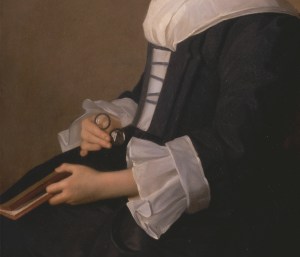
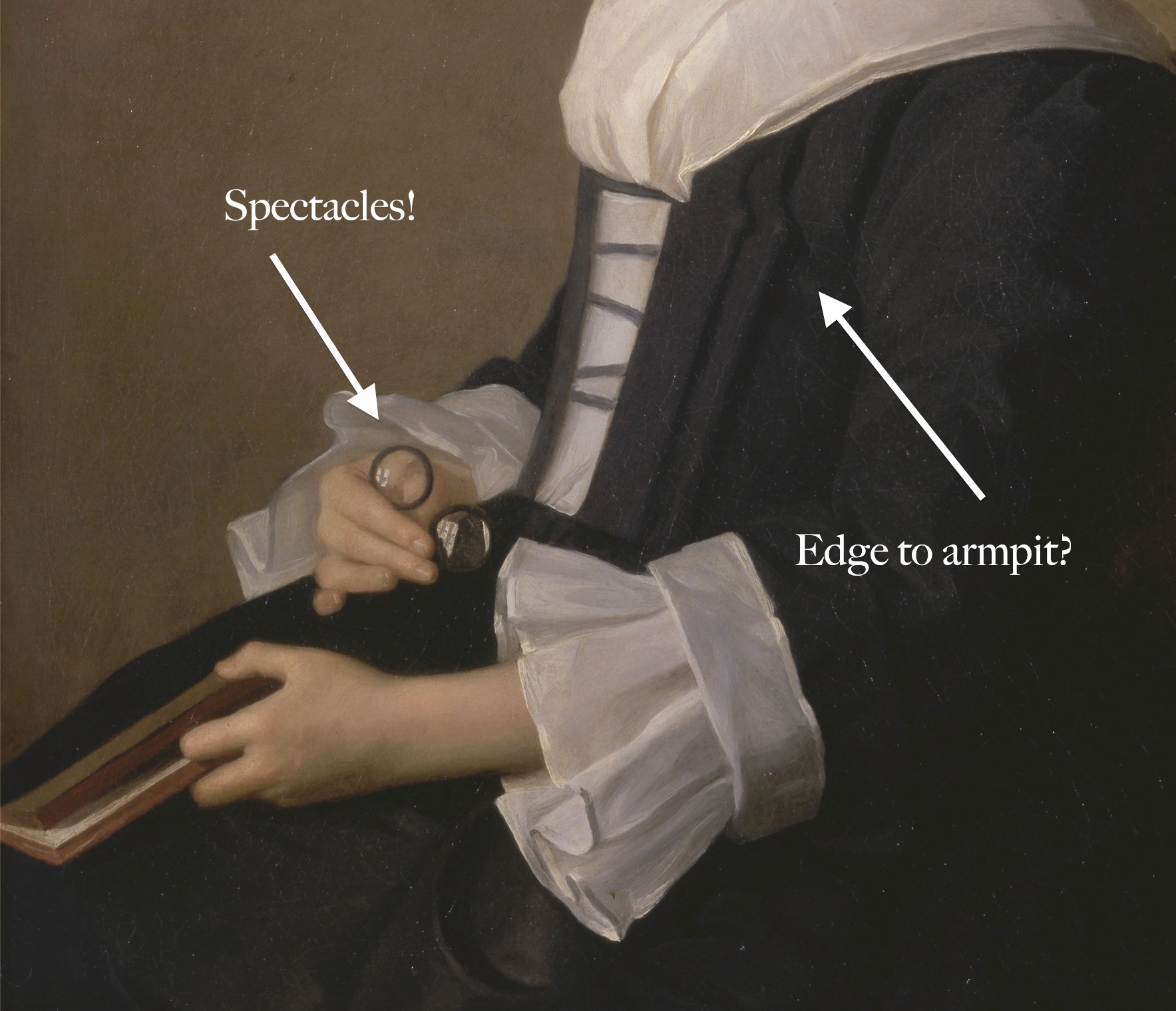
Detail, Mary Adams, 1754,B1981.25.513, YCBA

Did you catch that? It looks remarkably like Mary has laced her gown over her kerchief, and not over a stomacher. I’m doing a little dance, thankyouverymuch, because that is how I roll. Or lace, as the case may be. Look, too, at the top of the lacing: her gown is pulling. Yes. Imperfections, how I adore thee.

Snark aside, it’s a kind of relief. Looking at Copley and Feke and all their sleek silken women is like flipping through Vogue in the doctor’s office waiting room: after a while, I start to feel woefully inadequate in all ways. From the Richard III gown’s wiggly seams to my inability to pin my dresses straight, and heck, the generally asymmetrical rumpled-ness of my presentations… you can get to feeling very low, as Thompson and Thomson observe in Prisoners of the Sun.

Details!
Details!

So among the things  I note in the painting is the depth of the pull at the top of the gown.  Hmm. I feel better about how my flesh and gown relate in the armpit area now.

But if the pull line starts over beyond the robings, that helps a costumer figure out where to put the lace holes and how to arrange the gown. I also like the asymmetry of blue lace zig-zagging down the kerchief. When I work that out on Richard III, and alter my red calico gown, I’ll use Mary’s portrait as a reference.

Finally, and perhaps best, of all, Mary can read. And she need spectacles. That wonderful pair in her hand look like they are cousins of this pair. All in all, a happy find this morning.