Looking for a Ship

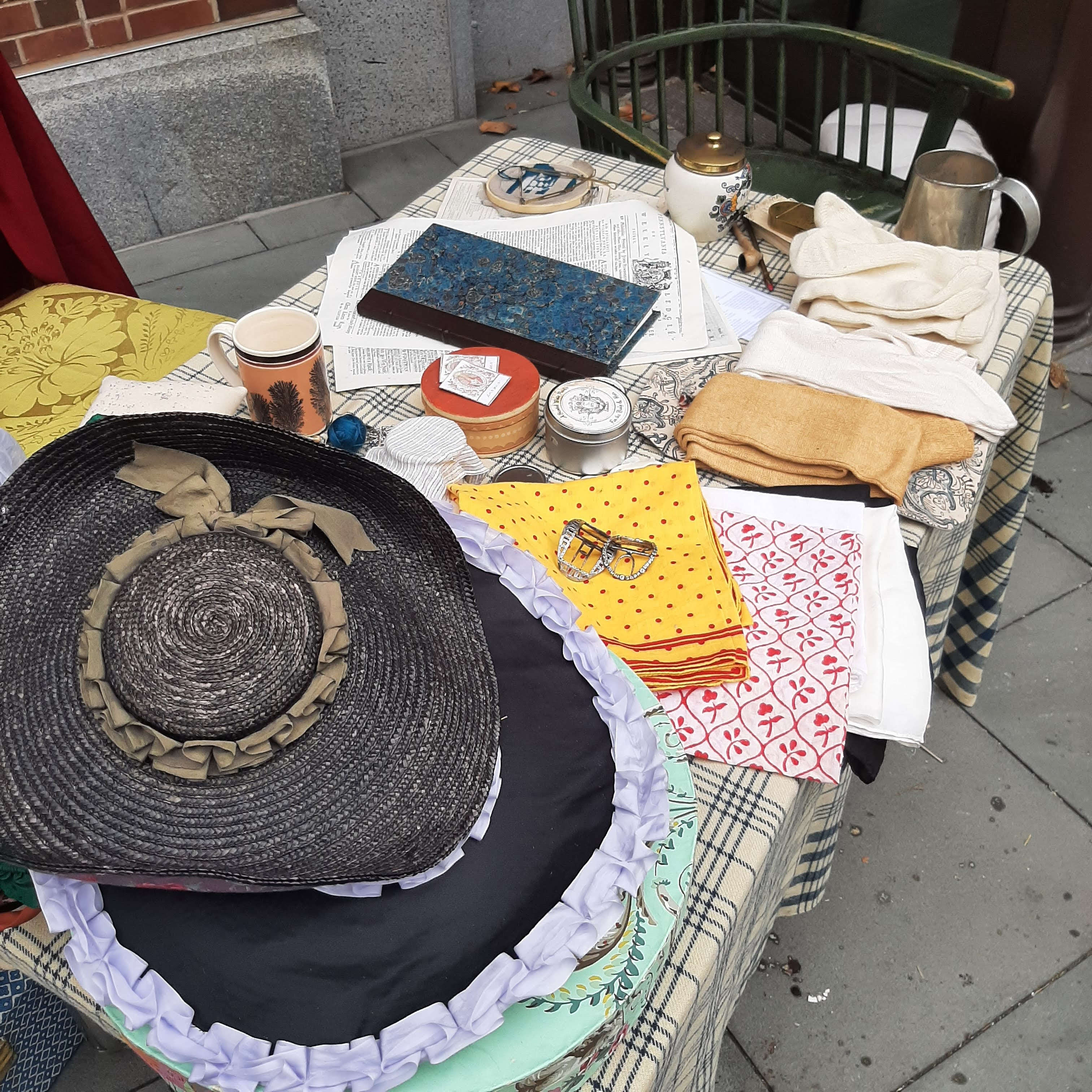
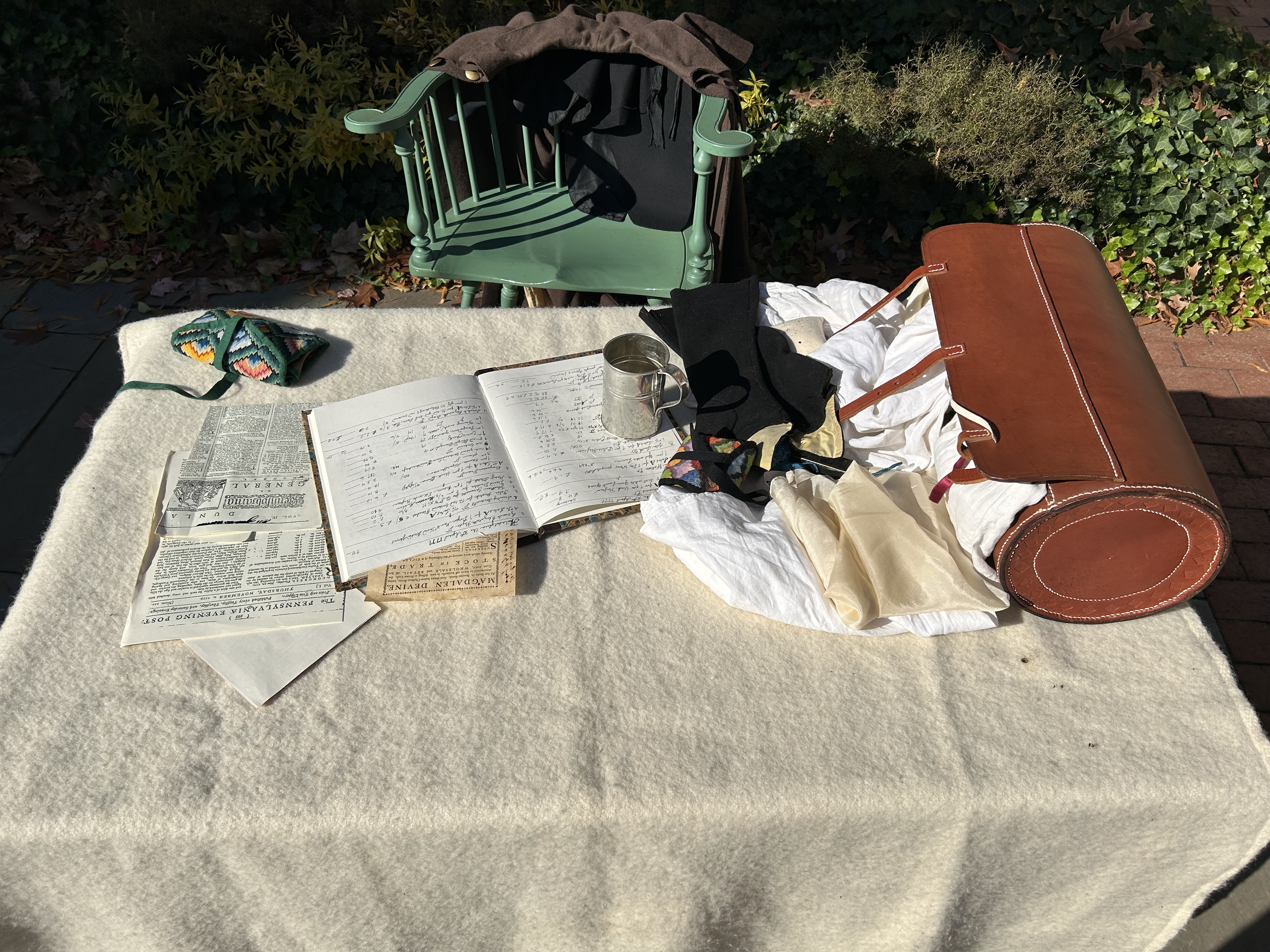
a table covered by a blanket with reproduction newspapers, a ledger book, and a leather bag
Collecting debts and packing up.

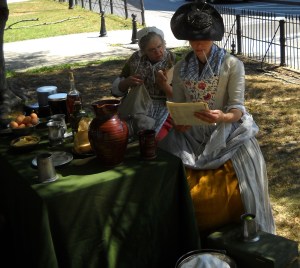
This past weekend (November 1-2) at the Museum of the American Revolution’s Revolutionary City (Pre-Occupied) event, I was pleased to represent Magdalen Devine, a feme sole trader in Philadelphia who ran a mercantile business between 1762 and 1775. Devine’s situation in 1775 reflects the tensions and uncertainties felt by many at the start of the American Revolution, and continues to resonate today.

a printed broadside advertising textiles for sale by Magdalen Devine in 1775
Broadside, Magdalen Devine, printed by John Dunlap, n.d. [1775] Historical Society of Pennsylvania, Ab[1780]-16

In 1775, Magdalen Devine, “being determined to leave off business,” advertised that she was selling “at Prime Cost, for CASH ONLY, WHOLESALE AND RETAIL, all her STOCK IN TRADE.” Devine first appeared in a Philadelphia newspaper ad in September 1762, selling imported goods with her brother, Frances Wade. By the following spring, the siblings had dissolved their partnership, and Magdalen had set up her own shop in Second Street between Market and Chestnut.

Devine’s ads reflected a keen sense of merchandising, including woodcuts illustrating printed and check fabrics and tightly wound fabric bolts. For more than a decade, Devine imported and sold goods on Second Street, eventually moving into a house she owned that was equipped with “two show windows with very large glass,” probably among the first instances of London-style shop windows in Philadelphia. 
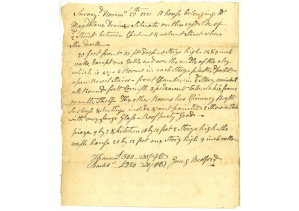
Fire Insurance Survey, “A house belonging to Magdelane Devine.” Insurance Survey S01561

For more than a dozen years, Devine traveled between Philadelphia and London, selecting, importing, and selling “a large and neat assortment of European and India goods.” The chintzes, linens, cottons, and woolens that Devine imported represented the wide range of textiles available, many with specific applications from jean cloth for clothing enslaved workers, tickings for mattresses, and hair cloths for sieves along with the chintzes, taffeties, and superfines that dressed the city’s elite. 

By April 17, 1775, she had “determined to decline business, as she intends for England shortly” and published ads in the Philadelphia newspapers calling in debts. Although she initially gave debtors two months (until mid-June), in August she was still in the city and advertising her intention to put debts “into a lawyer’s hands” if not paid within two weeks. An August 30th paper reprinted her ad of August 1, suggesting that the debt collection was not going as she’d planned in April, and the weeks and months kept stretching ahead. The ad placed on August 30th suggests she planned to leave not later than September 15th.

This slideshow requires JavaScript.

Unfortunately for Devine, mid-September saw a slowdown and stoppage of ships coming in and going out of Philadelphia. By September 18th, no ships were reported outward bound from the city. Magdalen Devine was stuck. 

A woman in a brown eighteenth-century dress with a straw hat and a white apron, standing in front of a painted door set into a brick wall.
“Magdalen Devine” dressed in brown silk with a new straw hat.

Did she get out on an early September ship bound for Cork or Dublin, and make her way from there to England? Perhaps, but it seems more likely that she miscalculated and was caught in the city as insurers, shippers, and sea captains struggled to make sense of the news from Boston, Providence, and London. Newspapers published English threats to burn all the port cities of the American colonies, and warships plying coastal waters from North Carolina to Maine surely made sailing seem unwise. 

Why did Magdalen Devine decide to close her business and leave Philadelphia for England? Just one year before, in 1774, she had acquired the shop with the “two show windows.” What made leaving a good idea? The threads are hard to find, let alone pull, but perhaps her childhood and young adulthood in Dublin suggested that the violence the British were willing to use against a rebellious colony. Famines and strikes in the 1740s prompted British reprisals against a country that served as a laboratory of colonialism.
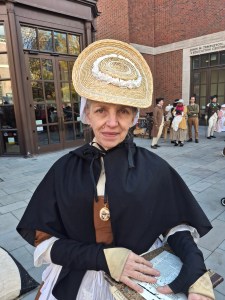
a woman in a straw hat and short black cloak
With my ledger in hand– and a fabulous new hat.

In the absence of passenger lists, it is hard to know whether Devine made it back to England in 1775, or whether she had to wait until 1783. We know she made it to London, because her death is recorded there in late 1783. 

Resources on the English in Ireland 

http://www.sneydobone.com/webtree/history-ir.htm

https://www.tcd.ie/news_events/articles/2023/how-ireland-served-as-a-laboratory-for-the-british-empire/

https://www.nam.ac.uk/explore/timeline-ireland-and-british-army

https://daily.jstor.org/britains-blueprint-for-colonialism-made-in-ireland/


What’s In a Wardrobe?

Ann Bamford & unreadable (below ground) Luke Exall Bamford?

Like Mary Cooley, Mrs. Ann Bamford provides a look into what a woman wore in the 18th century. Born in 1735, Mrs. Bamford’s estate inventory was created after her death at the age of 64 in May, 1799. (She is buried in the St. John the Baptist Churchyard, Borough of Harrow, Greater London. Her gravestone notes she was “An anxious wife and mother,” and records that she was married state to Luke Exall Bamford for 35 years and 17 days. That tells us that the Bamfords married in 1764, when she was 29. I love this detail of the late-20s marriage, actually reasonably typical for women of the period. When Anne Pearson and James Sparks married in 1772, they were roughly 43 and 50, respectively. Older, certainly than Mrs. Bamford when she married (James Sparks’ first marriage was in 1751, when he was 25; and early marriage, but he was by then already a Captain and ship’s master). 

Six years, at most, separate the Ann(e)s, Bamford and Sparks. In 1799, Anne Pearson Sparks is 70 or nearly so, married to a former Captain now gentleman and living in England, so the Bamford probate inventory provides a window into what the fashionable and well-to-lady of a certain age might have owned.

lwlacq000090The inventory, taken by a man,  and now in the collection of the Lewis Walpole Library, may suffer from a lack of feminine insight when it comes to descriptions, but it is comprehensive, listing at least 399 items. It begins: 

  • A Brocaded Sik Nightgown
  • A Gold Laced Jacket and Pettycoat silk grosgrain
  • A pair of pocket hoops
  • Two white petticoats worked at the bottom
  • A Black velvet bonnet
  • A Black Bombazine Negligee and Pettycoat
  • A piece of Printed Muslin for a Gown
  • One sprigged muslin nightgown
  • One Brocaded silk gown unmadeup

In the entire list, there are (among other things):

  • 3 jackets and petticoats, probably riding habits
  • 15 gowns and nightgowns
  • 5 negligees or sacque-back gowns
  • 20 petticoats
  • 14 shifts
  • 28 pairs of sleeve ruffles (various sizes, some worked, some laced)
  • 8 pairs of shoes
  • 3 waistcoats; 2 white, 1 fustian
  • 45 aprons, cloth, muslin, net, worked and embroidered
  • 33 caps, including wired caps and caps “with ribands”
  • 4 bonnets, including one in black velvet and one white
  • 11 hats
  • 26 pairs of stockings, including a pair in green silk
  • 3 stomachers
  • 12 cloaks
  • 58 handkerchiefs of various kinds, some “for wearing,” some worked (embroidered) in gold and silver
  • 5 entries described as“gown unmade up”

    a stack of 18th century hats and patterned handkerchiefs sit on a check blanket
    I love a stack of hats and handkerchiefs, too! Hats & hankies from Burnley & Trowbridge

There’s no reliable way to know when the gowns were made, or what exact style they are. We cannot know the state of all 45 aprons, the styles of all 33 caps, or 4 bonnets. There’s hope in the five gowns “unmade up.” There’s frivolity and impulse purchasing in 58 handkerchiefs. Fifty-eight! 26 pairs of stockings, one pair of green silk, and one pair of thread with clocks, but the majority seem to be worsted. 

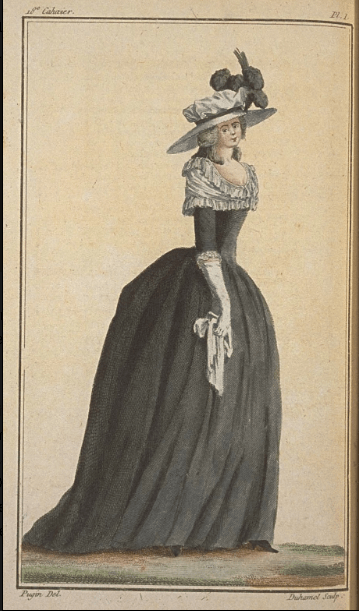
What does Ann Bamford not have? There are no quilted or matelasse petticoats; this may be a function of the list being made in 1799 when the fashionable shape shifted away from the round bell provided by quilted petticoats, but Ann retains a pair of pocket hoops and has no rumps or pads. The infrastructure of a fashionable shape for the 1780s and 1790s seems missing. 

Screen Shot 2024-01-23 at 6.11.36 PM
Cabinet des Modes, August 1, 1786.

It’s likely that the inventory contains clothing from a range of years, possibly dating back to Ann’s marriage. The brocade gowns may well have been reworked from earlier styles, and the jacket-and-petticoat combination in silk grosgrain with lace sounds like the laced and decorated riding habits of the 1760s when Ann was married. As styles changed in the 1770s and 1780s, she might have had additional riding habits made, since they were worn as traveling and visiting costumes and even at home. There are other clues: the black bombazine nightgown and petticoat and the black silk negligee and petticoat suggest mourning, as do the silver silk negligee and petticoat (there is a second silver silk petticoat as well). These would provide stages of mourning, deepest in black and half in silver. English, Ann’s mourning garb might have been worn for deaths in the royal family (like Barbara Johnson) as well as for her own family. (In this context, negligee describes an informal gown, that is, one worn at home, during the day. Nightgowns, or English gowns, were slightly more formal, for day or evening wear. There are subtle distinctions lost to us, but not entirely dissimilar from our “work to evening” outfits where accessories can change an outfit’s meaning.

An Introduction, or Re-Introduction, of Sorts

No, I won’t say how many cups I’ve had.

What is this thing, and who am I?

It’s Costume Blog Writing Month (inspired by NaNoWriMo), and I’m Kitty Calash. I used to post much more frequently, but life caught up: I moved, which meant I didn’t sew at all for over a month* and thus didn’t have much to write about, since this isn’t a packing and moving blog.

But even before that, posting had slowed as I began to wonder why I wrote, and why I sewed. Costume Blog Writing Month, with its 31 flavors of posts, is a chance to reacquire the writing habit, and to think again about what I do, and why– and thus proved irresistible.

I’m a curator in search of a collection, a fugitive from architecture school, a compulsive editor, and a cat wrangler. I started sewing as a child with help from my mother and grandmother** who made clothes for me and my favorite doll, Moira. Although I graduated from two art schools, my interest in history is deep: I craved china dolls, collected antique quilts and tools, and insisted my bicentennial Samuel Adams costume have functioning knee bands– and yet, it’s taken me years to admit I’m “detail oriented.”


Some days Drunk Tailor asks me if I really enjoy sewing– my face betrays my frustration, and I do not play poker–but I get both distraction and satisfaction from it. Most of what I make I wear at living history events, so I hand-sew everything I can. I fall into the “progressive” reenactor/enactor/costumed interpreter camp, and strive for authenticity and accuracy in what I make, how I wear it, and what I do.

I’ve come to realize that I’m chasing art: my thesis work looked at what it means to be an American. What does “America” look like, what does the myth of America and our founding story mean? How do we portray it? Yes: I costume and organize events in pursuit of an experience for myself and participants that helps explain this nation, and how it came to be the way it is.

Not every post gets into this kind of theorizing— really, most don’t– but at core, my costume pursuits do chase the myth of an American Dream as I try to understand the people of the past, how they thought, what they made and wore, and how the past continues to inform the present.***

*During this time, I lost the distinctive callouses that will help a detective identify me as a seamstress when my murdered corpse is found in a Paris hotel doorway in the Georges Simenon novel I write in my head. I watch a lot of murder mysteries while I sew.

**Elsa turns up here from time to time; she was a style maven, the doyenne of design in a small Southern Tier town, who, for 50 years, ran the shop that dressed the maidens and matrons of the nearly best classes in a community of striving Swedes aching to assimilate.

*** And that, friends, is what working in history museums for two and half decades will get you: your own personal mission and an empty bank account.