2020 Vision

Rebecca Young at the Museum of the American Revolution. Always a good experience.

We made it: another turn around the sun, another year, a time of resolutions and reflection. 2019 was the year I had three jobs, invented a job, and qualified for Medicaid. It was a year I spent wondering who I was, and what my experience meant, if anything. I developed a new chronic condition (can you have too many?) and continued struggling to manage the old ones. I applied to, was waitlisted by, and ultimately rejected by a prestigious graduate program. I applied and interviewed for five jobs and got two. The one I have now, though a short-term contract, uses all the skills I honed over three decades working in museums. I expanded the repertoire of 18th-century women I represent, learned about flag making, and increased the number and accuracy of remedies in my medical box. I even journeyed further back in time to represent a Lost Colonist of Roanoke.
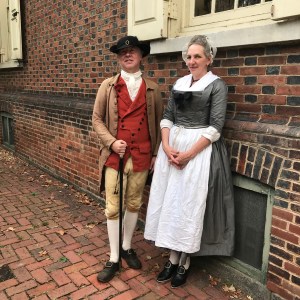
Together in multiple centuries, despite the bumps. Photo by Aaron Walker

Still, six months of working all weekend every weekend at job number two put me so far from my friends and habits that despite the pleasure of representing Rebecca Young and Elizabeth Weed, I still feel uncomfortable with living history and costuming. Those months certainly strained my relationship with Drunk Tailor, and with my own identity. Twenty nineteen is year I would revisit only in select details.

Mrs. Wainwright, Miss White and Miss Baker going into the Supreme Court to hear the decision on the Ohio ratification of the suffrage amendment, 1920.

For this coming year, I know only a few things. My contract expires at the end of March. I still love things and order, but I don’t know if I want to work full-time in a museum again. In a bit of perfection, I’m working as the de facto collections and project manager to transfer the library, archival, and object collections of the National Woman’s Party (NWP)  to the Library of Congress and the National Park Service, effectively closing the NWP as a cultural organization (the house is now preserved as a national monument).

I took this contract before my Kickstarter succeeded and admit I am ambivalent about it. Kitty Calash as a business is a little too small to sustain me with a kid in college, but museum work, aside from the work of establishing ownership and provenance, remains difficult for me. I wonder about the accumulations of objects, their meaning, and relevance for the future. I was a curator for a long time, but now I wonder what my role will be, in the evidence locker of history.

Like “curator,” “reenactor” no longer feels like it fits, even though I love history and clothes and dressing up. Perhaps this is too many weeks where dressing up was not an option, too many events missed, the habit lost. Perhaps it’s fear of succeeding, of striking out on my own and doing well, and instead of jumping, hesitating at precisely the wrong moment. Suddenly, it all seems so silly in the face of elections, climate change, and the instability of the gig economy.

Purveying ideas and goods as a milliner is a lot like being a curator.

I wrestled with this in 2017 and 2013,  winters when things seemed hopeless for reasons large and small. Three years ago, I found my refuge in art. Even a year ago, art and aesthetics felt like solace. This year, the New York Times’ Culture Therapist addressed a reader’s question, or problem, that echoed with my own sense of perturbation.

The core of the issue was this: “What happens when we no longer fit our own context?” The answers were varied, and to me, seemed like long shots (too many uncontrollable factors) but this struck me: It will require risking compassion to create an expanded and possibly destabilizing relationship to visual culture.

In 2019, I learned the key to most successful endeavors is vulnerability. I spent a lifetime building walls to protect myself that now box me in. Razing those walls is what I think of when I read “risking compassion,” though it’s hard to say exactly what a destabilizing relationship to visual culture (or history, or costume, or fashion) might be. It may be understanding how little one knows about the past, accepting new aesthetics, or trying something completely new. Even as I contemplate a possible grant-funded costumed interpretation program, clothes from 1919 don’t feel “new” enough to me; they are not different enough. I don’t know what will be, but I do know that unless I’m emotionally uncomfortable, I’m not learning.

For all the angst and tears and anger of 2019, all the feelings I do not want to feel again, this year taught me to trust myself, to try, to fail, and to succeed. We learn as much from our failures as our successes, and while some of us more easily recall painful memories, it is worth remembering they can lead to our happiest moments. For this coming year, I will try to hold onto hope, that thing with feathers, and plan to learn new skills, improve the ones I have, and continue to find joy in the everyday.

The City in Winter

December: when the year ends and begins again, a time when historically, for many Scandinavians at least, there was no spinning or winding, lest the world stop turning. No one wants to be stuck in mid-winter forever. This is the time when most of us look back, wondering what we accomplished this year, what it means, and begin to think about what we want for next year.

For me, this year has brought changes: three jobs, and my own business. I’m fortunate that I never stopped working. But I also never stopped working, and that keeps catching up with me. The days are grey and wet, and now that I work (part-time, for a few months more) in the district, I see winter creeping into the city as well as the suburbs, with all the signs of the changing seasons.

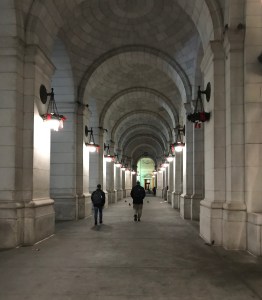
It’s not just sunsets, increasingly bare tree limbs, wool coats, or holiday lights as I walk to the train station, it’s what I smell. Some nights on Capitol Hill, it’s steak. Some nights at Huntington, it’s pizza. But even on the mornings when I collect the office mail from the post office, the terrazzo floored lobby with its glazed bronze doors smells like the office building lobbies of downtown Chicago in the 1970s and ‘80s. What was that smell: floor cleaner and metal polish, paper, and the seeping damp of melting frost? As difficult to describe as it is easy to remember, where I work now smells like where I grew up.

5200-5244 S. Greenwood Ave., Chicago

The landscape is similar, too, rowhouses on one walk to work, and office buildings on another, and, as I walk past the station proper, pigeons and homeless people. That, in particular, reminds me of Chicago, and a boy I knew from Eastern Europe.

He drove a cab with his father, but with me, he walked the scabby downtown streets eating croissants bitter with chocolate that turned sweet in our mouths as we kissed down the stairs from the cheapest seats at the Auditorium, sweets we carried in our pockets to share at intermission when we crept down to better seats not sold for that matinee performance.

I met him at a punk club, but he alone of all my friends loved ballet with me, he alone knew the ballerinas, the ballets, the composers.

He was tall and unforgiving.

“Your parks!” he said, “Dead pigeons and dog shot! People sleep in that!” and I had no answer, for he was right. He could say nearly the same about my walk to work today.

I think about this as the decorations go up, rituals are re-enacted, and we look forward and back at once. We’re our own private historical societies, editing our collections, interpreting our lives in ornaments, family photos, dinner menus, and table settings. Everything is different for me this year, even when I set the table with the same plates I’ve used for 25 years. And I have no idea what it will mean.

Next time, a look back at this year with an eye to next year’s aspirations.

Failure is Always an Option

Or, if not failure, at least screwing up.

The big cold box….

In my more exhausted moments, I make interesting mistakes and choices. Once, I engaged in an argument at work in which I repeatedly used “orange” when I meant “blue.” Another time, I lost the word “refrigerator” and had to coin the phrase “big cold box where we keep the food.” My brain is an interesting place.

When I sat down to start on a commission for some officers’ white linen sheets to be 60” x 85” I was tired. I chose not to do the math on paper as I measured, but in my head. And using a 60” tape measure, I measured and marked 60” and then added 16” to make up 85” plus seam allowance. Yes, I measured 60 + 16 = 85 finished inches.

Obviously not.

Round two of thread pulling to cut the second sheet correctly.

But it was not obvious to me until I held the fabric up, ready to iron, and realized it was just a little bit longer than I am tall. Since I am not 7’ tall, something was clearly wrong. I dropped the fabric to the ironing board, messaged Drunk Tailor, and took to bed in mortification and hope of a nap.

I tell you this story not just to make you laugh, bring you a modicum of schadenfreude, or to make plain that we all screw up sometimes, but to remind you that mockups are good, and so is math on paper.

Really, I’m not sure how this happened. But there it is: upside down.

Starting a project without laying down some ideas on paper or making a muslin is a quick trip to madness, or at least dismay. Creative problem solving will undoubtedly result, but that’s energy you could put into planning your next project instead of salvaging your current one (as I have salvaged my sheet).

Here are some measures I’ve learned to take to prevent repeating hilarious mistakes:

  • After hemming skirt fronts that put pocket slits upside down, I now pin notes to the panels so I know which make up the left, and which the right sides of the gown skirts.
  • I have been known to mark linings extensively in pencil or chalk; I sometimes pin notes to sleeves to denote left and right, front and back, especially if I cut pieces long before I will get around to sewing them.
  • I make lists of which pattern pieces I need and must cut, and then tick them off as I go, to make sure I have all the pieces I need.
  • To make sure I’ll have enough fabric and can minimize piecing, I will do a rough layout of all the pieces before I do actually cut anything.

It is by no means an extensive list, but once you know the types of mistakes you are most likely to make, you can take measures to prevent them. You know, like measuring twice and cutting once, or doing math on paper to double check your work.

Safe as Houses

Collections staff climb wobbly ladders all too often

Someone brought up the Plimoth Plantation workers concerns for safety, and how those outweighed the low wages in their drive to unionize. Uneven streets, low staffing levels and safety requirements placed on them– watching open fires– meant that they were unable to leave the houses even for “nature breaks.” These are all legitimate concerns and the expectation that workers will tolerate unforgiving, dangerous, or humiliating conditions because “it’s all for a good cause” is ridiculous (and, apparently, a darned good way to inspire a union).

The union effort I was part of was not driven solely by low wages. There were other factors, including an executive director with a large but fragile ego, who was inclined to operate rather whimsically. When the drive failed, the need for union was by no means diminished, especially given the retaliations that followed, including the case of a woman who went on maternity leave, only to find on her return that her job had not been saved for her, despite the museum’s need to comply with the FMLA and assurances made before she went on maternity leave.

Bad management makes it hard to get out of bed.

Do not think that cannot happen today, because changes to the terms of employment happen all the time in museums, even when the leave alternate work schedules have been negotiated and put in writing. Museums and their directors are, in general, no more benevolent than any other employer.

But safety seems basic, right? Well….would you like to be the sole person working in a 16,000SF historic house? Granted, no open fires, but you are still expected to answer the door and you will find that people will force their way into the house, even when you tell them the museum is closed. Lucky for you, none of them were threatening.

Some are more equal than others

Except of course the one who was. When the concerns were brought to the executive director, there was a surprising lack of support– It’s one incident. He’s crazy, so what? You’re overreacting. That’s the best neighborhood in [small town redacted]. House staff asked for mirrors at the door and minimum staffing levels of two. Someone suggested maybe Boy Scouts would be good to have come in on the weekend afternoons when the staff person is alone– Boy Scouts need service hours for college applications, after all. In less than a year, the house manager resigned. The exterior lights around the house were not fixed or replaced, and it was pitch dark and empty on the walk to the parking lot. Only when the executive director’s husband said, “Gosh, the parking lot seems kinda rapey when so it’s so dark” did the parking lot lights get replaced– but only the lot, because she used it to park in when she went out to dinner with board members.

The same employer expected staff to come to work even when the water had been shut off at the site all day for repair work; fortunately, they could be convinced to close sites to the public on those occasions. I have worked in modern museum and research facilities without heat, light, or water because no quarter was given, and no exceptions were made for you to work at a different, functioning site.

Toodles might as well have been on security

For years, I was the on-call person for all alarms at the collections facilities. This meant that in the middle of the night, I had to go to the sites if the alarms were tripped. I had to go in alone, and was expected to sweep the facility and site for intruders. Eventually, I talked the police into a policy of staying with me until the sweep was complete, but I can assure you that a 16,000SF facility is creepy AF at 3:00 in the morning when the security alarm has gone off and you don’t know if someone has broken in or not.

Employers send very clear signals about how much they value employees and they punish employees in ways both small and large. Punishing an entire division, and putting the director put on six months probation because the director and division staff tried to follow the employee handbook and procedures to deal with a new hire who turned out to be incompetent and unwilling to work? Not great. The new hire was transferred to another division where the same behaviour played out, and caused great frustration to her new supervisor and colleagues. Eventually, she quit when it became clear that she was going to be let go and could no longer manipulate the system. For a division director to be told, in a meeting with the executive director, that “This isn’t your fault, and this isn’t about you– you’re here because of what other people did,” is not reassuring in the least. Punishing people for trying to follow the rules when the HR staff won’t will not generate good morale, or retention.

Because I said so, that’s why

Employee leaves are another serious pressure point in museums. Often no one extra is hired and no tasks are reduced, but are instead spread across a variety of people. Sadly, when someone like a registrar takes an extended leave, and the museum refuses to reduce collecting or loans, someone has to process all the paperwork. Asking people who are already doing two jobs to take on a third is not uncommon. Directors reveal a great deal about themselves in the response they have when they’re approached with a request to reduce some of the workload because the person covering is burning out. Dismissing the request with “It’s just a few more weeks,” 10 weeks into a 16 week leave with major program planning starting on top of all the other tasks is not helpful, supportive, or collaborative.

Directors who say, “I’m the director, I always win,” when direct reports disagree with them, may find their direct reports seeking work elsewhere. I’ve heard directors complain about having to “seek consensus,” and chafe at having to convince boards to support changes to staff structure. Directors who chastise front line staff in front of the public and shake their fingers in the staff member’s face– and then turn out to be wrong about what they’re upset about, but refuse to apologize– are not as uncommon as you might hope.

Safety. Consistency. Respect. That’s all employees want, no matter where they work. They want policies that are applied equitably, and workplaces that do not place them in danger either by condition of the site or the attitude of the management. When any employer fails to provide those conditions, the result will be low morale and high turnover. The cost of those is significant, both in declining visitor experience and increased training.