Now Left

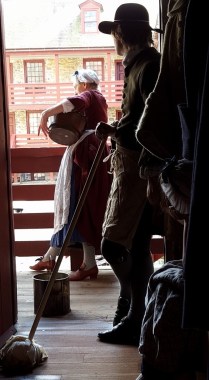
Through the barracks window on Friday night. Photo by Eliza West.

While for some events there are no second chances, Fitzgerald himself knew it wasn’t true that there are no acts in American lives.  And so it is with Fort Ticonderoga, changing hands several times throughout its existence, until British troops, retreating in 1777, did their best to raze the structure.

A day after participating in the “Now Left to their Own Defense” event at the Fort, I feel a bit destroyed myself, in the best possible way. (It isn’t history till it hurts, but sometimes cold nights on straw-filled ticks get into what’s left of my hip bones.)

Women at work.
Women at work. Photo by M.S.

Every trip to Ti teaches me something new. This time, against all odds, it was cooking. Against all odds because I usually object to reinforcing gender norms at living history events, particularly in a military setting, when women did not typically cook for mens’ messes. Fort Ti is different: both times I have cooked there, it has been as part of the women’s mess.

img_8435
Done! And no, it didn’t taste burnt. Photo by M.S.

This past Saturday, we may have gone a bit overboard, but we justified our efforts with the thought that Loyalist women would not only have used up all the supplies they could (waste not, want not) before retreating, but that they might also have striven for normal activity and to prove their worth to men whose protection they needed.

To that end, we made bread pudding. I’m a fan of Indian pudding and rice pudding, but I’ve never made a bread pudding, despite the similarity of these starch-and-custard concoctions. I like to think that rather than having reached a “throw reason and caution to the winds” point, I have, like any good 18th century cook, become comfortable enough not to rely on measuring cups but rather trust my eye and experience. Enablers help, of course, and I had the pleasure of spending my day with some of my favorites and meeting new ones, too.

Shine On

dscn4553

It has been quite busy chez Calash, with What Cheer Day a little over a week away, the Warren Commission happening tomorrow, and various and sundry other things to do, like get a Young Giant into college. But results were promised and results you shall have.

Despite my lack of chemistry knowledge, I made and used the pewter-cleaning liquor with some success.

The pewter plate spent some time sitting on its edge in a basin of the liquor, and the line is pretty clearly visible in the first image. The second shows the plate after being cleaned with the liquor and a wool rag. It’s better than it was, but there are still more experiments to do. I’d apply rottenstone, but the container hasn’t made it back to New England yet, the posts being poor and the roads infernal.

As the silver bowl demonstrates, rottenstone on its own is remarkably effective at removing polish. It is certainly a fairly readily-available, non-toxic, period method of cleaning metals (andirons and fenders to plates and punch bowls) that can be easil;y employed.

Would I Lye to You?

Now, really, would I lye to you?

img_7993Some people will tell you I overextend myself, and while those people may be correct, my enthusiasms compel me to do more, try more, travel more, and to that end I found myself preparing for an event by turning my 1962 Ossining kitchen into an experimental laboratory.

I was taken by Hannah Glasse’s receipt for cleaning pewter, copper, and tin in her section for The Scullion, so of course I had to try it. It’s simple enough: boil wood ash with unslaked lime for half an hour, let cool, and pour off the clear liquid. Easy-peasy, until you realize you have forgotten your high school chemistry, the Young Giant is not at home, and google searches for lime turn up too wholesome uses and unsavory quantities.

Happily, a more scientific brain than my own pointed out potash/pearl ash/potassium carbonate, which Amazon can provide in small quantities. Wood ash proved a little more challenging. Happily for me, I am one of those East Coast foodie fools with a backyard grill and a fondness for hardwood charcoal, so an overdue chore later, I had an enamel kettle of ash.

The receipt calls for “a pail” of wood ash to a “half- pail” unslak’d lime, boiled in four pails of soft water. Since “pails” is a general sort of term, I decided to use the quantity of wood ash I scavenged as the approximate measure of a pail, figuring that proportions mattered more than actual grams or liters. I have resigned myself to the fact that this is more art than science. Four pails of soft water included the remains of a few gallons of water stockpiled for hurricane preparedness years ago, bolstered with water from the tap.

Pail, schmail.
Pail, schmail.

Fortunately, art did not turn into science gone wrong. The boiling was rather placid, considering, and dissolved the fine ash and the potash. I filtered the liquid mixture through a screen (ok, the spatter screen for my frying pan) to ensure that when I poured off the clear, it would be as clear as possible.

By the time it had cooled, I had fished out appropriate containers into which I could “pour off the clear.” This recipe, seat-of-the-pants as it is, makes a fair quantity, a mason jar of which I have left with the Drunk Tailor so that he might better clean his officer’s pewter and copper, because, yes! This does work to brighten silver and copper. Tune in next time for details on getting shiny.

Front and a center: A liquor for cleaning pewter, etc.

Maintain an Even Strain

IMG_6471

Dude: I am conflicted. There are folks out there doing excellent work, but after reading some recent posts around the interwebs, I kept thinking, “Stockholm Syndrome much?”

I’m as much of a narcissist as the next person, and I think I recognize some of the folks being called out in various places for being critical of women’s roles in living history events. So, organize my own events? Come up with my own things to do?

Cool: challenge accepted.

I am, in fact, throwing down for the pleasure and pain of running a farm in late June. No, I didn’t organize it, but I was asked to take on a challenge and I have accepted, roping my favorite tailor into the effort as well. It’ll mean a bunch of studying, but in a pinch, I can always clean the house. We can rake, make refugees stay in the yard, and try as hard as we can to keep Quakers from putting radical ideas in the slaves’ heads. I think it will be hard, unpleasant, and uncomfortable—and that’s what I don’t like about the suggestions in the otherwise honestly well-intended and meant-to-inspire posts.

Playing at Quadrille. Oil on canvas by Francis Hayman. Birmingham Museums and Art Gallery

They’re so nice. They reinforce women’s subordinate roles in the past and present. Children’s activities? I might die, really, I might. If that’s your bag, go for it, please! We need it. It’s simply not something I can do.

No more can I talk about What People Wore. It’s not that I don’t care (y’all know I do) but that I want to move past the surface.

It’s not enough just to look great.

The Heir: Tom Finds New Wealth. William Hogarth.

Dive deep: find the dirt. Find the hard stuff. You don’t have to be nice. That’s my personal problem with what I’ve been reading: between the lines I keep hearing a voice suggesting that we be nice girls, that we simmer down. No, I’m sorry. I can’t. Reader, if you can, go for it.

But if you can’t, I want to tell you: Keep pushing. Keep asking. Keep speaking up. Challenge the status quo. Our Girl History did a great post on Well Behaved Women, and I fully support the work people are doing to represent the Well Behaved and the marginalized (shout out to the veteran with the knife-grinding cart: well imagined, sir!).

Russell, John; The Blind Beggar and His Granddaughter; The Bowes Museum;
John Russell. The Blind Beggar and His Granddaughter, oil on canvas, 18th century. The Bowes Museum UK.

Bring it. Bring the ordinary.

But if you can’t be ordinary or run the children’s games or be subservient or show how women dressed, that’s okay. For the love of god, someone, be desperate.

Be hungry, be angry, be resentful, be religious.

Whatever you do, don’t be afraid to speak your mind.