Making an Impression

Trade card for Dorothy Mercier, Printseller and Stationer; Etching with engraved lettering below. Print by Jean Baptiste Chatelain after Gravelot. 1745-1770. British Museum, D,2.3396

Dorothy Mercier: widow of an artist (and a painter herself), Mercier went into business after the death of her husband, Philip, first as a printseller and stationer, and later as a purveyor of artists’ supplies. Some of what she sold is listed below the vignette of a shop, and includes ‘all Sorts of Papers for Drawing, &c./ The best Black Lead Pencils, Black, Red & White Chalk./ Variety of Water-Colours, and Camels Hair Pencils./…English, Dutch, & French Drawing Paper, Abortive Vellum for Drawing,/ Writing Vellum, the Silk Paper for Drawing.’ She also sold “Continental prints” and “paintings of flowers in her own hand,” a pursuit considered suitable for ladies in the mid-18th century.

Evidence of widows taking over a husband’s print shop in the American colonies in the 18th century is harder to come by–there seems to be less specialization of retail sales in the colonies, certainly compared to London, which is one factor–though printers’ widows did assume their trade in Newport and Williamsburg, among other places. If we imagine a print shop in the colonies, what would we find for sale?

Nicholas Brooks’ ad from the Pennsylvania Packet of June 21, 1773 provides an answer:

Mrs. Yates in the character of Electra; Venus blinding Cupid by Strange (that’s a print by Robert Strange after Titian, no matter what glorious oddity you may imagine), and portraits of George Whitefield, John Wesley, and other religious luminaries. Whitefield and Wesley were popular Methodist ministers: Whitefield, the peripatetic evangelist, was the primary force behind the Great Awakening, and Wesley, despite his loyalty to King and Church, was an inspiration to the Revolutionary movement in America.
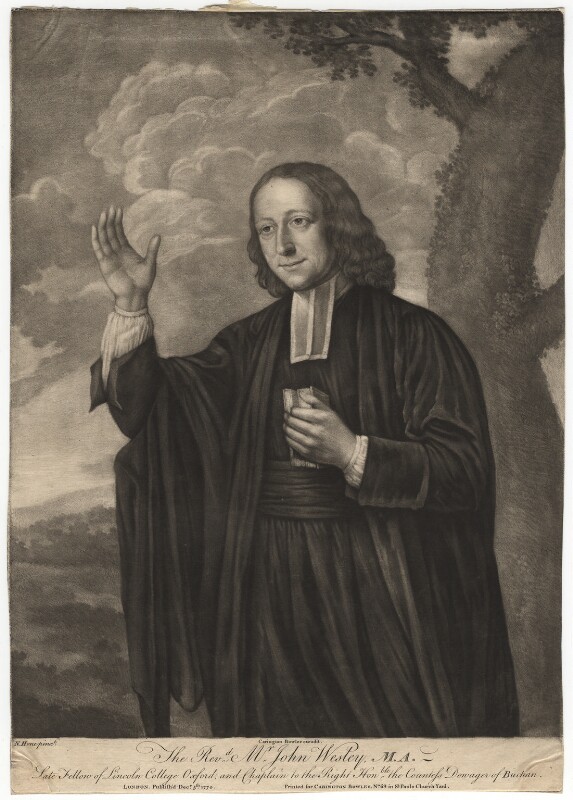
John Wesley after Nathaniel Hone
mezzotint, published 1770
© National Portrait Gallery, London NPG D4740

This print of Wesley is one I have seen in person, in a period frame, with a period backboard inscribed “Capt. Wm Noyes 1st Conts” and to be fair, it is one I have spent some time researching, so the titles in that Nicholas Brooks ad– which I was reading for another purpose altogether– were exciting to find. When I think about visual or print culture in the Revolutionary era, I try to imagine the ways in which people encountered imagery, and how they understood it. Wesley– and print shops– are one way I begin to fill in a picture of the past.

The Work of Women

International Women’s Day: I may have missed it online but I have spent this day– this entire week, in fact– working with a woman I greatly admire and like. I’ve written about her before, my 96-year-old friend who was in the OSS and married a man who had fought for Chiang Kai-shek in World War II and against the Communists after the war.

It has been a week of learning about my friend, her mother, her aunts and great aunts and grandmothers; of learning about her daughters (and son), and her friends and the work she did.

Tuesday night, we had dinner with one of her friends who lives in a little red house not far from where I lived before I left Rhode Island. The Little Red House, as we always call it, was cozy and warm, built in 1793 when the East Side of Providene was rural, and the north end of it occupied by the Dexters, Morrises, Sessions and Coles on their farms.

The parlor was small, and the five of us filled it (along with a silver standard poodle who shook hands with us all). We ate in what had been the kitchen of the house, with a fire in the fireplace that had been used for cooking (and was still set up for cooking, though that was not where our meal was cooked). We ate from antique transferware, drank wine poured from antique decanters, and sat on antique chairs at an antique table in a room lit by candles. I would be lying if I tried to deny the warm magic of the setting, the scene, and the storytelling.

But the point is not that I had a wonderful time: the point is that I learned that night, and this week, about the ways that women look out for each other (when they’re not competing with each other), and the ways that women shepherd the history of families and places as they maintain collections of furniture, textiles, paintings, and prints.

As I held my friend’s hand and lit her way with my phone flashlight down a stone path to a waiting Subaru, I might as well have been holding a lantern and guiding her down a path to a waiting carriage, where wooden and tin footwarmers would replace a heater and blower motor. Some things are timeless and placeless: friendship, love, and caring. The need (the aspiration) to always care for the people around you, to be gentle and giving when you can, and to take and ask for help when you must: Those “feminine” values are what makes the world go ‘round, and keeps it steady.

Compare and Contrast

Boston Massacre planning is underway for everyone involved at every level, including me.

I’ve made changes to what I plan to wear, in part because I have a newer gown that fits better and keeps me warmer, and because I have learned more, and looked at more, in the intervening time. Since 2016, I’ve made/upgraded a quilted petticoat (in a bronze silk, a color documented to Rhode Island quilted ‘coats), settled in to wearing my cap tied under my chin, and made both a new apron and a new bonnet.

Cap and bonnet shape and shoes help make time period distinctions between 1777 and 1770; if I could find the wool I made the gown from, I would add the cuffs it desperately needs. The heeled shoes skew earlier than 1770, but they are the only heeled shoes I have….if the weather is wretched, I will wear the flats for safety and comfort.

The bonnet, which I affectionately call “Lampshade,” is meant to have the shape of pre-1770 bonnets as seen in Sandby’s illustrations, and which I have been working on for a while.

Martha Collins, Thomas Sandby’s Cook. watercolor on paper by Paul Sandby, 1770-1780. RCIN 914339

I know from reading the standards that the understanding of mitt material has evolved, and my time this morning looking for an elusive apron shape raises questions for me as well. Here’s Martha Collins, painted by Paul Sandby. What’s that black thing on her arm? A mitt? An arm warmer? Is it knit, or woven? There’s always more to figure out, and more to make.

Cuffs on my gown don’t seem like a big enough deal to warrant buying wool for a whole new gown (with only six weeks to go), so my choices are live with no cuffs, alter the red gown of 2016’s event to fit properly, or initiate an extensive search for the scraps left over from the green gown…which may or may not be buried in storage. Tick tock.

History Hurts

We have been here before: terrible stays, stays in need of minor mods, and “it isn’t history till it hurts.” New this past weekend was the Busk Bust Blister (Bursting) which didn’t make History hurt, but sure did bring a sting to the wind-down afterwards.


These new stays are, so far, the best I’ve ever had and well worth the blood, sweat and swears it took to make them. Gowns do seem to fit better over these stays; they held up well at muggy Monmouth and in polar Princeton, but the last two rounds at Ti left me feeling like I’d taken a hoof to the ribs.

What gives, kidneys? At least this time I made it past Fort Ann and all the way into a private room in Glens Falls before I had to free the sisters and release the lower back.

IMG_7298

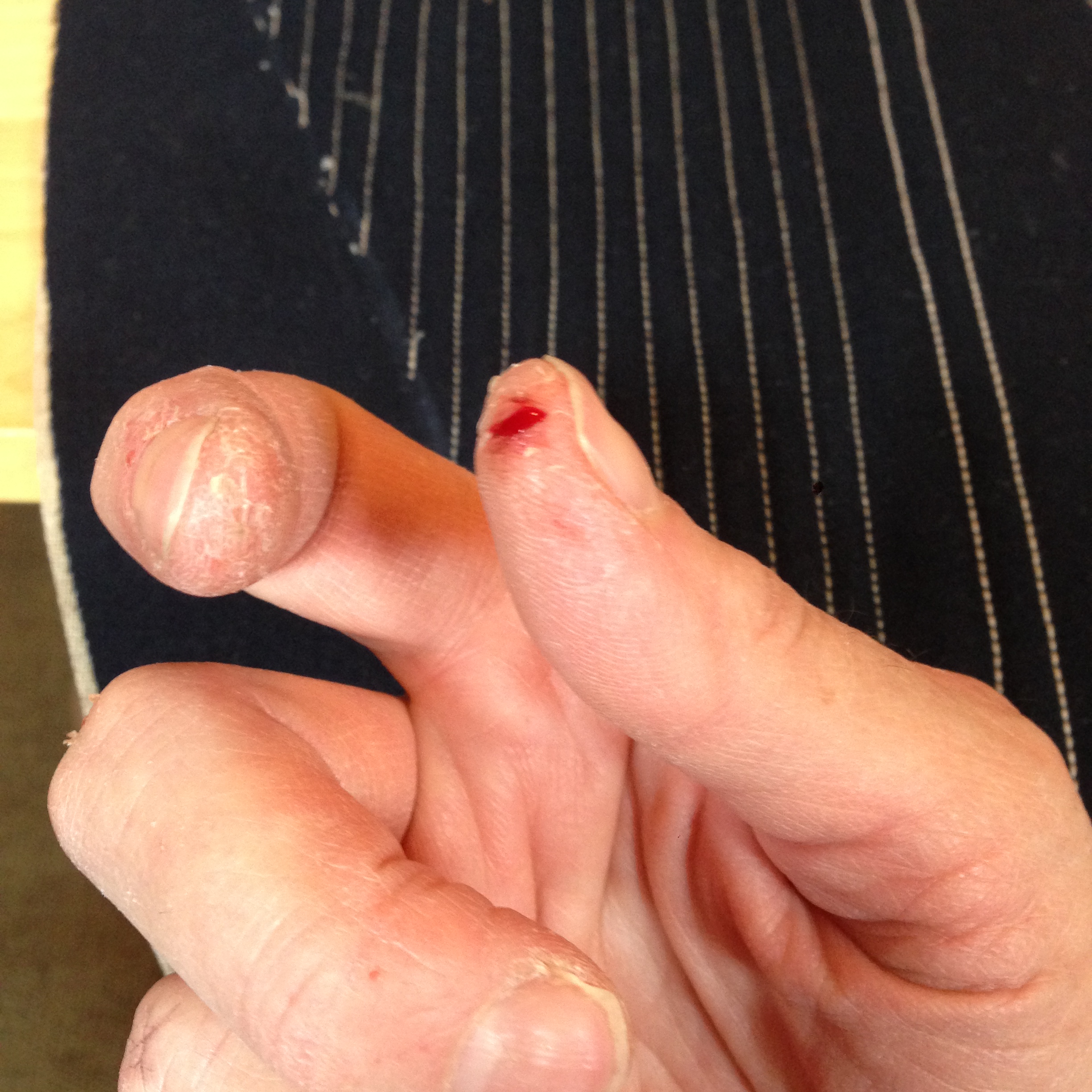
But this time, there was a bonus: the previously indicated Bust Blister. On the left side (I’m right handed), I developed a fairly robust .25” x .125” blister that crowned the top of a nearly 2” red mark, mirrored on the right by a less red and slightly less long mark. The culprit?

The Busk of Doom, of course.


dscn4568

Strictly speaking, I should not sport a busk when I desport as Captain Delaplace’s serving woman, or as a refugee cooking up the last of the bread, eggs, and milk. I’ve earned these marks and (potential) future scars by dressing above my station, and need to adjust accordingly.

Step one: Rounding down the busk edges (now in the capable hands of Drunk Tailor).
Step two: Foregoing the busk when working.
Step three: Wearing partially-boned stays when working.

Two is the easiest; three is the hardest. Which do you think I am, therefore, actually contemplating as a necessary next step?

But of Course: Step Three, Pathway to Finger Cracks and Stained Stays.

d'oh! surgical tape made this *much* better later.
d’oh! surgical tape made this *much* better later.

Fortunately I have people close to me who will ensure that I work through steps One and Two before embarking upon step Three, but I certainly want to know more about (and will look much more closely at images of) working women in the third quarter of the 18th century. My suspicion is that women who are performing labor that requires movement– up and down before a fire, back and forth across a floor, bending over a tub– may not be wearing stays made in exactly the way high style stays are made for ladies who bend over an embroidery hoop, glide back and forth across a ballroom floor, or move up and down the stairs of a well-built home they supervise.

Or my busk pocket is too big, my busk edges too square, and my actions too fast and continuous.

Paul Sandby. At Sandpit Gate circa 1752 Pencil, pen and ink and watercolor. RCIN 914329
Paul Sandby. At Sandpit Gate circa 1752
Pencil, pen and ink and watercolor. RCIN 914329

What are these women wearing? They certainly look fully boned. What can I change to make my stays work better for working? No matter what, where there are variables, there are experiments to run, and that’s what really makes history fun (even when it hurts).