Ready for Bed

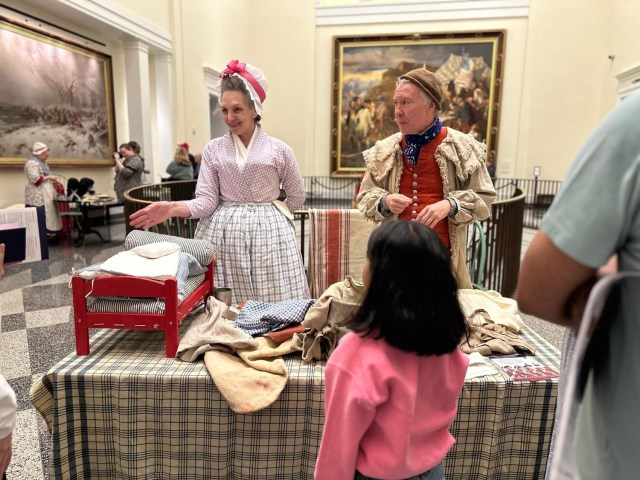
With some regularity, I portray an upholsterer-turned-contractor at the Museum of the American Revolution, and I’m scheduled to be there again mid-month. One upgrade I made last year, based on a friend’s adorable creation, was a doll-sized bed.

This is an IKEA bed for children or cats, so it’s an affordable, durable option for hands-on demos. It’s reasonably easy to adapt, with a chisel and a drill (Mr. K has a little drill press which made the rope-bed conversion much easier).

I outfitted the bed with woven ropes and a sack bottom, designed to make the bed more comfortable (the mattress can’t sink through the sacking). That’s topped with a a bed (mattress) of ticking stuffed with wool.

Bed with
Bed with sacking bottom laced to ropes

 Beds were stuffed with a range of materials, including straw, cattails, cornhusks, hair, and wool. Hair is pretty itchy and I had wool on hand; in graduate school round one I slept on a wool futon so I can attest to its loft and comfort.

A feather bed tops the wool bed, feathers stuffed into a linen bag stitched shut. The linen is pretty tightly woven vintage material, and still the feathers escape! The case of checked linen ties shut. A ticking bolster, also stuffed with wool, supports the feather pillow in its linen case. The top sheet is, again, linen, with a center seam to mimic historical sheets.

This week, I started making the blanket. Modeled on an original rose blanket in the Colonial Williamsburg collection, I used wool broadcloth cut from a remnant. This, too, has a center seam like most originals. I have a stash of wool thread for embroidery, and matched the colors as best I could. It’s satisfying work, though I discovered that I’ve been stitching the wedges incorrectly (this is the result of having a laptop, rather than a large monitor). Oh well. I’ll stitch the last rose correctly.

Left, Colonial Williamsburg original; Right, my first attempt

The Workwoman’s Guide lays out how a bed should be made up, with layers of mattresses (beds), a feather bed, sheets, counterpane, and blankets. It’s a lot of layers. The Workwoman’s Guide was published in 1838, and although it is always dangerous to engage in backward interpretation (i.e. to apply the logic of 1838 to 1778), it is not unreasonable to think that an eighteenth-century bed would be similarly furnished. In houses without central heating, layers would be necessary.

While sheets and blankets could be made at home (butt-seaming linen or wool is easy), wealthy folks without enslaved laborers could order sheets and blankets from seamstresses or upholsterers. Betsy Cadwalader did not make her sheets, and while Martha Washington stitched cushion covers, the labor for the slipcovers or case covers was likely accomplished by enslaved seamstresses. The Cadwaladers ordered their case covers from Plunkett Fleeson, who probably had the work done by women rather than by more expensive male workers.

The new blanket will debut at the Museum of the American Revolution on Flag Day weekend, and I will once again talk about women’s work in eighteenth-century Philadelphia as they pivoted from domestic to military work during the Revolution.
“Now Selling at Prime Cost”

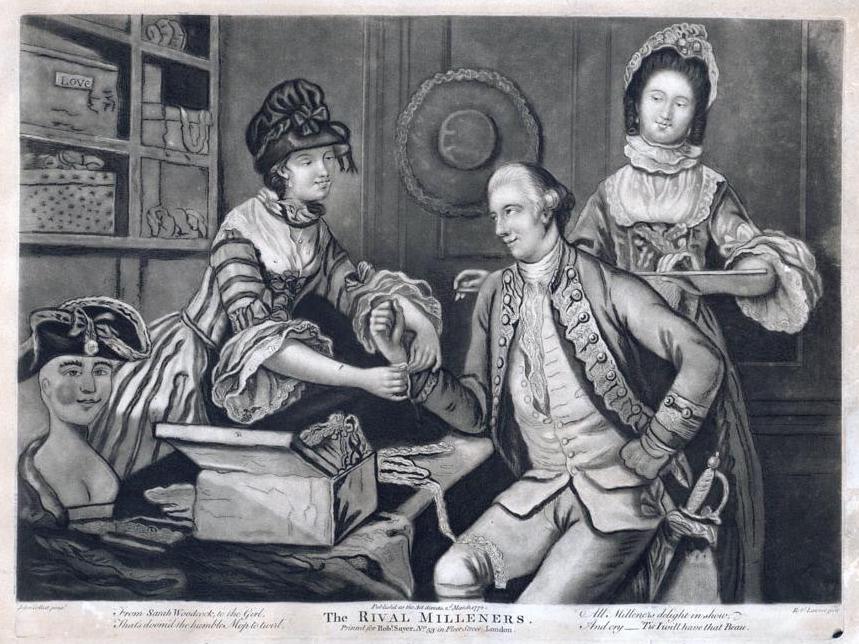
Although I’ve portrayed a milliner before, the earliest iteration has been as a shopkeeper in August, 1804, so I thought it best to refresh my knowledge of what 18th century milliners advertised. (Deep dives into bonnets help me focus on bonnets, but necessarily what else was being sold.)

Pennsylvania [Philadelphia] Packet, January 15, 1772.

One of my favorite ads is from the January 15, 1772 Pennsylvania Packet. Mary Symonds of Philadelphia published an extensive list of goods, many of which will lead you down a rabbit hole. Three of the listings had particular appeal.

“Womens’ and childrens’ black and coloured silk, Dunstable and chip hats, and bonnets”

“Black and coloured silk” almost surely encompasses the range of colored silk bonnets seen in Boston advertisements, but what’s the difference between Dunstable and chip hats? Price, of course. What most of us think of, or call, “chip” hats should be called Dunstable or simply straw.

Chip hats like the one above in the Snowshill Wade Costume Collection, were made of plaited (woven) thin strips of wood, more like flat baskets or chair seats.

Straw hats, like the one above (also in the Snowshill Wade Costume Collection) are clearly finer than chip and do not need to be covered. The earliest description of the distinctions between hat types that I’ve found thus far is from 1815, in “An Encyclopæaedia of Domestic Economy, Comprising Such Subjects as are Most Immediately Connected with Housekeeping etc etc” which goes into some detail.


The most entertaining discussion I found was in  The Sessional Papers Printed By Order Of The House Of Lords, Or Presented By Royal Command, In The Session 4 And 5 Victoriae And The Session 5 Victoriae 1841. The recorded exchange resonates with current discussions of tariffs on imports, but the really revelatory bit is this:

Class distinctions expressed in materials and apparel are eternal.

“Tobines” were new to me (or at least forgotten) and have nothing at all to do with the bishop of Providence. Thankfully, Textiles in America has the answer: “A wide variety of dress materials from fine silks to silk and worsted, and linen and cotton combinations that have warp-float patterns of small flowers or intermittent stripes and dots.” (p 367). Once you’ve seen it, you realize you’ve seen it before.

Berch papers, Nordiska Museet.

“Childbed baskets” were also a new concept to me, but The Female Reader, Or, Miscellaneous Pieces in Prose and Verse; Selected from the Best Writers, … for the Improvement of Young Women illuminated the term; the current equivalent is a layette set that includes bedding, and goes beyond the crocheted sweater, cap and booties some of us came to fear receiving. (Mint green acrylic? really?)

It’s a wide range of goods for women to buy (including small accessories for the men and boys in their families), and somewhat beyond the bonnets-hats-jewelry-trimmings we typically associate with milliners. While I don’t have any plans to start manufacturing chip bonnets or making up childbed baskets, I am definitely intrigued by the possibility of expanding my “offerings.”

Women in Business


One of things I’ve struggled with in living history is reconciling my own life as a 21st century working woman and feminist with interpreting the lives of 18th century women.

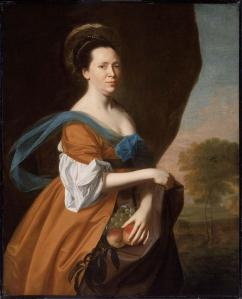
Mrs. James Smith (Elizabeth Murray)
John Singleton Copley (American, 1738–1815) 1769

It takes a while– and a bunch of reading– to get past the notion that these women lack agency in their own lives. Sure, there are notable exceptions: Abigail Adams, Mercy Otis Warren, and Elizabeth Murray, but those wealthy Boston women aren’t the kinds of women I’m interested in portraying. What about more everyday women? What about the women more like me? They’ve proven harder to find, but not unfindable–though even they, by dint of being findable, are more exceptional than the vast majority of 18th century colonial American women.

Elizabeth Weed carried on her husband’s business as a pharmacist, noting that she “had been employed these several years past in preparing [his receipts] herself,” and was therefore well-equipped and trustworthy to carry on in his business. Rebecca Young advertised as a flag maker, and as a contractor, made flags, drum cases, cartridges and shirts for the Continental Army, thanks to her brother Benjamin Flower’s position as a Lieutenant Colonel.

In researching Elizabeth Weed, I read about other women running businesses in Philadelphia, and practicing as “doctoresses” in nearby New Jersey, demonstrating that Mrs. Weed operated in a context of other successful women, including some practicing medicine, or at least “medicinal arts.” What I would really like is to track down the records of a mantua maker or milliner in 18th century America, and not only because I make and sell gowns and bonnets, but because in doing so, I’m carrying on with the kind of work that my grandmother and great aunts did.

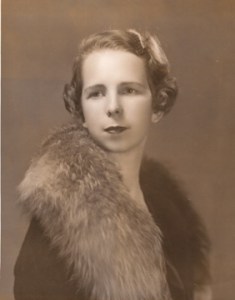
Elsa, Studio Portait ca 1935

For fifty years, my grandmother ran a dress shop in western New York state, dressing the women of Jamestown and the surrounding counties in fashionable and flattering clothes. My aunts made hats and accessories in their own shops, completing the look. I come from a family of makers (including a great-grandmother who made her own shoes), who care deeply about fit and helping people look and feel their best. My grandmother ran a successful shop for fifty years, until she sold it in the mid-1970s. I have many fond memories of sorting costume jewelry upstairs, and gift-wrapping boxes in the basement, with a rack of ribbons in all colors handy on the wall.

She was exceptional in her own way, though you will be hard-pressed to find much (if anything) about her on the interwebs, but maintaining a business through the Depression and World War II was challenging. She gave back, as a member of the YWCA and Women’s Hospital boards, recognizing the importance of sustaining the community you’re part of. When I portray Elizabeth Weed or Rebecca Young, or the Hawthorns of Salem, I think about my grandmother. Maybe it’s a step too far to say the living history work I do or the business I’ve started honors her and the other working women of my family, but I like to think that it helps make visible women who, though now forgotten, were as important to their own communities as she was.

The Widow will See You Now

No idea how I lost that pin. Photo by Mike Cirilo. 

Part five: portraying Widow Weed

I almost prefer first person interpretation, largely because it catches visitors a little off-guard, excites their curiosity, and allows me to use more humor in conversation than third person. This time, though, I found that despite the research and thinking I’d put into this portrayal, I couldn’t synthesize the material fast enough to fully immerse myself in first person, having over-scheduled the days leading up to Occupied Philadelphia. 

Over the course of talking to 1200 to 1500 people, I was able to synthesize the material, and refine my spiel. Talking about how the remedies could be (relatively) easily made in the kitchen, using ingredients drawn from kitchen gardens, South America, the Caribbean, India and Southeast Asia allowed me to talk about trade networks and the British Empire– a reasonable segue to complaining about a port closed thanks to Mr. Nevell, and a way to explain the effect that has on the city.

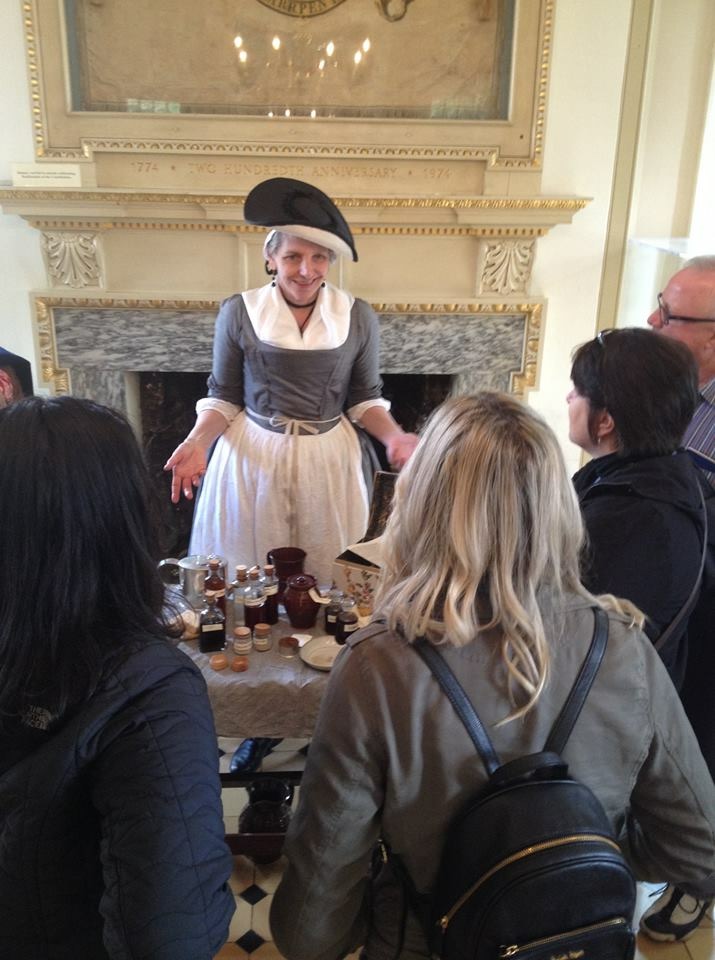
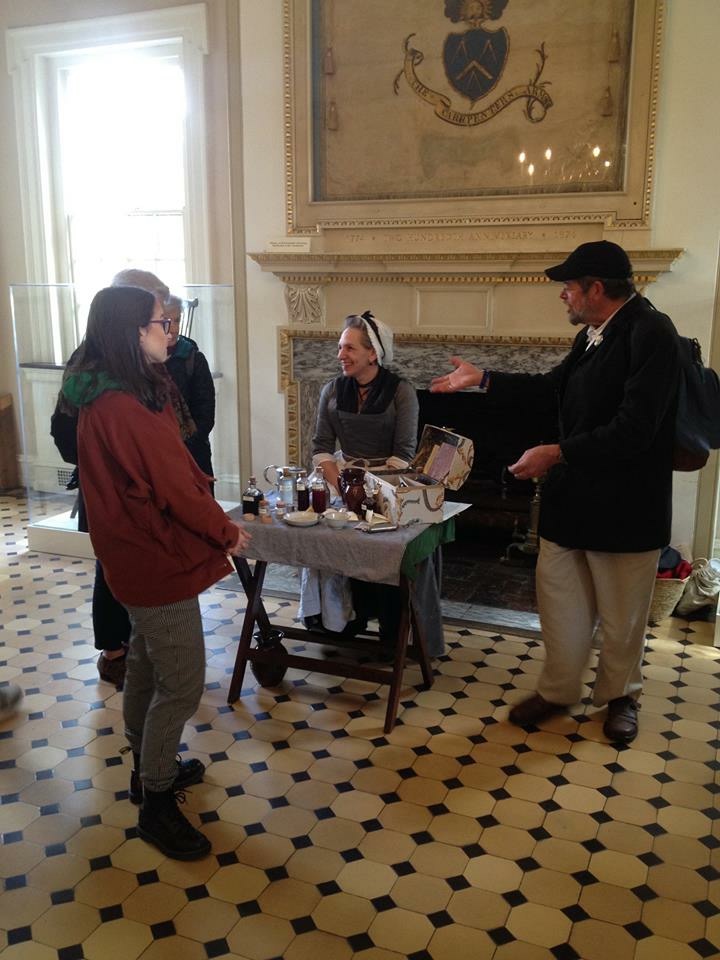
One of the most interesting aspects of this portrayal is how well women engaged with it– and enjoyed hearing about a woman with her own business. True, Drunk Tailor was steering women my way, but they also seemed to gravitate on their own. As much as I prefer in situ interpretation over the science fair table style, a table (or counter) offers enough of a barrier to make people feel comfortable approaching. On-street interactions are different, but somehow, indoors, people sometimes react as if one was perfume-spraying staff on a department store cosmetics floor. 

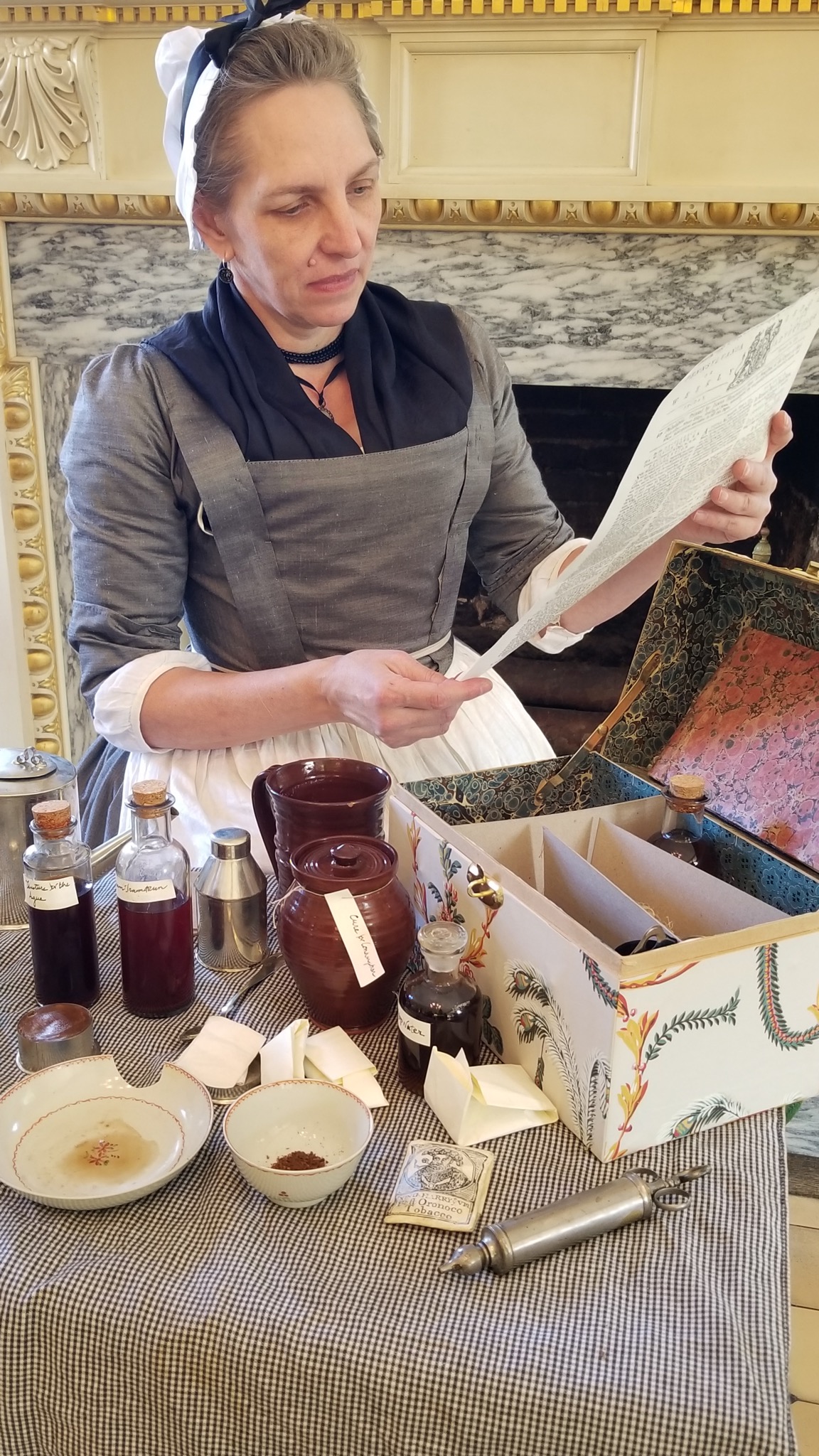
Photo by Mike Cirilo, saucer chip by me.

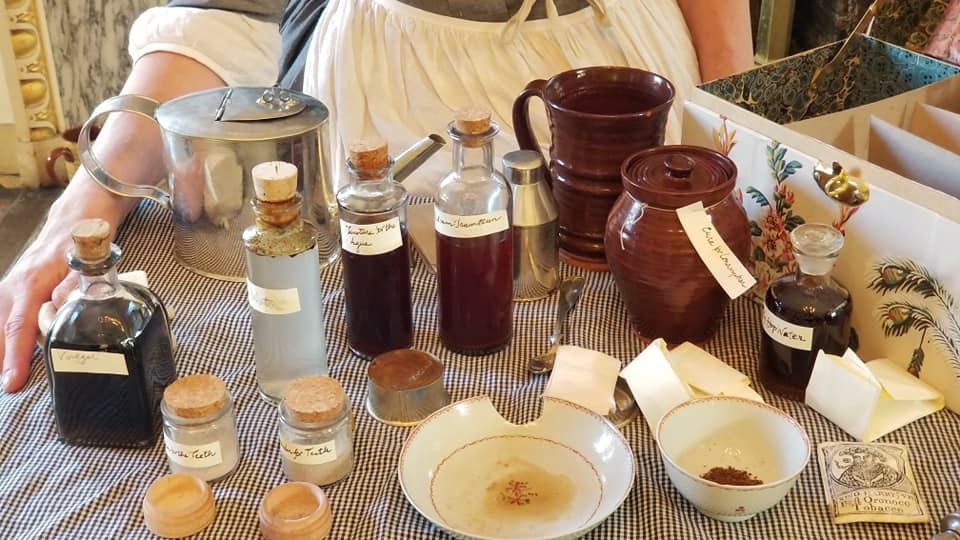
Not that scent wasn’t an excellent way to engage people! I couldn’t let visitors taste the remedies, but they could smell them, offering the opportunity to play “What’s that smell?” (non-feline edition) and talk about how people use the flavors they’re accustomed to in their medications and treatments. My cats never cared for bubble-gum flavored amoxicillin, but it’s bigger hit with toddlers than the straight-up medicine flavor would be. So, too, with tooth powders past: cinnamon, mace, and nutmeg are the blue raspberry of the yesteryear– though the tooth powders smell much better than they taste. I cannot recommend a weekend of use unless you wish to feel sad each time you clean your teeth.

Mr Nevell finds himself on the list of members of the Company of Carpenters

Drunk Tailor used the relationship between Thomas Nevell and Elizabeth Weed (their third marriage each) to move people around the main room of Carpenters Hall, and to some comic, as well as interpretive, effect. It’s far easier for him to say, “Six months in, six months left, of her mourning” as a means of explaining the grey and black palette of my clothes, allowing me to avoid the “You look like you’re ready for Thanksgiving!” lead in from the public. Confiding in the public that he’s had his eye on me for while lets them in on a secret, and visitors enjoyed trotting over to warn me about his interest, and that’s he’s sold his tools! I am always happy to tell them he’s just the kind of man my mother warned me about, adapting a banter we have used in multiple scenarios. While it’s broad, and nothing like how we really are together, it’s playful enough to engage the public, relax them, and get them comfortable asking questions.

The man on the left talked to me longer than anyone else

There are, as always, things I’d like to change about this presentation. Although I’d like to work on it enough to be more comfortable in first person, I’d miss the third-person ability to refer to 1849 cholera maps and general epidemiology. I definitely need to add a couple inches to the hem of the gown, up my cap game, and trim the mantelet. I’d like to find a wooden box, and add a proper mortar and pestle to the kit– my stainless steel one is perfect for home, but won’t work in public. But on the whole, I’m pleased to have an impression of a woman roughly my age, who can interact well with a character roughly Drunk Tailor’s age. Onward to refinements.