It has been quite busy chez Calash, with What Cheer Day a little over a week away, the Warren Commission happening tomorrow, and various and sundry other things to do, like get a Young Giant into college. But results were promised and results you shall have.
Despite my lack of chemistry knowledge, I made and used the pewter-cleaning liquor with some success.
The pewter plate spent some time sitting on its edge in a basin of the liquor, and the line is pretty clearly visible in the first image. The second shows the plate after being cleaned with the liquor and a wool rag. It’s better than it was, but there are still more experiments to do. I’d apply rottenstone, but the container hasn’t made it back to New England yet, the posts being poor and the roads infernal.
different class levels
As the silver bowl demonstrates, rottenstone on its own is remarkably effective at removing polish. It is certainly a fairly readily-available, non-toxic, period method of cleaning metals (andirons and fenders to plates and punch bowls) that can be easil;y employed.
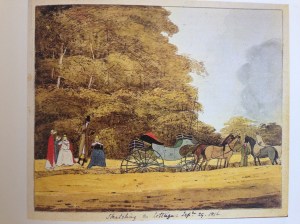
Sketching a Cottage, Sept 29, 1816. Watercolor by Diana Sperling
In a mere four weeks, I will pack the Subaru and head west into New York State as so many Rhode Islanders have before me. And while I will have clothes suitable for the time of the RI Quaker Migration, I will be leaving not to found a more utopian society nor to seek my fortune on a farm. Instead, I’ll be joining some dear friends for a weekend sketching party (minus the horse and carriage).
This new enterprise has required some additional research, and while I look forward to painting miniatures at some point this summer, I suspect this venture will be a simpler proposition. A new dress and apron are the least of my worries: brushes, watercolor boxes, sketchbooks, pencils and pens all require research just when I should be thinking more seriously about the way the Revolution played out as a civil war in New Jersey.
Anne Rushout, ca. 1768–1849, British, 3 sketchbooks of 82 drawings by Anne Rushout (B1977.14.9506-9587), 1824 to 1832, Yale Center for British Art, Paul Mellon Collection
Still, the Yale Center for British Art has rarely failed me: a simple search for sketchbook turned up a catalog record for three sketchbooks of 82 drawings by Anne Rushout. These are lovely, well-executed landscapes in a fine British tradition, far more sophisticated than Diana Sperling or Sophie DuPont– I fear I will closer to Sperling and DuPont when I take up sketching again, and can at least console myself that my wonky drawings will be part of a fine tradition of ladies’ accomplishments.
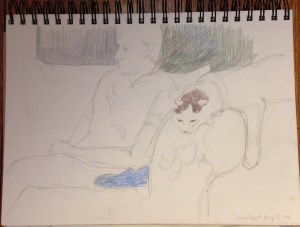
Man and cat, 2004
The Yale Center for British Art also has a nice Romney sketchbook for Paradise Lost, which demonstrates the cartoon-like nature of preliminary drawings (and I mean cartoon in the old sense, not the Animaniacs sense, though the uses are related). And as I sew my dress of unmatched checks, I have art programming to entertain me: Fake or Fortune, thanks to a tip from Ms B, has provided happy, envious hours of conservation labs, artists’ colourmen, and auction rooms. Vicarious delight, indeed.
Dude: I am conflicted. There are folks out there doing excellent work, but after reading some recent posts around the interwebs, I kept thinking, “Stockholm Syndrome much?”
I’m as much of a narcissist as the next person, and I think I recognize some of the folks being called out in various places for being critical of women’s roles in living history events. So, organize my own events? Come up with my own things to do?
Cool: challenge accepted.
I am, in fact, throwing down for the pleasure and pain of running a farm in late June. No, I didn’t organize it, but I was asked to take on a challenge and I have accepted, roping my favorite tailor into the effort as well. It’ll mean a bunch of studying, but in a pinch, I can always clean the house. We can rake, make refugees stay in the yard, and try as hard as we can to keep Quakers from putting radical ideas in the slaves’ heads. I think it will be hard, unpleasant, and uncomfortable—and that’s what I don’t like about the suggestions in the otherwise honestly well-intended and meant-to-inspire posts.
Playing at Quadrille. Oil on canvas by Francis Hayman. Birmingham Museums and Art Gallery
They’re so nice. They reinforce women’s subordinate roles in the past and present. Children’s activities? I might die, really, I might. If that’s your bag, go for it, please! We need it. It’s simply not something I can do.
No more can I talk about What People Wore. It’s not that I don’t care (y’all know I do) but that I want to move past the surface.
Dive deep: find the dirt. Find the hard stuff. You don’t have to be nice. That’s my personal problem with what I’ve been reading: between the lines I keep hearing a voice suggesting that we be nice girls, that we simmer down. No, I’m sorry. I can’t. Reader, if you can, go for it.
But if you can’t, I want to tell you: Keep pushing. Keep asking. Keep speaking up. Challenge the status quo. Our Girl History did a great post on Well Behaved Women, and I fully support the work people are doing to represent the Well Behaved and the marginalized (shout out to the veteran with the knife-grinding cart: well imagined, sir!).
John Russell. The Blind Beggar and His Granddaughter, oil on canvas, 18th century. The Bowes Museum UK.
Bring it. Bring the ordinary.
But if you can’t be ordinary or run the children’s games or be subservient or show how women dressed, that’s okay. For the love of god, someone, be desperate.
Be hungry, be angry, be resentful, be religious.
Whatever you do, don’t be afraid to speak your mind.
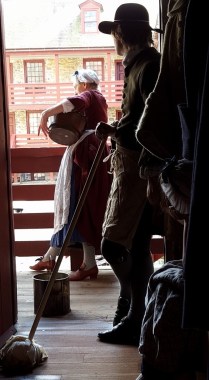
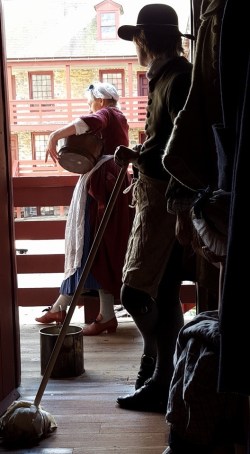
This past weekend, I took my show on the road down 95 to Trenton’s Old Barracks Museum, where once again, soldiers’ rooms needed cleaning. Hannah Glasse exhorts servants (housemaids and housekeepers) to clean household rooms daily, and I can tell you this: if you’re cleaning 18th century spaces using period techniques, daily is the way to go.
Unpaved streets and sidewalks meant people tracked significantly more mud and grit indoors, and soldiers would have brought the parade ground indoors every time they crossed a threshold. Not a pretty thing– and then there’s the straw mattresses (to be changed monthly at a minimum), wool uniforms, skin, hair, and vermin that could accumulate as well. Filth: a major contribution to ill health if not managed properly.
Brandy-new broom sweeps clean. Photo by Drunk Tailor
Being possessed of a particularly detail-oriented mind, I went in search of a more 18th-century correct broom at an affordable price and found a broom enthusiast on Etsy who agreed to make and priority mail custom brooms just in time for the trip to New Jersey. On the whole, I’m very pleased with these. They make a satisfying sound as they move across the floor, and draw a fair quantity of dirt. Turns out that strewing wet sand on the floor before you sweep is remarkably effective and absolutely the way to go. The damp sand keeps the dust down and is swept out the door with the filth without harming the floor.
Mop making: surprisingly contemplative. Photo by Drunk Tailor
After sweeping, mopping. Once again, I used the lavender-infused vinegar in the mop water (though I forgot to strain the solution this time). The mixture has a unique but not unpleasant smell, and as the floors dry, the room retains the odor, a sure indication of cleanliness.
This weekend was also the first run for a new wool scrap mop, which was proven the best mop yet. Many thanks to my secret source for the contribution to the effort. It’s clear that mops could easily have been made by binding rag strips to pole handles, and whether made by poor house inmates or soldiers, mop making is cheap, low-tech busy work.









 Kirsten Hammerstrom
You must be logged in to post a comment.