

Winter’s hard for me. I don’t like the lack of light, I don’t like the shortness of the days and how the sky is pale and stretched in these months. But this is a good time to think about basic needs, like light and heat and warm clothing.
The New York Times came to my rescue this morning with the article by Holland Cotter (and others) on “Artworks That Shine in New York Museums.” Cotter is one of my favorite critics and writers, and he, along with Karen Rosenberg, Roberta Smith, and other NYT critics, have selected some interesting pieces.

Ken Johnson leads with Georges De La Tour’s Penitent Magdalen. It’s earlier than my usual era but I was attracted to the image of the flame in the mirror; it’s not just a lighting device, of course, it’s a metaphor, but the rendering of the candlelight, and the use of the mirror to boost that light, tells us about how 17th and 18th century painters saw light, and how light was manipulated. We know from our simple experiments at work that mirrors really do amplify light, and that large stately rooms would only glitter with lots of candles and lots of mirrors. Light gives us a window on economy and wealth, as a precious commodity that cost money or labor to have.
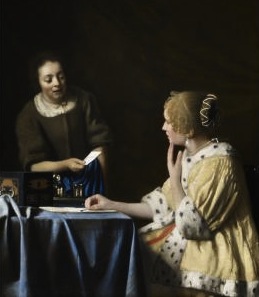
Cotter looks at Vermeer’s Mistress and Maid at the Frick, and notes the lack of obvious natural light or other light sources, and the overall dark mood of the scene. But Cotter’s writing shines, as he concludes the little essay: Whatever Vermeer’s anxious thoughts, light stayed on his mind. It scintillates in the pearls the woman wears in her hair and shines in the butter-yellow silk of her jacket. And the blacked-out space the women occupy turns out to have sunlit windows after all. We see them reflected in glassware on the writing table as tiny lozenges of light, far in the distance, as if at the end of a tunnel, but there.
Writing like that is its own kind of light, a joy to have in the daily newspaper on a cold, short day. In all, four critics look at five paintings each from a range of cultures and time periods. It’s enough to make one want to hop a train south.
 Kirsten Hammerstrom
You must be logged in to post a comment.