What Table Manners?

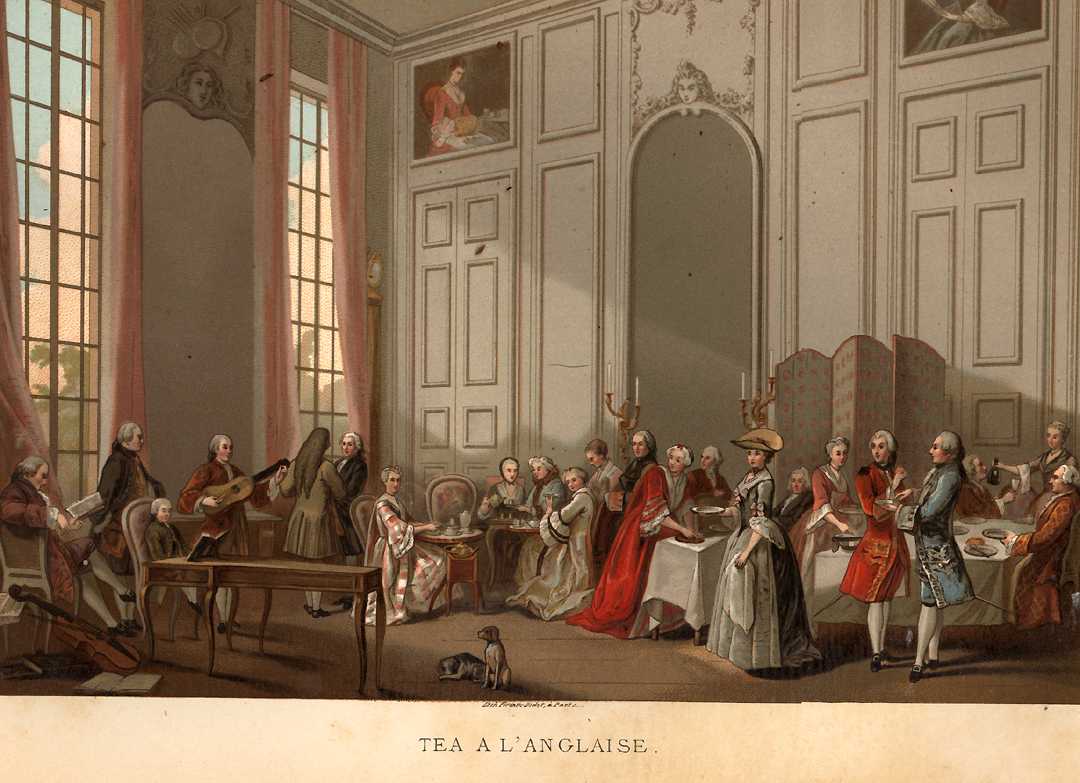
When you think of 18th century dining, which image comes to mind, tea on the left, or the sea captains to the right?
While I did not carouse with sea captains this weekend, at dinner today, I found myself deeply envious of someone’s skill in eating from a knife. I shoveled food onto my spoon yesterday with abandon. I coveted the last three pieces of quince tart today despite knowing that one of those pieces was for my husband. And I am not ashamed. Ok, not too ashamed.

The best part of living history is always what you learn, and I feel a separate blog post should deal with “the public, god love ’em.” What I learned this weekend was less about quilting and more about living old school. Ok, and maybe more about the public’s…breadth….than depth…

The most instructive thing was about being hungry and thirsty. Thirsty as in my lips are dry and I know I need to drink, which means being past thirsty and at dehydrated. Yesterday I went all day without peeing and that’s not right. Both yesterday and today I left the farm hungry, not because there was not food but because I ate mindful of leaving enough for those eating after me. The goose pie was delicious and seriously worth eating standing up in the kitchen. I’d fight for that pie.

Eating boiled dinner (ham, parsnips, carrots and turnips) along with a pudding, with 18th century utensils was challenging. Two-tine forks have great sticking ability but not much carrying ability.  Spoons are your friend. Knives may be better as trowels than cutting implements. No one really cares about your manners, they are too hungry to notice. Boiled pudding is this season’s smash hit.

Coggeshall Farm uses Amelia Simmon’s American Cookery, which I started reading last week. It is full of useful receipts based on American ingredients and I recommend it. Here is the receipt for the fantastic, sliceable pudding we had today:

A boiled Flour Pudding_.
One quart milk, 9 eggs, 7 spoons flour, a little salt, put into a
strong cloth and boiled three quarters of an hour.

There were hot words about those “7 spoons” from the kitchen staff and to be honest, I did not quiz them fully on the size of the spoons they used. But whatever magic they worked, it was truly delicious with and without the molasses cream sauce. Sliced and eaten with spoon or fingers (I snitched some later in the kitchen), it a consistency of solidity like the best parts of a Swedish rice pudding, though smooth.

It is hard to countenance how hungry people must have been much of the time in the past. More than the extreme hunger of the soldiers (like Greenman and Plumb Martin), I think common people experienced days of lacking, and accepted them, with the seasons. Food was not constant, but in flux, and even at harvest, I think, or hope, that one was mindful of the needs of others.

For more on seasonality and 18th century ways of thinking or seeing, read Circles and Lines: The Shape of Life in Early America. That’s what I’m going to pretend to do while I fall asleep.

Framing a Plan

cross-posted from A Lively Experiment, all images copyright RIHS.

This coming weekend, I’ll be joining in at the Coggeshall Farm Harvest Fair, along with my co-worker who helped clean the museum 18th-century style. She will be helping with cleaning and laundry and ironing (must remember to pack the lavender and vinegar solution), while I will tackle a quilted petticoat.

At first glance you might think I’ll have the easier weekend, and in some ways, I will, sitting in a parlor with a quilting frame. On the other hand, I booked myself a weekend with worries that have pestered me since we were invited in mid-August. Is the fabric I’ve chosen going to work? Do I know enough about the quilted petticoats in the RIHS collections? What kind of quilting frame is correct? And where did I stash the batting?

Research is always the place to start. I compiled a Pinterest board of quilted petticoats  in other collections to build my visual literacy, and tracked down articles by Lynne Zacek Bassett in PieceWork[i] and in the  Textiles in New England  II: Dublin Seminar for New England Folklife Proceedings[ii].  From the Textiles in New England proceedings, I learned that September is the second-most common month for quilting mentions in diaries for the late 18th and early 19th century in New England (May is the most often mentioned, Octobe is third). This was a relief as I wondered if quilting in September was even appropriate. With that resolved, I was able to move on to aesthetics.

New England and Rhode Island quilted petticoats share some general characteristics: the overall skirt is quilted in a diamond or diaper grid of about 1” square. Below this is a decorative band or border, usually about 12” deep. The top of this is set off from the grid by a cyma curve or wave pattern. Some examples use an undulating feather border, and others have a stylized arc and clam shell border.  The background of the border is stitched in diagonal lines. Sometimes the direction is set from center front, and lines radiate to the left and right, and in other cases the lines radiate to left and right from the center line of each arced segment.

Within the border, floral and animal motifs are quilted. Animals seem prevalent in New England quilts—there is even a mermaid in Connecticut—but none of our quilts have a mermaid. We have sunflowers, pomegranates, and carnations similar in form to the stylized flowers that appear in samplers and embroideries of this time period. Animals include deer, lions, squirrels and a creature that looks like an oryx but may be an elk. Birds are represented as well, peacocks and stylized songbirds as well as an owl, and even what seem to be roosters.

I drew these conclusions not only from reading, but from examining two quilted petticoats in the RIHS Collection, the lighter one made ca. 1745 by Alice Tripp [Casey], accession number 1985.7.1, and the darker one made in 1770 by Anna Waterman [Clapp], accession number 1982.76.3. In the catalog record, the images for 1985.7.1 are incorrect–they are for 1982.76.2, and the confusion testament to cataloging and linking records in a building several blocks from where the petticoats are stored. Now, at least, we can work on correctly them.

The quilted petticoat that I plan to make will use the typical Rhode Island elements. The top portion will be quilted with an overall diamond pattern, while a feather border will set off the bottom band. Within that, I will quilt squirrels, chickens, and probably an owl and a cat, because they are favorite creatures in my household. I’ll also quilt in my initials, just as Anna Waterman did in her quilt.

You can join us at Coggeshall Farm Museum this weekend, September 15 & 16, starting at 10 each day, and see RIHS staff members in action! We think it will be a good warm up for What Cheer! Day, coming to the RIHS on Saturday, October 13.


[i] “Sarah Halsey’s Mermaid Petticoat.” PieceWork. January/February 2003

[ii] ‘..a dull business alone’: Cooperative Quilting in New England, 1750-1850.” Textiles in New England II: Four Centuries of Material Life, The Dublin Seminar for New England Folklife Annual Proceedings 1999. Boston University Press, 2001.

Finishing Touches

Sewing:

  1. Finish Overalls for Mr S
  2. Waistcoat for The Young Mr
  3. The Young Mr’s haversack– can finish in camp
  4. If there’s time: linen jacket for Mr S, off-hours.
  5. Bed gown or short gown for K
  6. Linen work bag

Things to Acquire:

  1. Cane rod, local source
  2. Blanket (wool with blue stripe, in Texas) or two
  3. Tent??
  4. Camp kettle
  5. Coffee pot?
  6. Tea pot (Jackware or brown-glazed redware)
  7. Canteen for K

Things to Modify:

  1. Paint knapsack
  2. Paint Ikea box
  3. Swap Ikea box screws for brass flat-head screws
  4. Marble paper or hand-paint wallpaper to cover sewing kit
  5. Hemp webbing for pack basket (Missouri source)

As you can see, I have a sewing problem. Right now, those overalls have become breeches, and I am at the knee band stage, just before 10 more button holes. I can manage those in a week, but I suspect that will be it. And a work bag, I can probably manage a work bag. Last year, I went to OSV with bleeding and punctured fingers. This year, I’d like to have fingertips I can do things with. Also, I need to sleep in order to do my job decently, so perhaps this list is more about learning my limitations than it is about things I really need to do.

Watson Farm

20120703-061241.jpg Sunday afternoon we decided to go to a farm, and chose Historic New England’s Watson Farm on Jamestown. It was a good choice, I think, and perhaps this will be the summer of historic farms and landscapes.

I always wanted to be Tasha Tudor when I was little, live in a historic house, wear historic clothes, eat historic foods, perform historic chores. We lived in a ca. 1875 house in Chicago, so of course I wanted 1875 clothes for my school, which was also ca. 1875, at least in part. Fortunately, I did not get them, children being even less tolerant in the Dark Ages of my youth than they are today.

So Watson Farm’s ca. 1790 date and traditional methods appealed to me, and appealed to Mr. S, who wanted just “farm,” and the Young Mr. was just stuck with the decision.

20120703-061408.jpg The farm is largely uninterpreted. HNE provides a brochure and map for a self-guided tour, and there are cows, sheep, chickens, ducks, and cats scattered about the landscape. The fields are pasture, with the farm managers maintaining a vegetable garden for their own use. In terms of learning, it was not a stellar experience and knowing what I do about the farm, I can see why. With 285 acres that need to remain untouched, you can’t plant signs everywhere despoiling the landscape and getting in the way of cattle. In terms of beauty, it was outstanding.

The brochure takes you on a roughly 2-mile walk through the fields and down to the shore of the island. (There is a shorter loop option.) The view was lovely and on Sunday, with weather coming in from the west, the sky was dramatic and it was just about like walking in a Thomas Hart Benton painting.

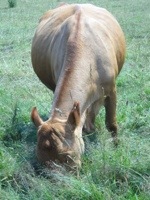
I think the best moment for me was hearing the cows eat. I don’t remember ever hearing a cow eat grass before, but it was a wonderful sound, “like eating a whole lot of celery, with a pillow over your head,” said Mr. S. Well, sort of. I wish I’d made a recording of it, because it is a sound very few people ever hear anymore. Even the most urban among us can encounter police horses snuffling in their feed bags, and reenactors can visit the dragoon’s horses at battles. But cows snuffling up and chewing grass–that’s another kind of almost-lost sound altogether.

And that’s the whole point of these historic landscapes, preserving the things that would otherwise be lost: not just the vista, the plants and the animals, but the sounds the animals make, the smell of hay toasting in the sun, the sandy prints of burrowing animals, and the truly otherworldly, out-of-time experience of stepping off the asphalt path.