On Saturday, my friend Dana and I went to the Franklin Mill Store in, yes, Franklin, MA. Their 20% off everything sale ends this coming Saturday, when Dana is working and I am taking the Young Mr to an admissions open house at a local school. So off we went, and here’s what I came back with.
From the left:
Green English broadcloth for Mr S’s frock coat.
Dark blue Italian linen-cotton blend heavy weight plain weave for Mr S’s summer frock coat, to be modeled in part on one at work that a historic costume specialist calls “Joe Providence.”
Interfacing for waistcoats and frock coats, already successfully applied to the Young Mr’s new waistcoat collar.
Green ribbon for a black taffeta bonnet to be made from the black taffeta seen here, and enough taffeta for a petticoat.
Brown wool for buttons. Expect tangling.
Magasin des Modes, June 1787, thanks to Dames a la Mode
The taffeta for the petticoat seems out of character for my linen and wool life, but I have a plan. At the Artee Fabrics store in Pawtucket, I picked up a remnant of green silk taffeta, but not enough for a full dress or gown. There is enough for an open robe, though, and I got an idea watching The Duchess. One costume is dark redingcote over a rose petticoat: not my colors. But then I found this fashion plate, with green over black, and there you are. Pure costume fantasy, but fun to make. Or at least fun to think about making–there’s always swearing.
To keep track of these insane plans, I started a projects page to list the schemes and deadlines. We’ll see how it goes.
The majority of us do not consider the chicken. We may consider whether the package of chicken we purchase is free range, organic, cage-free, grain fed, cruelty free. But we are unlikely to think about the implications for the physical being, the essence of chicken-ness, that the chicken’s conditions create for it.
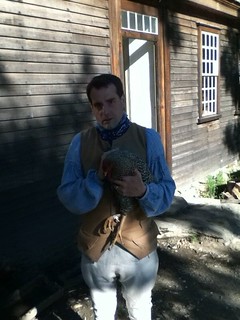
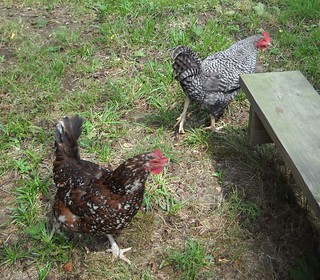
And I am here to tell you that the cage-free, organic, free-range chickens and chicken parts that you purchase at Whole Foods or your other large vendors bear little to no relationship to the actual free-range, catch-as-catch can, ne’er-do-well chicken of the historic barn yard. For one thing, living history chicken is ripped.
It’s well-developed physically, with strong, sturdy bones and robust ligaments. Its musculature is tight: this is not a bird in need of a personal trainer. Its meat, when cooked, is not white. It is dark meat, not so dark meat, and sort-of white meat. Its taste was described to me as gamey, but I disagree. It was chicken, but earthy, sweet and fresh and rich.
But all that came after the meeting of human, knife, and chicken.
Disassembling the chicken fell to me; I declined rubbing butter into flour having prevented a fall down cellar stairs by putting my hand in fresh goose guano, so I after I washed my hands, I addressed the chicken in its bowl, and took up a knife.
By this time, post-carrots, -parsnips, -squash, -string, -tallow and -suet, the knife lacked the purest essence of knife, that is, sharpness. But it functioned well enough for the task, with some persuasion. The skin was much thicker and more resilient than a store-bought chicken, and greasier, though not in an unpleasant way at first. The muscles were well-developed, and pink. Rosy pink, deep pink, dark like wine. There were no large slabs of the shiny, flaccid, pale meat you find on the chickens in the store. Those aren’t chickens any more: those are products.
The process of quartering the chicken took strength and pressure on the knife, and the strength of my hands. I did have to rip joints apart, and break the carcass’s back. All of this had a sound, and a mild smell of chicken, mixed with the melting tallow. But it was the sound that, with the greasy, slick knife, and the grease that soon covered my hands and wrists, that kept bringing me back to what I was doing, and that, when the bird was broken apart and in the pot and my hands washed, again (they itched), send me outside and up the hill for air and sky.
We boiled the chicken in a kettle we’d already boiled crook neck squash in; later, we added sage, thyme, parsnips and carrots. It was delicious. The broth was incredible, and the whole meal very simple. That’s the whole of the recipe: boil a chicken, add herbs and root or fall vegetables, boil until done, serve. Use any uneaten broth and bones/meat for stew, pie or other dishes. That’s it.
The product chickens from the market are bred to fall apart. They haven’t got what a running, pecking, eating everything chicken’s got in muscle, ligament, and tendon.
On Sunday, after we came home, I looked at the food in our cupboards. There were boxes, cardboard, plastic, layers of packaging. The cheese was square. These things came from the good market, but were they food, or were they products? I felt like a passenger on the ship in Wall*E, and I was appalled.
That’s approximately what the costumed interpreters say their leader says.
Let me affirm for you that history does, in fact, hurt, when you are doing it right. That is to say, you will be bodily tired. You will be hungry. You will be cold. Your judgment will be impaired. Your world will shrink.
I have so many thoughts/ideas/inspirations/observations after another weekend at the farm that I do not quite know where to begin.
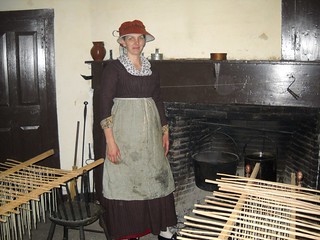
Yesterday, I made 290 candlewicks and draped them, with some help, over 50 sticks. My colleague and I managed to dip each stick of 6 wicks 2 or 3 times, though I had to trim the wicks after the first or second dip so they would match the depth of the kettle. Today, we got there late (thanks to my broken stay laces which had to be replaced…once replacements were found…annoying) so the fire was not hot, the wood not gathered, the tallow not melted—oh, it was not what this control freak wanted. I wanted to both make dinner and dip candles.
Well, we did manage both, in a way. Dinner was more of a snack of boiled chicken and root vegetables, followed by a snack of squash custard tart, and the candle dipping was managed only sporadically once the tallow was melted. First it was too cold, then too hot: it was a day of details. At some point I realized I was so tired that I could no longer think about a simple thing, and that what got in my way was simple lack of fluency. If I did this every day, I wouldn’t need to think about it. But I don’t. So while I can do these unfamiliar tasks, they are just a bit harder when I am cold, hungry, tired, or hurting.
Hot tip: sheepskin insoles. In wool stockings yesterday, my feet were freezing cold in the kitchen when I was not near the fire. With sheepskin insoles, my feet were warm today. Your mileage may vary, but well worth a try.
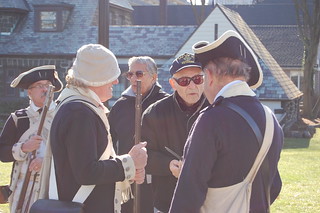
Surreal: that was the word for the morning at Monument Park. The RI Reg’t walked over the park instead of parading with the troops, because one of our members has not been well, and did not think he could keep up with the parade. It was odd to follow the reenactors in 18th century clothing under power lines and past high rise apartment buildings shouldering out old frame homes, but the surrealism really kicked in at the park.
Describing sniper fire in WWII to salsa music
There it became multi-sensory when the ceremony’s organizers turned on the music. It wasn’t exactly merengue, and it wasn’t exactly salsa…then the soundtrack switched to updated Big Band hits and finally landed on a strange, over-the-top, quasi-operatic version of “Battle Hymn of the Republic.”
So when you look at the photos on flickr, play some salsa or an album you might have ordered at 2 AM from a TV ad, and think about standing in 40F/4C weather eavesdropping on politicians talking about inching closer to universal health, and the lessons of Hurricane Sandy for high-rise dwellers, while squeezing up next to you for a photo op.
Later, at Fort Lee Historic Park, the artillery demonstration was loud and satisfying, but we got behind schedule and to the oddness of the morning was added rushing. It was capped off at the end by the order to fix bayonets, which led to bayonets being caught in branches.
Bayonets fixed, Capt. Becker takes measure of the trees
Finally, for me, the day nearly foundered when I pulled my phone out of pocket at the end of the event to check the time, and saw my boss had been texting me all afternoon over a non-crisis. Part of why I love re-enacting and living history so much is that it takes me so far away from myself and from my daily existence. It’s related (slightly) to my work, but to be so far away in place and time and effort is a delight. I can’t just throw the phone away or not take it along: I am supposed to be on call, all the time…but it’s history, not a hospital, and if budgets change, so should expectations.






 Kirsten Hammerstrom
You must be logged in to post a comment.