The Wind From the Hudson

Looking East from Fort Lee Historic Park

The cold on the Palisades was not as bitter this past weekend as it was last year; there must have been at least an 8 degree (F) difference. There was a rumour of 37F/2C but I think it was about 45-50F (7-10C). Where there was sun, it was quite pleasant, as the wind was gentle.

So what did we wear? Mr S and the Young Mr had long underwear under their uniforms (white so it would not show under the overalls), and long stockings, too; the Young Mr has a wool waistcoat, and is still so wiggly that I don’t know how much he feels the cold yet.
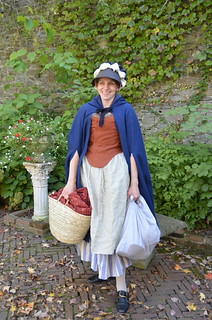
Layers are your friend

I wore my 1780s wool jacket, two linen petticoats and a wool petticoat, my still-unfaced cloak, and wool stockings, and was comfortable enough at nooning to take off my cloak. It’s a long cloak, based on one in the collection at work, but blue broadcloth and not drab (the extant cloak is drab, but both drab or dun and blue appear in RI runaway ads).

So what’s the key to keeping warm? Then, as now, (or now dressing as then) it does seem to be layers. The wool petticoat makes an effective barrier against cold, and the wool jacket is warm. I tried patterning mitts, but my hands are so large relative to my wrists that I tore the muslins at the thumb or had very baggy wrists.
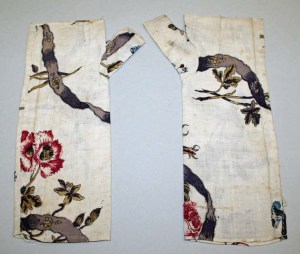
These chintz mitts from the Met (C.I.39.13.185a–d) seem to have a similar tendency to width at the wrist, and might work better than the pair I was following from Costume Close Up. It was late and I was tired, so a fresh start might work to keep my hands warm.

Post-war women with long sleeves would have been able to avoid that chill wind on the forearms, and I look forward to wearing my new long-sleeved wool dress.
Light, or Lack of It

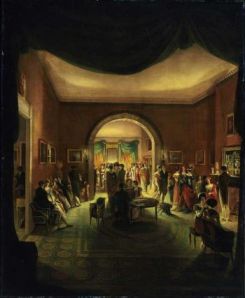
The Tea Party, 1824, MFA Boston

On Saturday evening, we drove up to Old Sturbridge Village for their “Evening of Illumination” tour. The village is by no means as fancy as the house depicted at left, but the gentle quality of the candlelight captured by Henry Sargent reminds me of the evening. I took no photos, because I just wanted to enjoy the experience…and learn from it.

Candles used in New England were usually home made, dipped, and of tallow. (See here for one reference.) The Browns of Providence had a spermaceti candle manufactory, and people in cities and towns often bought candles–by the pound, not by the stick. Spermaceti supposedly burns brighter than beeswax or tallow, but the only spermaceti candles I know of are accessioned museum objects and will never be lit.

In thinking about upcoming programs at two different sites, I’ve been thinking about what it was like to live in the dark, and to work mostly within the sun’s hours, and then judiciously by candle light. Sharon Burnston says, “Sew by daylight, knit by candlelight,” and if you think about process, you can imagine that  in low light, even the fine thread of sock knitting is far more manageable than fine sewing.

Large fireplaces provided both heat and light, and candles are surprisingly bright. I suspect that an evening by a fireplace, reading aloud by candlelight while a friend or sibling knit, was pleasant enough in a wool gown, or with a shawl over muslin. The trip to bed would have been another matter, and getting up something else indeed.

It is also well to remember that class difference would have created comfort differences: a servant would have been colder getting up than the master, for the servant would rise in a cold room and be expected to light a fire in the master’s bedroom. Rural workers would also have risen in a cold room, to cold or frozen water.

These are some of the things I’m thinking about as I read and look and get ready for programs, and for winter.

Quiet Tuesday

The worst for us: dirt and leaves on the house

Quiet for us in Providence because there is no school, so no school buses and no children  chattering past the house on their way to the middle school. After the storm passed last night, the city was eerily quiet, the way it is just at the end of a snow storm. We were lucky: no damage to our property, everything secured and although wind howled between the buildings and it sometimes sounded as if the side of the house would peel off, it did not. Perhaps the sheer power of ugliness held it together.

Far worse weather in NY and PA where museums remain closed and cities overwhelmed by water. I don’t expect much damage here in town, but do expect places in South County and East Bay have damage.

When in doubt and out of danger, keep sewing. And now, off to work.

The Calm is Now

Closed hurricane barrier at Fox Point

It’s the waiting that’s hard, that and listening to the wind. We’re likely to be fine up here on the hill. Mr S has taken the car to the ground-floor satellite office so he can get a server off the floor…really, I’d expect health care offices to do better on disaster prep than a museum, but seemingly not…but with the car gone, I have only to worry about tree limbs falling on the house. Most came down in Irene, but the maple is old and sick and needs to come down.

What to do when schools and work are closed? Sew, and teach the Young Mr grammar. He needs to cram on commas, and write a paragraph.

A burn test revealed that the only wool (or part-wool) fabric of which I have yardage enough to make a gown will not be safe to wear around fire. Time to rethink…and ride out the storm.