Eating in the Field

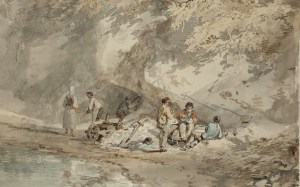
Workmen Lunching in a Gravel Pit circa 1797 Joseph Mallord William Turner 1775-1851
Workmen Lunching in a Gravel Pit, circa 1797. Joseph Mallord William Turner 1775-1851

A compatriot asked how we handle food and cooking in the field. What do we do about “yucky stuff?” by which she meant meat.

She was doing just about the same stuff we were doing, and with Battle Road around the corner, I thought I’d write about food in the field, and ways we handle it. Other people will have other ideas, but the main things I think about are:

  • Maintaining authenticity and food safety (Nobody wants flux.)
  • Historical eating is seasonal, local eating
  • Gear: less is not only more, but easier

Food safety is one of those things where you really don’t want to compromise too much, though from eating at the farm, I think there is more leeway than we admit. I will confess that when I was poor and in school, I stored dairy products on the windowsill of my studio when there was no fridge, so eating at the farm is like eating… when I was a whole lot younger.

Here are my principles. I’m not an expert, your mileage may vary, but this is where I begin.

Universal Truths

Start with who you are.
Objects you bring, and food you eat, should be true to your impression.
Authenticity goes beyond the date of accouterments: a porcelain tea set may be quite correct for a 1778 Newport or 1763 Boston parlor, but it makes very little sense if you are with a Continental private. One chipped plate is different for a woman to carry, or a piece of pewter. How long either would last you is another story, but at least you’d have a story. If you are the Colonel’s wife, it’s a different matter, even more so if it’s a British Colonel.

Food safety trumps purest authenticity.
Cloth covered, hidden ice packs will hurt no one and may save you misery later.

Stay Hydrated.
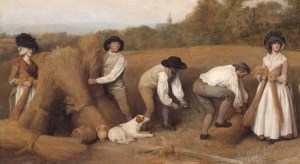
Reapers 1785 George Stubbs 1724-1806
Reapers, 1785. George Stubbs 1724-1806

Soldiers drank water.

In a hot summer camp, we keep a large pitcher full of water (see the Stubbs painting at left). Covered with a white linen or cotton cloth, it will keep coolish and free of dust & insects (or dog fur & fleas, if you’re in the Stubbs painting). We sliced limes into our enormous pitcher, and refilled it all day from the pump at OSV.

Limes are in period; justifying a source can be tricky, but at a certain level, safety trumps authenticity. 98 degrees and 90% humidity means drinking a lot of water.

Chances are you’re a caffeine addict like me, so what do you do? Boil water in a kettle, and bring tea in a screw of clean white paper is one answer. What’s your justification? I’m a personal fan of ‘stole it from my master,’ but in small quantities, perhaps you got it from home, or did a farm woman  a favor. Or stole it from her. John Smith (I kid you not), Sergeant in Colonel Lippitt’s Rhode Island State Regiment, in Continental Service, writes in his diary* of apprehending geese and chickens who failed to respond with the correct password when challenged.

*Published as “Sergeant John Smith’s Diary of 1776”, edited by Louise Rau, in Mississippi Valley Historical Review, No. 20, 1933, pages 247 – 270. NB: Kitty Calash recommends reading, not stealing.

Tomorrow: Food-related recommendations by event type.

HSF # 3: Under it All: A shift, and a petticoat

Done at last: the shift. Plus bonus bonnet

Remember that shift I couldn’t finish in time for HSF # 2, UFO? I did get it finished for HSF # 3, and a bonus petticoat as well. They don’t go together, but in honor of the excessive amount of snow we got this weekend, they’re both white. The snow is also how they got done: nothing like snow days and travel bans to keep one home and sewing.

How ‘Bout Them Facts?

Fabric:

  • For the shift, lightweight linen, probably this one.
  • For the petticoat, one of a pair of Ikea curtains found on sale one day. The light-weight cotton appealed to me and suggested filmy late 18th century petticoat better than anything I had seen at a fabric store.
The petticoat, over another petticoat. It’s that sheer.
Back view (again with cat bowl)

Pattern:

Shift:

Year:

  • Shift: 1775-1783
  • Petticoat: 1795-1800

Notions: Both: Just thread. And some left over white cotton twill tape.

How historically accurate is it?

The shift is pretty close. The fabric is, well, not the linen they had, but it’s as fine as I could afford. It is entirely hand-sewn, and the sleeves have bands and tie closed.

The petticoat is also hand sewn, and uses a historic garment for a basis. (I also looked at bodiced petticoats at the Met.) However, it is made from a curtain and while I unpicked all the seams, the machine stitching holes remain. It gets the job done that I wanted it to do, though: fluffy white stuff.

Hours to complete:

Shift: Killer. Started it last August and have worked on it off and on since then. It went to so many events in the basket that it smelled like woodsmoke. Intensively completing it probably took 24 -30 hours, so it could be a 40+ hour shift. After a while I stop paying attention.

Petticoat: Like candy. Started it Saturday morning, finished it Sunday afternoon. Best guess, about 10 hours.

First worn:

Shift, probably April 13.

Petticoat? Probably Dress U.

Total cost:

No good way to know…the fabric was bought so long ago! The petticoat curtains, when not on sale, are $20, so $10, because I only used one. For the shift, it’s harder to say. I piece aggressively when cutting out, so I bought less than the pattern recommends. Remnants were used for the petticoat bodice and various linings, including the Curtain-Along robe currently underway.

Blame the Milk Maid

Sandby: A Milkmaid. ca. 1759, YCBA
Pyne, Milk Woman, 1805, MoL
Pyne: Milk Woman, 1805, MoL

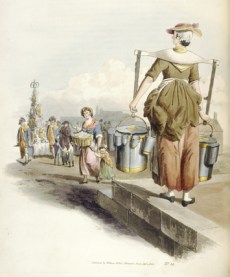
What do pewter and tin have to do with costuming? Well, aside from the many expensive buttons Mr S and the Young Mr wish to sport, I got interested in the milk maids’ pails because of their similarity to the tinned kettles used by RevWar reenactors. The uses converged in December in a conversation I had with a colleague about Carl Giordano’s beautiful kettles. (He made my wash basin, but my kettles came from Missouri because I needed them very quickly; the fur trade & rendezvous reenactors have similar material culture interests and needs, because of time period & culture overlap.)

1793: Milk Below Maids, V&A
Milk Below Maids, 1793, V&A

The milk pails look like tin, don’t they? One from ca. 1759, the other from 1805, and both appear to be carrying shiny, seamed metal buckets with brass details at the base and rim. The captions call them pewter, though. So I went to the V&A and the Museum of London looking for pails, but only found more milk maids.

I began to wonder: if the pails were really made of pewter, wouldn’t they be awfully heavy? And wouldn’t there be extant examples? Pewter is highly collectible. There’s a George II pewter milk pail on Worthpoint, but it looks nothing like the pails in the images. Is pewter ever so…shiny? And I’ve never seen seams in pewter the way they appear in the Pyne illustration.
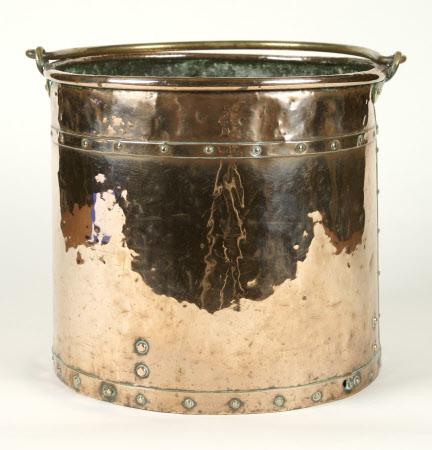
Here’s something that reminds me of that George II milk pail.  I think I trust the Met more than I trust an online seller. On the right is a “bucket carrier” from the National Trust (UK) Collections.

Mid-18th century dinner pail with cover, MMA
Mid-19th century bucket carrier, NTC (UK)

Google defines pewter thus:

pew·ter

/ˈpyo͞otər/

Noun
  1. A gray alloy of tin with copper and antimony (formerly, tin and lead).
  2. Utensils made of this.
Synonyms
tin
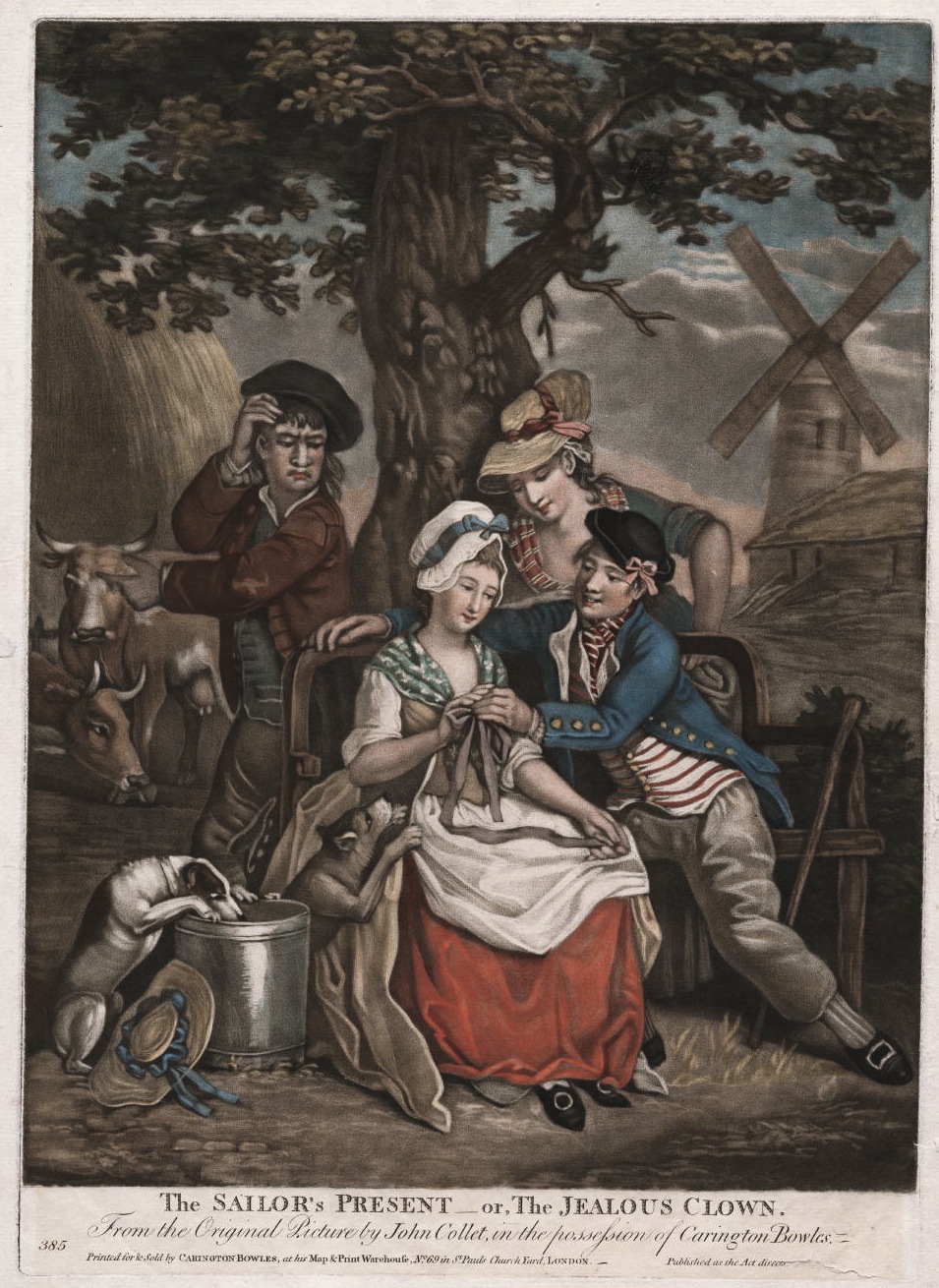
178, Collet: The Sailor's Present, LWL
178, Collet: The Sailor’s Present, LWL
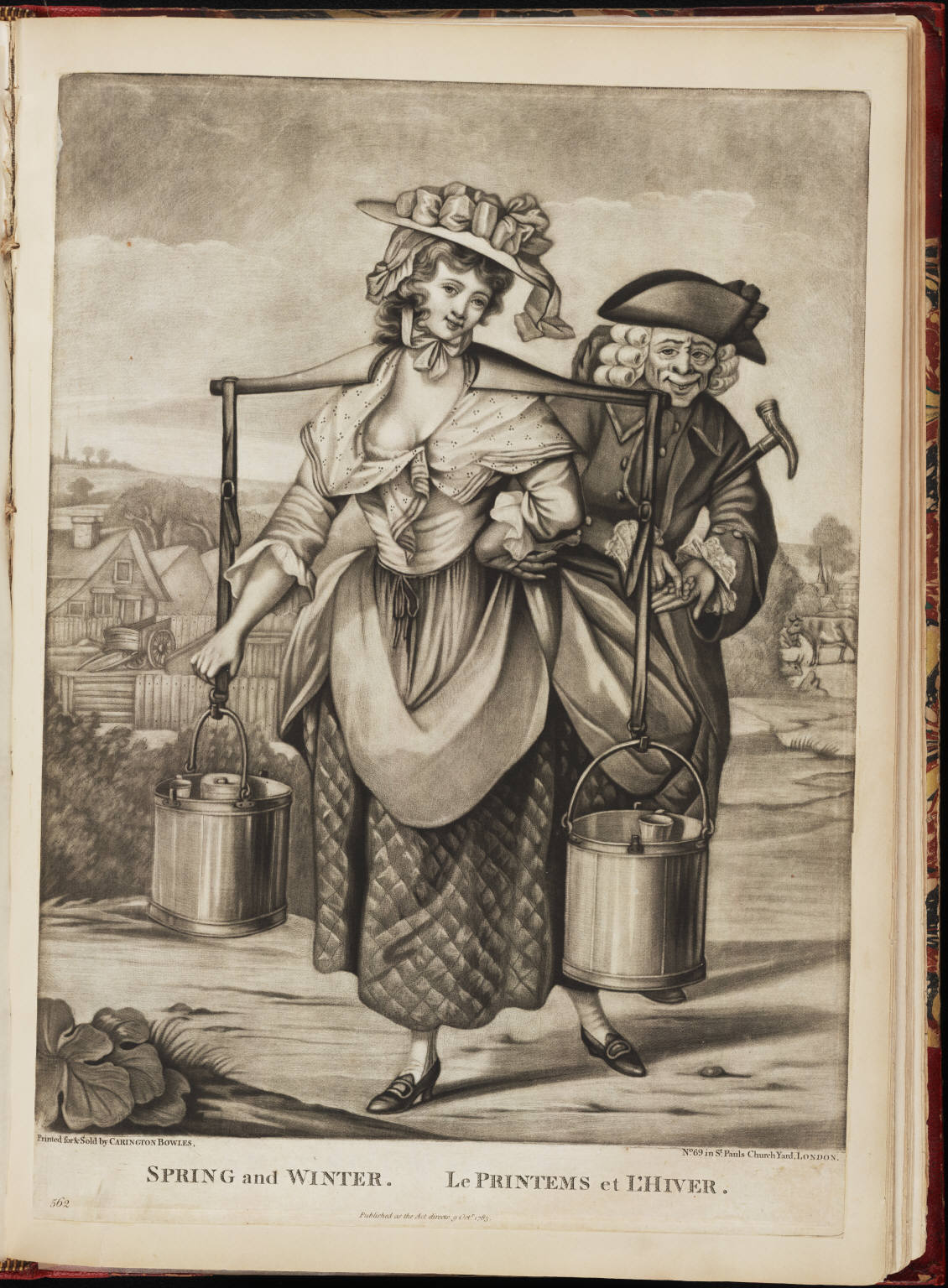
1785: Spring & Winter, LWL

Synonym: tin? That’s pretty interesting, even though I don’t trust Google with etymology.  But don’t these tin kettles look a great deal like the milk maids’ buckets?

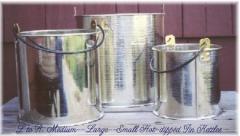
Carl Giordano Tinsmith: Kettles

The Giordano tin kettles can be made with brass ears (that’s the part the bail, or handle, goes through). Look at the ears in the photo, and at this detail from “Spring and Winter:”

Detail, Spring & Winter, 1785, LWL

The ears may be the best lead to follow. There are plenty of ears (handle attachments) if you search the Met for bucket or pail and limit the search the metalwork… but they’re bronze, and Roman. The National Trust (UK) doesn’t turn up much, or the Museum of London (yet).

ca. 1750: Silver cream pail, MFA

There’s a silver cream pail at the MFA, and it sort of looks like its handle attaches with ears, but not in the riveted-on kind of way, but in a purposeful and elegant way. This is just about where I start to ask myself why I care, but then a number of other questions present themselves, like:

  • Where are the milk pails? Are there really no milk pails in museum collections? (Yes, this could be true)
  • Was this pewter milk pail with attached measures specific to London, as my colleague thinks?
  • How does milk taste when it spends quality time in pewter (or tin)?
  • How heavy would a pewter milk bucket be?

Things to ponder as we prepare for heavy snow… In this state, that means dashing out for “French toast supplies.” I’m not originally from here, and I solemnly swear we are legitimately out of bread, eggs, and milk.

It Isn’t History Till it Hurts

End of the day, Sunday

That’s approximately what the costumed interpreters say their leader says.

Let me affirm for you that history does, in fact, hurt, when you are doing it right. That is to say, you will be bodily tired. You will be hungry. You will be cold. Your judgment will be impaired. Your world will shrink.

I have so many thoughts/ideas/inspirations/observations after another weekend at the farm that I do not quite know where to begin.

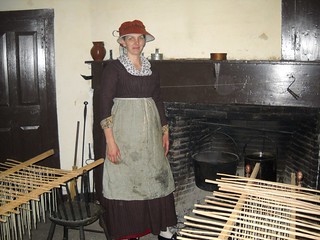
Yesterday, I made 290 candlewicks and draped them, with some help, over 50 sticks. My colleague and I managed to dip each stick of 6 wicks 2 or 3 times, though I had to trim the wicks after the first or second dip so they would match the depth of the kettle. Today, we got there late (thanks to my broken stay laces which had to be replaced…once replacements were found…annoying) so the fire was not hot, the wood not gathered, the tallow not melted—oh, it was not what this control freak wanted. I wanted to both make dinner and dip candles.

Well, we did manage both, in a way. Dinner was more of a snack of boiled chicken and root vegetables, followed by a snack of squash custard tart, and the candle dipping was managed only sporadically once the tallow was melted. First it was too cold, then too hot: it was a day of details. At some point I realized I was so tired that I could no longer think about a simple thing, and that what got in my way was simple lack of fluency. If I did this every day, I wouldn’t need to think about it. But I don’t. So while I can do these unfamiliar tasks, they are just a bit harder when I am cold, hungry, tired, or hurting.

Hot tip: sheepskin insoles. In wool stockings yesterday, my feet were freezing cold in the kitchen when I was not near the fire. With sheepskin insoles, my feet were warm today. Your mileage may vary, but well worth a try.