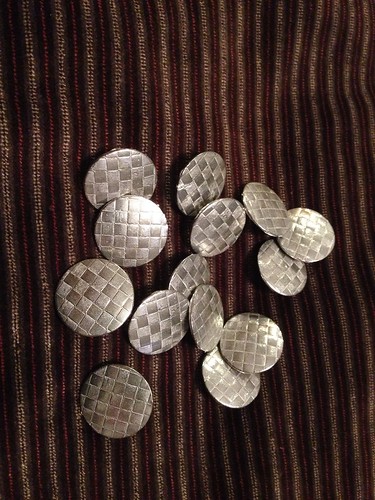
The buttons came from Roy Najecki earlier this week, which was exciting. They aren’t for the plush breeches currently under construction, but rather for the green wool frock coat I’m making for Mr S to wear with the breeches. And, luckily, there is enough plush for me to screw up and recut select portions of the breeches should I need to. That’s always a relief, and not a luxury I always have. The pockets won’t be plush, though– or he’d always have a hand stuck!
It is lashing rain on the windows chez Calash, and soon enough the present-day chariot known as the Subaru will commence hauling Mr S to the train station and the Young Mr to school. Bikes and buses are unpleasant in the rain, though the Young Mr is always (and only) driven to school on Wednesdays due to a peculiar busing and schedule arrangement.
But what if they lacked this luxury, and had to venture out? The way it sounds out there, the smartest choice would be to stay at home by the fire, but someone has to fetch the wood and the water, and someone has to milk the cow and fetch the fool cat in.
Greatcoat, Chester County Historical Society. from Fitting and Proper, by Sharon Burnston. Scurlock Publishing, 1999.
If you could afford one, you’d wear your greatcoat (new or second-hand).
Made of broadcloth, this would be your non-flammable water-resistant choice for inclement weather. Woven and then milled, the fabric would be dense enough to resist water and hold a cut edge, which makes those capes a more winning proposition.
Over a slim-cut body, layered capes can emphasize and exaggerate shoulder width, making these utilitarian garments sexier than you’d expect. (Of course, I have a thing for guys dressed like this, so your mileage may vary. But by the Civil War, the lines are boxy and, well, yawn.)
Greatcoats aren’t even remotely on my list for this year, but someday I’d like to make one, if only to borrow it. Baby, it’s cold outside.
It’s always cold, though, and I could use a day sewing various projects or vacuuming. But it’s also the last event of the season. Of course, in the slack time, I always stand on the NJ shore wondering how feasible it would be to run over to Manhattan for trim, fabric, or a trip to a museum. In kit. Because…. why not?
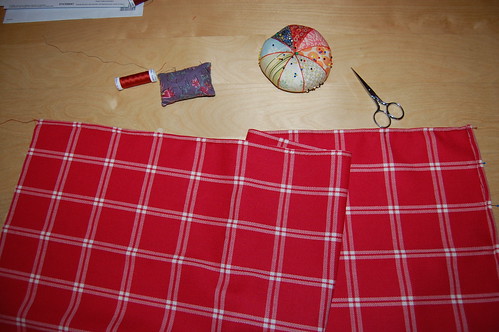
But Mr S wants me to come, so I’ve stirred myself to cutting and pressing and starting to hem a wool kerchief. This is made from some crossed-barred wool found in Somerville on the shopping expedition with Sew 18th Century.
She kindly sent me the image above, which is a good thing because I get distracted and think, “you know, that image with the duck and the girl and the bonnet,” which will give you 71,000,000 results in Google, but fortunately includes this one.
Three hems: I should be done by now.
It’s an easy project, but sometimes those are the hardest because you’re not learning anything. That, of course, is what Netflix is for: ghastly murders or sophisticated dramas keep you going on repetitive hems. (I do my best backstitching to BBC crime dramas– go figure.)
So, a November Saturday up on the Palisades means wool, in fact, requires wool, and for the first time I think I have enough wool to stay reasonably comfortable. That’s a cloak, kerchief, gown and two wool petticoats, plus wool stockings and, if they fit, sheepskin insoles for my shoes. We have a wool shift at work, but at about 50 years later than the Fall of Fort Lee, it provides no justification for a wool flannel shift. Still, a wool shift is a tempting thought, and suddenly that kerchief hem gets more interesting, as I start to think about where to look for documentation of wool or flannel shifts.
Summer is, of course, fully upon us and those of us on the eastern seaboard feel its oppressive and sticky heat. Ordinarily, my town isn’t terribly hot and cools off at night, but like everywhere else, this is not the case. Last weekend, I wore wool; technically a wool and cotton blend, but more problematically, burgundy in color. This is the price of gowns inspired by London watercolors.
This leads to constant questions: Aren’t you hot in those clothes? Aren’t you dying of the heat?
There is an underlying tone that suggests that perhaps the people of the 18th century didn’t know enough not to wear wool, or perhaps they only had winter clothes. I’ve heard “well, they didn’t know any better,” as if they never took their clothes off, and if only they had, 18th century men and women would have promptly abandoned their stays, gowns, waistcoats and breeches for tank tops, shorts, and wife beaters. Of course, history is not a Fiat commercial.
Well, what did “they” do?
Barbara Johnson’s book, 1764.
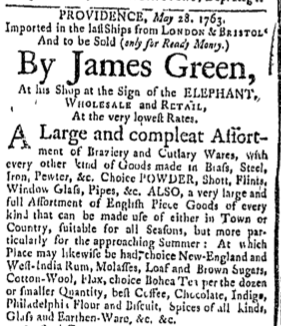
They took their trade to James Green and merchants like him who offered “Piece Goods of every kind … suitable for all Seasons, but more particularly for the approaching Summer.” (Boston Post Boy, August 8, 1763.)
And what would be suitable? Cottons, fine linens, light silks, in light colors.
Barbara Johnson chose floral prints on white backgrounds in July and August of 1764, both could be “suitable for summer.”
And as you probably know, the answer to “Aren’t you hot?” depends on who you are, but is often, “Not really. Once my shift/shirt is soaked with sweat, I’m pretty comfortable.” This is true as long as your shift/shirt is made of linen; cotton and cotton/linen blends don’t wick as well as linen.





 Kirsten Hammerstrom
You must be logged in to post a comment.