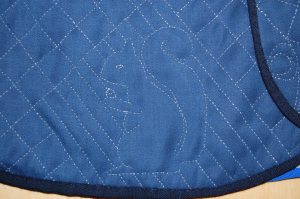
Squirrel!

It’s astonishing to me, in a way, that I haven’t posted about this before, but shockingly, I have not. Remember the need to keep warm in Princeton? Tested on at Ti? A compromise?

I updated that garment and wore a nearly-completed version at Ti last February but never wrote about the new version: the Squirrel Waistcoat.
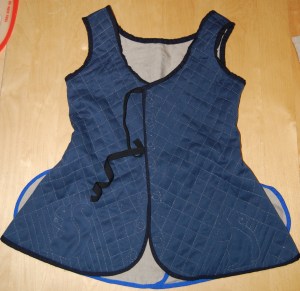
Wool hand-quilted to a wool backing and lined with wool, I wore this almost finished at Fort Ti last February, and found it comfortable and cozy. I had imagined its state to be far worse than it was: with a lining in need of piecing, mangled seams, your worst nightmare come true. But no: all it really needed was some binding adjustment, not surprising considering that I stitched the binding by candlelight while chattering away with friends over cider.

The back pieces weren’t bound at all, but because I’d imagined this needed so much more work than it did, I put it aside until now, when I know I will want it for a weekend in Trenton, and another at Ti in December. All it took was a little time, and accepting that the bindings will not match.

This wasn’t a long, involved project, really, though I spent lunch hours and evenings working on it last January and February. It is, as so many things are, about patience. Patience and good needles.
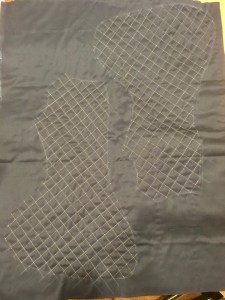
The construction was based on the quilted waistcoat I made two years ago, with a pattern derived from Sharon Burnston’s research, using fitting adjustments I’d made to an earlier jacket pattern (long since abandoned due to living in New England).

I don’t fully remember how it fits best, over or under my stays, but I’ll get a couple of opportunities to test drive the layers in the next two weeks. And in the meantime? Squirrel!
Waistcoat Wanting? Workshop!

Gentlemen of Rhode Island

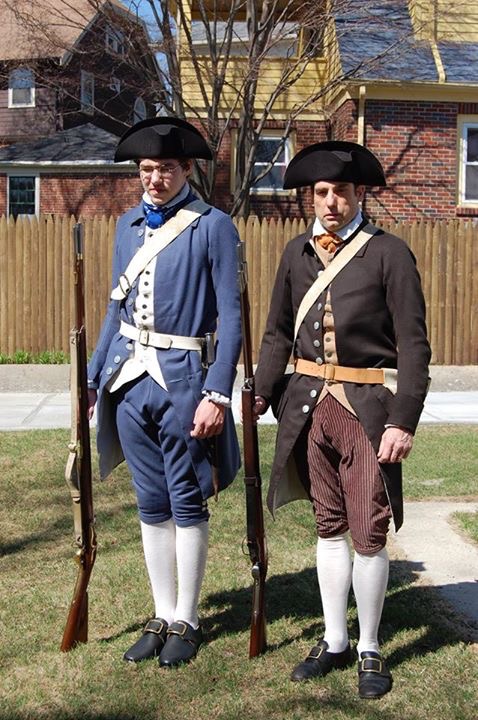
I managed, with sore fingers and considerable snake-eyed concentration, to get breeches and coats finished enough to send these two off to Battle Road better dressed than ever before. I’m pleased indeed with how the blue suit turned out, and planned to make a blue wool waistcoat to complete the set. Except…the Young Mr prefers some contrast in his clothing (a change from his prior preference for complete camouflage) and now wishes for white. I ask you.

Mr S is need of a new waistcoat himself, and he’s registered for a workshop with Henry Cooke to make a new waistcoat for himself. He was awfully taken with Mr B’s clothes two Saturdays ago, when he dressed as George Claghorn, the Naval contractor who supervised the building of the USS Constitution

Plush. No, really, it's made of plush *and* it's fancy, at least for us.
Plush. No, really, it’s made of plush.

.

L’Hermione is coming to Boston and Newport in July, and then we have An Afternoon in 1790 planned, with What Cheer Day not far behind, so there’s plenty of need for new waistcoats in a variety of styles– 1780, 1780, 1800 each have their variations.

Why not join us May 2nd and 3rd in Providence, and make your own fabulous waistcoat? There’s still a space or two left! Register here.

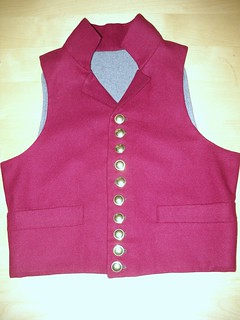
HSF # 1: 1813(ish) waistcoat

Waistcoat, my waistcoat

The Challenge: #1, __13

More photos here.

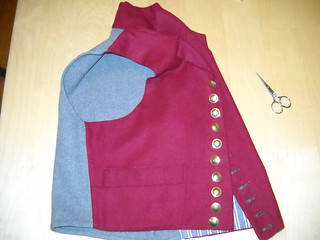
Fabric: Fronts, 100% wool leftover yardage from a petticoat. Back, wool broadcloth left over from remnant (is that a remnant remnant?) purchased for Mr S’s short jacket. Lining, heavy-weight linen.

Pattern: Kannik’s Korner Man’s Waistcoats, 1790-1815

Year: You can call it 1813. This style works for a couple of decades, though it will be worn for 1799 this weekend. Time machine, anyone?

Snazzy, right? This color is closer to the actual color.

Notions: 10 domed brass buttons with rims; silk buttonhole twist, both Wm Booth Draper, and some interfacing from the Franklin Mill store.

Red Waistcoat, MMA

How historically accurate is it? Well…the pattern has good documentation and the fabric is within reason for the period. The waistcoat is entirely hand-sewn, and the coarse linen pocket linings match extant garments in collections. So I know that’s good. And as it turns out, I completely and inadvertently made…this! So excited to find this! More excited than you’d expect! First quarter 19th century means 1813 is A-OK!!Also, that waistcoat is HOT! So I think I have achieved pretty accurate, even if it will be used in a time machine back to 1799. 

Hours to complete: This was much faster than the first one. 12 hours for cutting and sewing, with about 3 hours just on button holes.

First worn: To be worn by the new owner (The Young Mr) January 19, at the Winter Frolic

Total cost: Since I used fabric left over from a petticoat and the jacket, I’d say the cost was really only in the buttons, so $14.50.

Start Your Needles!

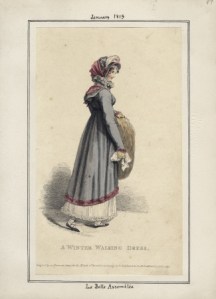
LAPL- Casey Collection

I haven’t sewn anything in nearly a month, and it has been delicious. Really. No buttonholes, no hems, no seams. Nothing! I ripped a button off my winter coat and pocketed it, people. I didn’t sew it back on. That’s cold turkey.

But spring beckons, or so I’m told it will, eventually, and the sewing must start again. There are many, many things I want to make and several I need to make. Wants and needs…and more meditation.

I’ve been watching the Historical Sew Fortnightly that The Dreamstress is running, and I’m in. What the heck! I need another kick in the pants,  breeches, what-have-you, to get back to sewing. I really do enjoy it, so why not?

To start with something simple due by midnight? Hmm. I have at least two ideas already, but one garment under construction might allow me to meet the deadline. Well, the North American midnight, anyway. I’ll have to cheat to start, and that isn’t usually the Calash way…

Looking ahead, I see a possible 1813 garment in my future. How about this 1813 Winter Walking Dress? I could make it just for fun, which would be a good task for me.