
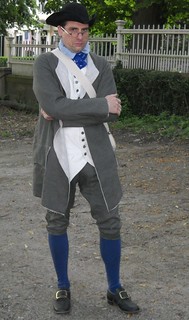
 Ah, the public. We’re not really much without them—we need an audience, don’t we? Living history practitioners/costumed interpreters/re-enactors are all looking for an audience. We like to tell people about the past, so we need the public. Sometimes, though, the public is a trifle confounding.
In one weekend, I heard or heard about the following questions or comments:
Are you Jane Austen? (This from a 10-year-old girl in a grocery store, so it’s actually score one to the girl for knowing Jane and getting the dress period right, and one to Dana, who answered with grace.)
Look, it’s the Pilgrims!
Gosh they must have been hot back then. I guess they had to adapt, but they must have been awfully hot, even if they didn’t know any better.
Why is it like it used to be in here? (My favorite!)
Did children chase chickens back then?
What are you chopping all that wood for?
Oh, look, the fire’s on!
I thought you’d all look pretty like the ladies on British TV. [i]
There was also a group that trouped in and just stared. Stared. Hard. I couldn’t manage to say anything, though Vicky and Johanna did an excellent job explaining what we were doing. By the time it was my turn, they’d stared in silence for several long minutes and it was just too weird to say anything.
So, what to do? Not much, I think, but to join and support your local history organization to encourage history education for all. And for those of us on the receiving end? Take a break, eat a snack, stay fresh, and park the snark. Wait until the tour has left the building to react.
I had only one not-great experience. A child came behind my quilting frame, popped on my bonnet, and left the room while I asked several times, “May I have my bonnet back, please?” Her mother turned to me and said, “We thought this was interactive!” Well, yes, but that is my personal bonnet. So the lesson for me is hide my bonnet better, and for the public? It never hurts to ask if you can try on the item sitting next to the interpreter, or to touch the things they’re clearly working with. And never touch an interpreter or re-enactor unless invited to. Yes, it has happened.
Manners transcend centuries: please and thank you always work.
[i] This is similar to what a guide at work said the first time I did a program in period dress, wearing a linen gown. “I guess they were more comely at Colonial Williamsburg than in New England.” I am not a fancy lady. But not comely? Well, maybe I’m built for speed.

 Kirsten Hammerstrom
You must be logged in to post a comment.