Summer is, of course, fully upon us and those of us on the eastern seaboard feel its oppressive and sticky heat. Ordinarily, my town isn’t terribly hot and cools off at night, but like everywhere else, this is not the case. Last weekend, I wore wool; technically a wool and cotton blend, but more problematically, burgundy in color. This is the price of gowns inspired by London watercolors.
This leads to constant questions: Aren’t you hot in those clothes? Aren’t you dying of the heat?
There is an underlying tone that suggests that perhaps the people of the 18th century didn’t know enough not to wear wool, or perhaps they only had winter clothes. I’ve heard “well, they didn’t know any better,” as if they never took their clothes off, and if only they had, 18th century men and women would have promptly abandoned their stays, gowns, waistcoats and breeches for tank tops, shorts, and wife beaters. Of course, history is not a Fiat commercial.
Well, what did “they” do?
Barbara Johnson’s book, 1764.
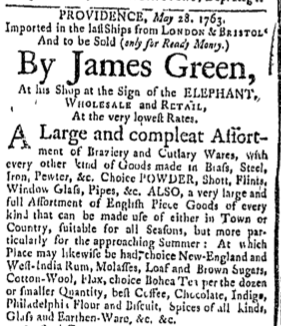
They took their trade to James Green and merchants like him who offered “Piece Goods of every kind … suitable for all Seasons, but more particularly for the approaching Summer.” (Boston Post Boy, August 8, 1763.)
And what would be suitable? Cottons, fine linens, light silks, in light colors.
Barbara Johnson chose floral prints on white backgrounds in July and August of 1764, both could be “suitable for summer.”
And as you probably know, the answer to “Aren’t you hot?” depends on who you are, but is often, “Not really. Once my shift/shirt is soaked with sweat, I’m pretty comfortable.” This is true as long as your shift/shirt is made of linen; cotton and cotton/linen blends don’t wick as well as linen.
In short: we enjoyed it, and yet we didn’t. Battle Road is the kind of event where those of us who come from Rhode Island and are on the fringes of the organization are not fully integrated into the event. Mr S fielded in the morning, but the Young Mr could not, again, though he had been told at inspection that something would be found for him to do. He recovered pretty well, but there is a lot of waiting.
So lovely!
I was very grateful to have friends, new members of the Regiment, to chat with while we waited and watched the action. When you can’t participate, it’s fun to pick out your friends in the columns marching past. Sorry, no photos: authenticity standards.
Afterwards, we had lunch, and saw more friends. That gown is a copy of one in the Newport Historical Society. It has robings and front lacing–what an amazing artifact! I would love to get my fingers on the original’s front to find out how many layers there are.
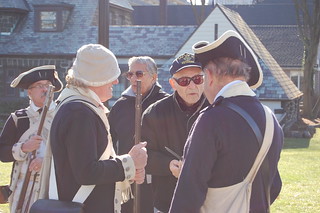
At this point, though, my claustrophobia began to kick in. In the photo of my friend and her daughter you can see tourists taking photos of the Young Mr (by his buttons you shall know him) and Brian Jean of the 2nd Helpings.
The line to see Hartwell Tavern snaked through the yard, and the road was getting full of people, and dogs, and bicycles. We fled.
This is often my view if I want space to breathe. Good thing I’m tall.
We slipped up to the MMNHP Visitors Center (flush toilets!) and watched the presentation on April 19, 1775. When we walked out of the theatre, the ranger said, “Welcome to chaos.” The Center was packed full of people, all talking, many pushing: we found a way through the crowd and snuck up to the National Heritage Museum (more flush toilets and a Coke machine!), which had a nice map exhibit. I had some ideas at the time about mixing maps and objects in a thematic exhibition, and vaguely, they remain.
I’m usually tracking the animal the arrow is pointing to: The Kid.
Here’s where the not-so-great part started for me. At Tower Park, I got left alone on the public side of the rope line. (We rode up with Brian, so my ‘getting around and doing things’ options were pretty limited.) To be a living exhibition with one other person is good; to be a living exhibition with a normally-dressed companion is bearable; to be alone is annoying.
Hands to yourselves, people, please. Also, those are my friends and family out there on the field, and I would like to see them, too.
I had a moment at Tower Park where I thought, Really, the hell with the public. This kind of reenacting is not for me; I’ll stick to something more personal, something for reenactors/living historians alone. But what I think I really wanted was a friend or a larger zone of personal space–you’d think petticoats and a cloak would help, but they don’t–a way for people to understand No Touching. Also, I like to be able to keep My Kid in view to manage my anxiety levels. Superstitious Mother Tricks…
The Brown Gown, which I do actually like, 12 hours on
I was a lot crankier about it last night, which was probably the result of being rather tired (getting up at 5 to lace yourself into a new gown after a week of insomniac-style sleep and intense work is not how most folks start “vacation”), hungry, and cold (it settled inside my stays mid-morning and I will feel it for a while to come).
Will I do it all again? Yes. Will I try to make better afternoon plans? Yes…though I’m not sure yet what they will be.
As someone who just finished mending a petticoat, you’d think I’d leap at the chance to drench my hem in water to prevent future mending episodes, but not so. For one thing, in the house or in the camp, that’s water I had to haul or cause to have hauled, and I’m not wasting it. Wet the hems and what’s next? Caked lumps of ash, mud, and.or other filth. No thanks.
High-tech historical cooking
The burns I got in my dress were acquired at the end of the day when we were hearth cooking and were practically in the fireplace ourselves. That is where you must be if you wish to stir the sauce until it thickens, and there was the hoisting of roast in its pan a couple of times, and general playing with fire in pursuit of food. My ca. 1799 dress is longer than my 1770s petticoats and gowns, and the extra inch or two probably contributed to the burns. But I wasn’t engulfed by flames, because the damn thing is wool. Self-extinguishing wool, worn with linen and wool petticoats and a linen apron. not going to go up in flames. Also not going to get dipped in water–and wouldn’t that result in steam and hence scalded shins?
I don’t know where these rumours start, but they could have started with a cynical curator joking with house tour guides who failed to get the joke. Not that I know anything about a story of about Providence kitten named Georgie in honor of George Washington’s visit to a large brick house on a hill .
Surreal: that was the word for the morning at Monument Park. The RI Reg’t walked over the park instead of parading with the troops, because one of our members has not been well, and did not think he could keep up with the parade. It was odd to follow the reenactors in 18th century clothing under power lines and past high rise apartment buildings shouldering out old frame homes, but the surrealism really kicked in at the park.
Describing sniper fire in WWII to salsa music
There it became multi-sensory when the ceremony’s organizers turned on the music. It wasn’t exactly merengue, and it wasn’t exactly salsa…then the soundtrack switched to updated Big Band hits and finally landed on a strange, over-the-top, quasi-operatic version of “Battle Hymn of the Republic.”
So when you look at the photos on flickr, play some salsa or an album you might have ordered at 2 AM from a TV ad, and think about standing in 40F/4C weather eavesdropping on politicians talking about inching closer to universal health, and the lessons of Hurricane Sandy for high-rise dwellers, while squeezing up next to you for a photo op.
Later, at Fort Lee Historic Park, the artillery demonstration was loud and satisfying, but we got behind schedule and to the oddness of the morning was added rushing. It was capped off at the end by the order to fix bayonets, which led to bayonets being caught in branches.
Bayonets fixed, Capt. Becker takes measure of the trees
Finally, for me, the day nearly foundered when I pulled my phone out of pocket at the end of the event to check the time, and saw my boss had been texting me all afternoon over a non-crisis. Part of why I love re-enacting and living history so much is that it takes me so far away from myself and from my daily existence. It’s related (slightly) to my work, but to be so far away in place and time and effort is a delight. I can’t just throw the phone away or not take it along: I am supposed to be on call, all the time…but it’s history, not a hospital, and if budgets change, so should expectations.




 Kirsten Hammerstrom
You must be logged in to post a comment.