
 except when they do.
I try hard not to be acquisitive, though our home is perhaps more crowded than it might be if I were better at the task or cleaned at work less and at home more. Around the time of What Cheer Day, I became rather obsessed with teapots.
At the local antique mall, I found an attractive Chinese export porcelain cylinder or barrel-form teapot with crossed strap handles, suitable in design and shape for use in 1800 Providence. I made a special mid-week trip fully intending to buy the teapot and free poor Mr S from ever hearing “teapot” again in endless conversation. When the item was out of the case, though, it turned out to have a mended crack right across the bottom, and as I told the woman, “It matters because I intend to use this.”
 In the end, I did not have my fabulous teapot for What Cheer Day. In fact, my fabulous teapot arrived just this past Thursday, after patient stalking on eBay. It arrived with a bonus of five cups and a saucer, most with mends, but the pot itself has just a handle flaw or mend (typical, and seen, along with wear, in some museum pieces, too). The quantity of cups suggests that the previous owner had a relationship with them not unlike the one you might develop with a large litter of kittens you were fostering…adopt one, get another! Just to get them out from underfoot.
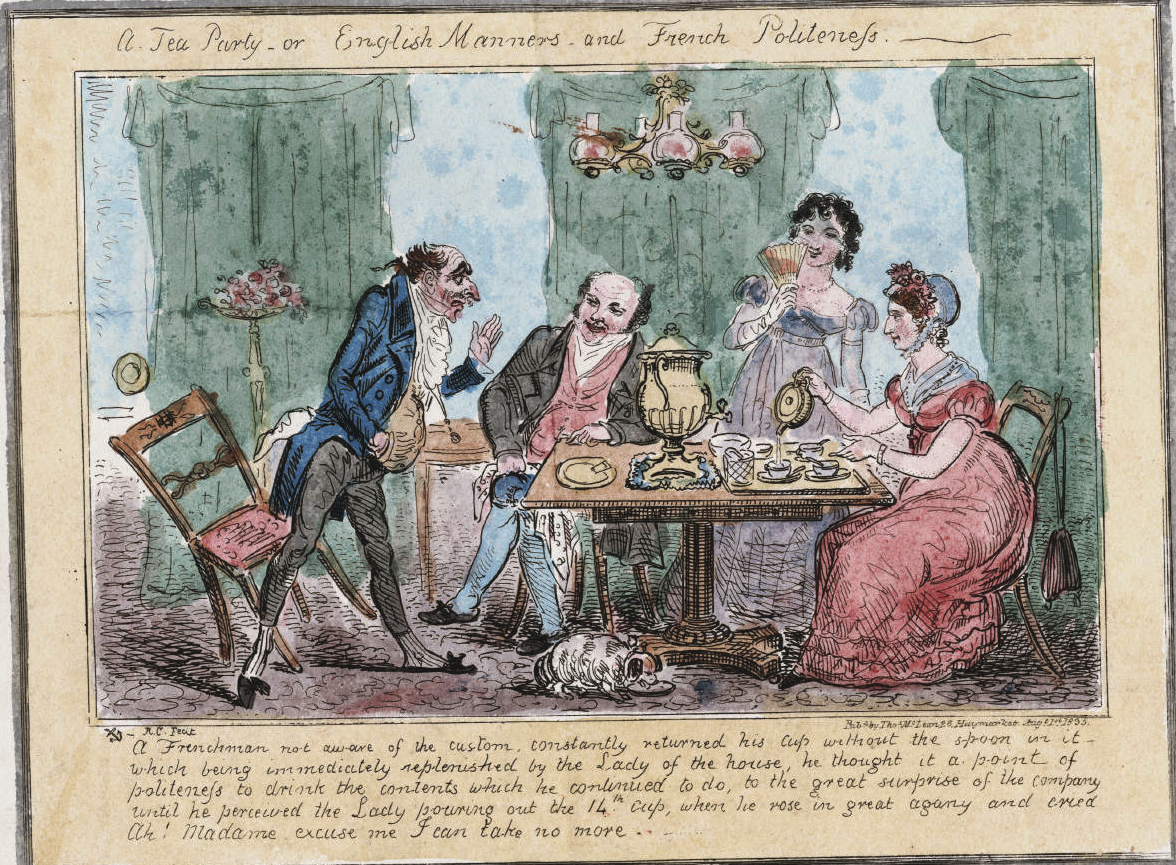
 The cups and pot reminded me of the difficult meals and teas Elizabeth Bennett takes with Maria Lucas and Lady Catherine whilst visiting Mr Collins and his new bride Charlotte Lucas. There’s a tension in these cups, some combination of the dainty and the strong, some slightly misshapen (not all makers were equally skilled) that calls to mind the polite verbal combat of tea parties.
I washed the cups, and was reminded of the duties of maids to clean and care for these delicate items, the kind of thing they were unlikely ever to acquire, though there were grades of china then as now: what sat on John Brown’s table was not what sat on the Dexter’s table, or at least not in the same quantity.
 The quantities of china coming into Providence and the rest of the Eastern seaboard after 1788 were enormous: in 1797, dinner sets of 172 pieces could be ordered at Canton for $22, and included 6 dozen large flat plates, 2 dozen large soup plates, 2 dozen small dessert plates, 8 pudding dishes, 2 large tureens, dishes and tops, 2 smaller ditto, 16 dishes of various sizes, 6 sauce boats and stands, and 4 salt cellars. Tea and coffee sets of 81 pieces were bought in Canton for $6 to $9! Just for dinner and tea, you could have 253 pieces of china, and we haven’t even begun to get into custard cups, cache pots, and garnitures!
 The indifferent pieces I have acquired may have started out as kaolin, feldspar and quartz in Ching-te-Chen, 200 miles west-southwest of Shanghai. There were important porcelain manufactories there, and porcelain wares traveled by road and boat to Canton, where sets were customized to meet specific orders and then loaded onto ships bound back to America, six months or so after the order was placed in Providence, Salem, or Boston. It’s a lot of work for a fashionable sip of Hyson or oolong, and no wonder cups and pots were mended, saved, and reused.


 Kirsten Hammerstrom
You must be logged in to post a comment.