Mind the Gap, or, The Basket Case

I was in the midst of planning yet another maid’s dress (some of us have all the luck) when a friend alerted me to an online discussion that drew from my recent post on baskets. The comments — which I skimmed but twice– made me think about philosophy and intent.

Engraved by John Raphael Smith, 1752–1812, British, A Lady and Her Children Relieving a Cottager, 1784, Mezzotint and line engraving on medium, slightly textured, cream laid paper, Yale Center for British Art, Paul Mellon Collection

There are two approaches to developing a living history persona and appearance I’ll consider here: one prescriptive, and one not. The prescriptive, didactic approach tells you what to wear and carry. Some folks like that. It is completely correct in some cases: soldiers, for example. You want to fall in with a unit of Light Infantry in 1777, it’s generally more convincing if you don’t wear the 1781 coat. Not everyone cares: some people will keep on wearing the Brighty Whitey Hunting Frocks and 1780 coats at reenactments commemorating events of 1776. Those folks can no longer be reached by prescriptive standards, and my preferred approach probably won’t reach them either.

Joshua Cristall, 1768–1847, British, Young Woodcutter, 1818, Watercolor with scraping over graphite on moderately thick, slightly textured, beige wove paper, laid on thick, slightly textured, beige card, Yale Center for British Art, Paul Mellon Collection

Mindful reenacting or living history sounds pretty nutty, but that’s what I would encourage. Thoughtfulness. Consideration. Not just the what, but the why. Why you wear or carry something can be as important and interesting as what you’re wearing and you’ll be all the more convincing for thinking it through. Thinking, not rationalizing. How appropriate is it to be in your best clothes carrying a basket also used to carry fire wood? You have to answer that for yourself, and if you’re doing it right, the answer will not always be the same– nor will the question!

Print made by James Bretherton, ca. 1730–1806, British, A Maid, 1774, Etching on moderately thick, rough, blued white laid paper, Yale Center for British Art, Paul Mellon Collection

This isn’t the easiest way to go about anything, asking all these questions, but for some of us, the experiences make it worthwhile. You won’t always be able to do, carry, or wear what you want.* But the picture you create of the past will be more accurate and more engaging if you think more and justify less.

Look, I threw down about that floppy bird basket, but I have to provide food to troops this Saturday in Cambridge. What the heck will I carry it in? What will I take my sewing in?**

Probably a wallet and a bag, unless I can pack that floppy basket convincingly– it is entirely suitable to my lower sorts-stained gown impression– but if I can’t, I won’t take it. And that’s just one less thing to carry.

*I’m pretty much always the maid to make scenarios work, and while it doesn’t come naturally, art imitates life.

**Prays no one gets the bright idea to bring (shhh) tents to work on.
Itching for Style

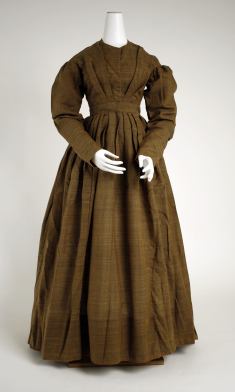
Dress Date: 1830s Culture: American Medium: wool Dimensions: Length at CB: 53 1/2 in. (135.9 cm) Credit Line: Gift of John Eastman and Gerard L. Eastman, 1976 Accession Number: 1976.209.2
Dress, 1830s. American, wool.
Gift of John Eastman and Gerard L. Eastman, 1976.209.2 Metropolitan Museum of Art

Wool. It’s a thing. This dress from the Met has many of the markers of everyday fashion– a vernacular form, if you will, of what Deliverance Mapes Waldo is wearing in this portrait

Deliverance Mapes Waldo and Her Son about 1830 Samuel Lovett Waldo (American, 1783–1861 American) DIMENSIONS 77.15 x 64.45 cm (30 3/8 x 25 3/8 in.) ACCESSION NUMBER 45.891 MFA Boston
Deliverance Mapes Waldo and Her Son, about 1830
Samuel Lovett Waldo. 45.891 MFA Boston

Of course, dating these things is never a science when they don’t come with a clearly labeled tag you can affirm with research. The extant garment first. The sleeves say 1820s, the waistline says 1830s. Could it be 1840s? Perhaps. Without provenance, it’s really hard to know.

Mrs Waldo’s sleeves are clearly 1830s sleeves: full on gigot, sloped shoulder. It’s the contrast between her sleeves and the Met’s dress that makes me question their date (along with the fashion plates we saw yesterday).

Here’s a wool gown from England, land of the fabulous wools.

Dress, England, Great Britain.  1836-1838. Printed wool, trimmed with printed wool, lined with cotton, hand-sewn Given by Mrs H. M. Shepherd, T.11-1935. Victoria & Albert Museum.
Dress, England, Great Britain. 1836-1838.
Printed wool, trimmed with printed wool, lined with cotton, hand-sewn
Given by Mrs H. M. Shepherd, T.11-1935. Victoria & Albert Museum.

Here the sleeves are starting to be narrowed at the shoulder, taming the gigot. That places this 1836 or later, which is helpful. The bodice style is still not the pleated or smocked front of the 1840s, so that’s another marker for mid-to-late 1830s.

What will I do? I don’t know. I’ve ordered two patterns (and one for a new chemise, sigh). The Past Patterns Lowell Mill Girl dress appears to make up quite nicely, but I also ordered the Wisconsin Historical Society pattern for comparison. (Hey, when you can’t examine originals, you have to use the patterns.) Fabric is always a question, but if I’m feeling plain wool, there’s always Burnley & Trowbridge’s “Virginia Cloth.” I’ve worked with it before, so I know how it handles, and while the color looks itchy, it’s actually pretty soft.

Gigot or Gigantic?

Carriage and Morning Dress, 1832. LAPL Fashion Plate Collection

So, about that 1833 thing…

No, it’s not that I’m reconsidering. It is merely that as I consider the options, the fashion plates are a bit overwhelming. On the other hand, I am getting really good at recognizing the look of the 1830s in undated portraits. There’s an upside to everything.

Extant garments are fairly plentiful in the Usual Suspects’ Collections; there’s even a Tumblr. There’s a Tumblr for everything.

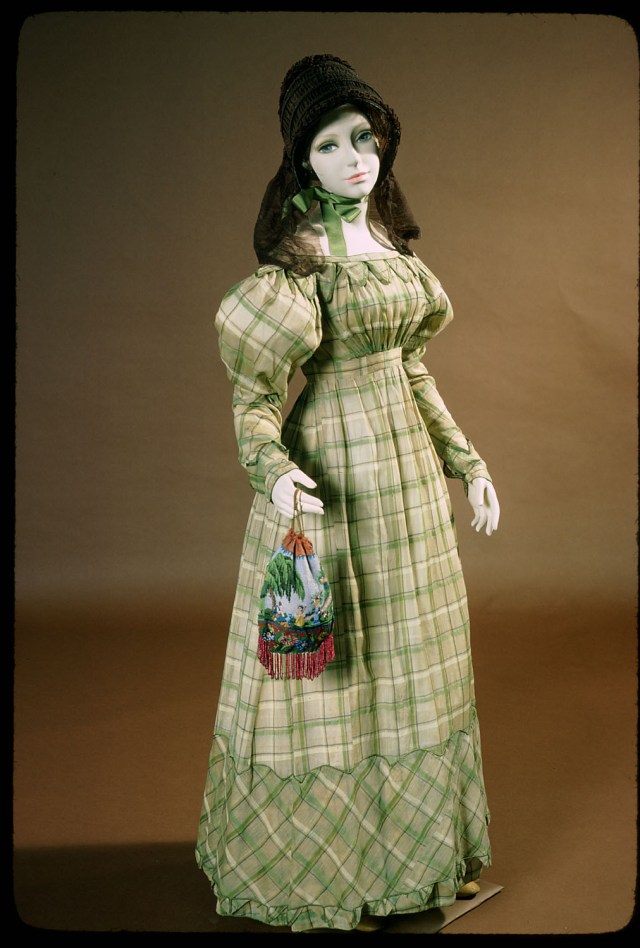
Woman's Green, Tan, Yellow and Blue Striped/Plaid Gown. OSV, 26.33.63
Woman’s Green, Tan, Yellow and Blue Striped/Plaid Gown. OSV, 26.33.63

Fortunately, there are some tamer garments out there, with sleeves less likely to result in flight in a high wind. Bonus: not floral, and not silk. Printed wool seems to have been fairly common, but the weight is just impossible to find. I did some looking in New York, but nothing convinced me with print or price.

This is a milita muster, so there will be time outside. I’m toying with a habit or Amazone (hard to resist a garment with that name) though the most I know about horses is that they have four legs. It’s tailoring that attracts me, not use. Also, wool. Mid-September might warrant wool, even if that’s hard to imagine today. (The downside, of course, is that there’s menswear to be made, too, so a simple dress is surely the best option.)

Frivolous Friday: Foot Guard Officer

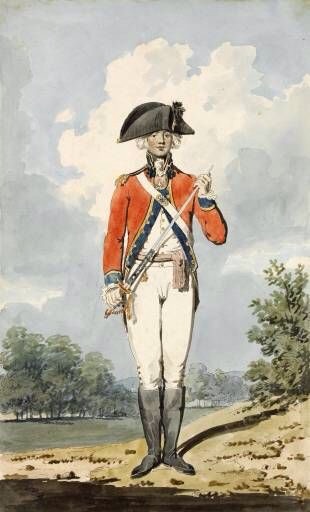
Officer of the Third Regiment of Foot Guards, 1792 British Museum 1890, 0806.2

Every now and then, my interests collide in unexpected ways. While searching the Tate Collection for something completely different, I came upon this image of a fine-figured officer. I love a man in a uniform, and this one comes with a bonus: the curator’s comments.  “According to Binyon the outline etchings are by Thomas Kirk, after a drawing by Edward Dayes, coloured by Turner as a boy.”

You can see Turner’s  style latent in those trees and in the dramatic sky, and even in the shadow that lies at the officer’s feet. 

18th century coloring book, or image defaced by inchoate genius: you be the judge.