Fashionable Furniture, or, The Glories of the Past

include window drapes.

Ackermans's Repository of Arts., etc. April, 1817.
Ackermans’s Repository of Arts., etc. April, 1817.

Every now and then, someone argues with me that the historic house where I work would not have had window curtains or drapes. Sometimes they like to expand that argument to “there were no curtains at all” in early Federal America. The reasoning is usually that textiles were too expensive to “waste” on window dressing. If you know me, you know this kind of argument is a Bad Idea. The public fight (I was angrily accosted by a now-former docent during a public presentation) is known as The Great Curtain Kerfuffle, and resulted in my reply that the owner of the house could very well afford anything he pleased. Fabric is Money.*

There’s another iteration of my argument: Color is Money.

Ackermans's Repository of Arts., etc. April, 1817. page 244
Ackermans’s Repository of Arts., etc. April, 1817. page 244

Those of us who shop at IKEA are not going to have “the most fashionable style of decoration” in our 1817 homes. The Willings and Binghams of Philadelphia were models for the  most fashionable families of Providence, and while well before this 1817 plate, the Binghams were recorded draping their chairs with orange and red silks. In early 19th century Providence, the John Innis Clark family had silk covers on their sofas and chairs in 1808, and plenty of carpets and curtains in their Benefit Street home from the 1790s on. 

“Crimson is very rich, but blue is handsomer,” wrote Eliza Ward to her sister, Mrs John Innis Clark, in the 1790s. Curtains and covers were fringed (Mrs Hazard Gibbes was blue and yellow). Windows were dressed, and younger, less affluent relatives received hand-me-down curtains. In 1803, Elizabeth Watters in Wilmington, North Carolina was having a carpet “wove in true Scotch taste in imitation of Highland plaid.”

John Phillips (1719-1795) Oil on canvas by Joseph Steward,1794-1796. Sack Gallery, Hood Museum of Art, Dartmouth College.

Some carpets, no? Maybe the new mantra is Carpets are Money.

But quite aside from an obvious display of wealth, what we have to realize about these images and letters is that they are depicting a world that looks very different from our own. Color sensibilities, tolerance for pattern mixing, non-matchy-matchy sewing and dressing. We have to abandon our 21st century aesthetic sensibilities when we dress ourselves or our spaces for the past, and really embrace the vivacity of that world. Sensory overload, perhaps, but getting closer to what the world of the past looked like will help us see– in every sense– the way the people of the past did.

*I may or may not have made additional statements afterwards to the effect that of course wealthy Americans squatted naked in the corners of their well-appointed mansions gnawing raw meat until Benjamin Franklin invented fire and fabric. I should be sorry about that, but I don’t seem to be.
Sometimes a Great Notion

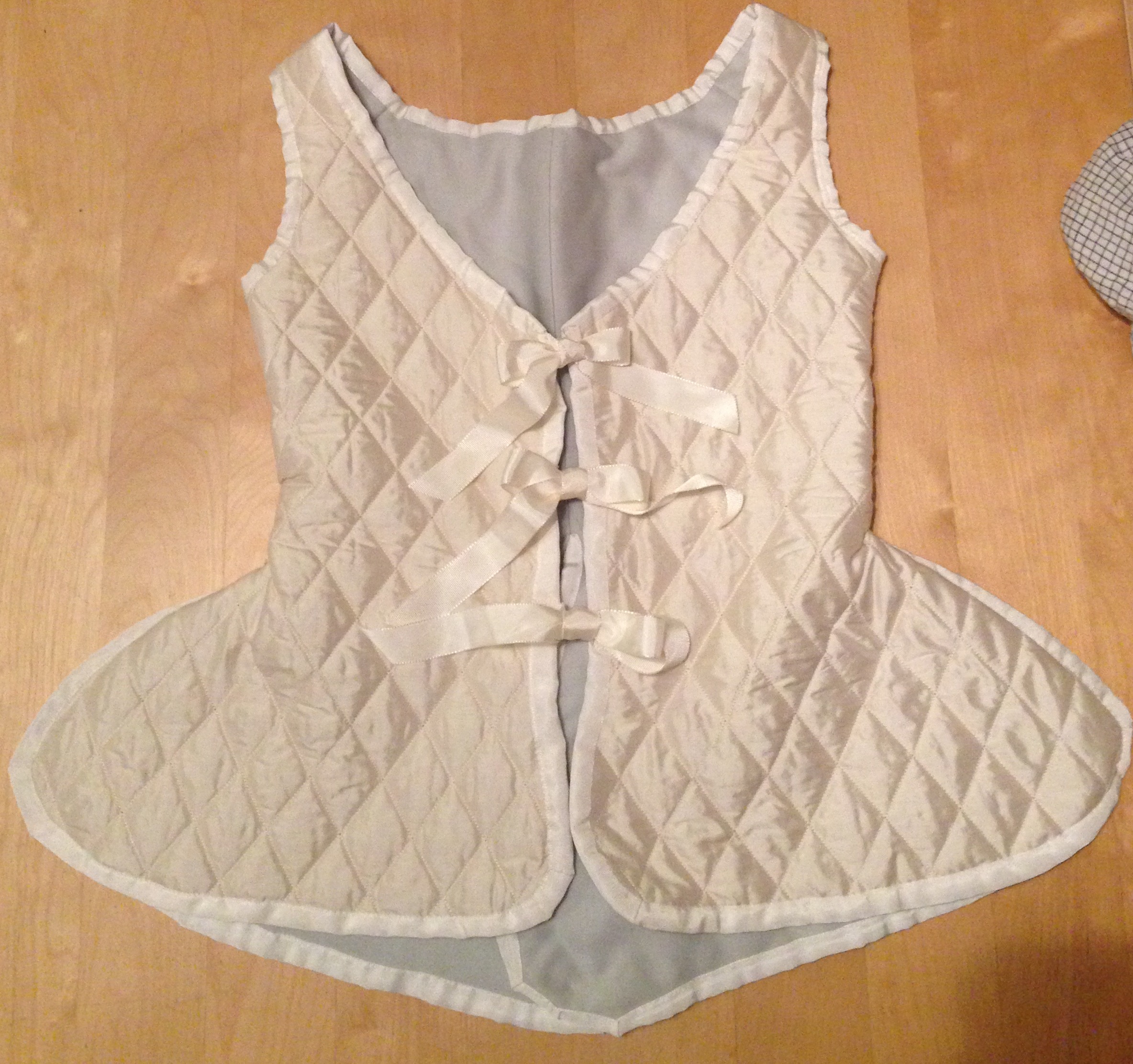
Finished! Cozy, too.

(Think Lead Belly, not Ken Kesey.)

No, I did not take a notion to jump in the river, but I did take a notion to sew slightly more than the quilted waistcoat.

I couldn't resist.
I couldn’t resist.

I got this unshakable great notion, you see, about some wool from the remnant table in Framingham. It was a lovely olive color, and paired up with some plain weave I already had, it reminded me strongly of World War II-era Army uniforms from the ETO, which I had been packing recently in Rhode Island’s alpine north. And yes, if I find a pinker tan for a petticoat, I will procure it.

Since I already have an olive wool petticoat that will also work for this notion, I started on the gown last week, cutting it out on Wednesday night so the table would be clear for Thanksgiving dinner.

The wool was a little slippery to pleat, and the twill slightly dazzling with its sheen. Let’s pretend it’s shalloon, shall we?

A week into the project (after a brief annoying detour attempting to correct my mitt pattern), I have only half the hem and the bottom of the robings to finish. Not too shabby, thanks to a holiday weekend and hours of The Pacific, Band of Brothers, and The Purple Plain. Homage to the color, I suppose.

I'm never not smirking, so thanks for not smacking me.
I’m never not smirking, so thanks for not smacking me.

It fits– which always seems like a miracle, even with a tested pattern– and better yet, it fits over that plush waistcoat.

The rustle of the silk and the swish of the wool are unlike anything I’ve ever worn. I think I shall feel quite fancy– let us hope I shall also feel quite warm.

Cold Comfort Compromises

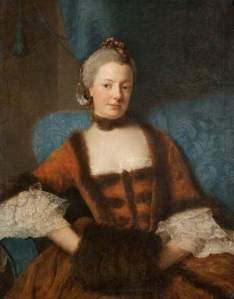
"Henrietta Diana, Dowager Countess of Stafford", Allan Ramsay, 1759; Glasgow Museums 3026 (c) Glasgow Museums; Supplied by The Public Catalogue Foundation
Henrietta Diana, Dowager Countess of Stafford, Allan Ramsay, 1759(c) Glasgow Museums. Fur: cozy, but not for me. Also too early.

Winter is bearing down upon us, and while I was not in Connecticut last weekend, nor will I be in New Jersey two weekends hence, I do have winter history plans, barring the proverbial 50 feet of snow, which even a Subaru cannot handle. The Noble Train: I could not resist, for, as regular readers know, I prefer my history to hurt.

Still, I try to avoid cold-related illness and extreme discomfort, so I’m making sensible preparations. Of course, I have not finished my quilted petticoat, and lack the time to make a proper hand-quilted silk under-waistcoat. Reader, I have done a terrible thing: I have compromised.

The saddest part of all of this is that the waistcoat I’m making is the most feminine and luxurious item, and the only item even close to lingerie (aside from shifts) that I have ever made myself, or even own, no matter its inaccuracies. There is a kind of irony built into this project, hence a post while the irony is hot.

Waistcoat. Silk quilted and bound with silk grosgrain ribbon. ca. 1745. V&A Museum, T.87-1978

The waistcoat: an item of occasional debate, these are not the most common beast in museum collections. Fortunately, Sharon Burnston has a handy article and pattern posted on her website. To be clear, I am not recreating the Atwater-Kent waistcoat. I am cobbling together my own inappropriate but satisfying item. I am also using the absolutely inexcusable excuse that no one will see this garment, as well as previous bouts of pleurisy after long, cold events in stays when I had the merest hint of a cold. (My boss kindly offered to cup me for a cure when I had to take time off work, but I declined. The look on her face suggested a lack of appreciation for my historic ailment.)

But here we are, “confessions of a known bonnet-wearer” and all that, so onward to the project. I started with Sharon Burnston’s scaled diagram of the Atwater-Kent woman’s waistcoat. The shapes are very similar to a basic woman’s jacket of the period, bonus: loose fitting, no sleeves. It was easy enough to pattern up in an afternoon, with limited fitting (I did test it over stays, just in case.)

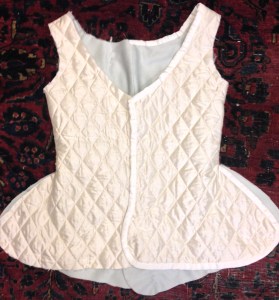
overview

The compromises I made are in the materials: pre-quilted silk (with a cotton backing), lined with wool-cashmere, and bound in silk grosgrain ribbon. The size of the diamonds and the machine quilting, plus the wool lining, make this an inauthentic, inaccurate garment. The shape, construction, and binding are at least correct, as far as they go. But the lusciousness of that remnant table cashmere and the soft colors please me immensely, and I do expect to be warm.

corner

This has been a quick project, with the majority of time spent on the binding. As in the Atwater-Kent waistcoat, I’m top stitching with a running stitch on the inside, folding the ribbon over, and hem stitching on the outside.

Will this feel like a hair shirt of shame under my gown, compromise as it is? Maybe, but at least it’s cashmere.

Frivolous Friday: Festive but Frigid

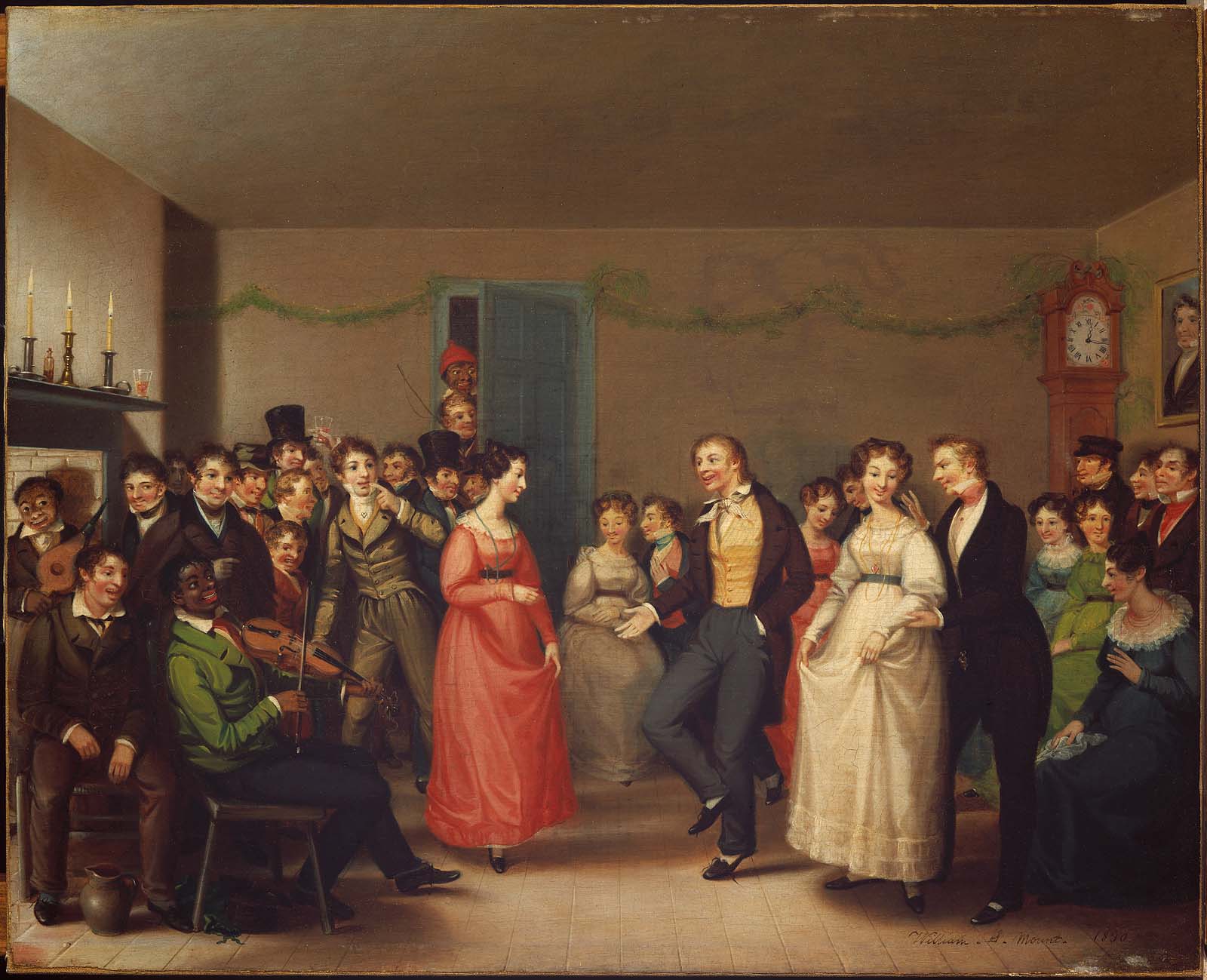
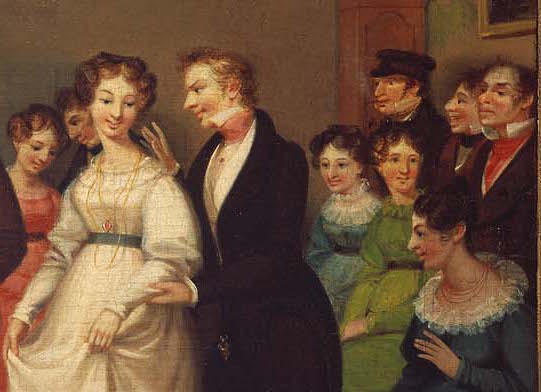
Rustic Dance After a Sleigh Ride, 1830. William Sidney Mount MFA Boston 48.458
Rustic Dance After a Sleigh Ride, 1830.
William Sidney Mount MFA Boston 48.458

I don’t know about your weather, but we’re in full summer in New England, sultry and humid, with the occasional thunderstorm and power outage to enliven the evening. A sleigh ride sounds like fun today– and I know we all just finished complaining about the snow of February– but a brisk ride followed by a dance would certainly round out this week.

1833 approaches faster than expected, so it’s time to pick that back up and get serious. Not just a gown but petticoats and, ideally, a new shift should be made. This may be the project that breaks my resolve and finds the Bernina back on my table for cording a petticoat.

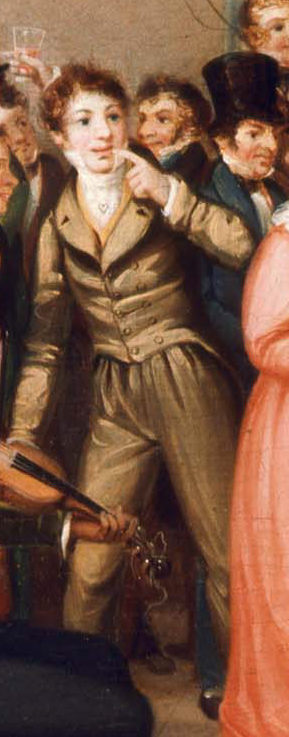
Detail, Rustic Dance After a Sleigh Ride, 1830. William Sidney Mount. MFA Boston 48.458

This image helps define the look of the early 1830s: not nearly as exaggerated as the fashion plates, these dresses and coats seem to fall into a progression from the 1820s– as you’d expect this early in the decade.

The gentleman at the back, in the drab colored suit, sports an interesting pair of trousers. I don’t think I know anyone ready to bust out the cossacks, but Mr Drab may be sporting a slightly modified pair. The collars and lapels show a shawl-shape that seems new, and modified from the more serpentine form seen in fashion plates– or else not yet as developed. There’s a range of headwear, too: tall hats on the left, a soft cap on the right. The Ladies’ Workbook has a pattern for one of those caps. Wonder how hard they are to make?

Detail, Rustic Dance After a Sleigh Ride, 1830. William Sidney Mount. MFA Boston, 48.458

In the detail, we can also see the women’s hairstyles, less exaggerated than the fashion plates with their high top knots, and within the realm of possibility for those of us not practiced in historical hairstyle recreation.

So much has carried into this decade: colored neck wear, ruffles or chemisettes under women’s gowns, men’s hair brushed forward. As always, it’s the details that count. Tall shirt collars, rounded lapels, ladies’ sashes, the shape of sleeves. This should be a fun decade to represent.