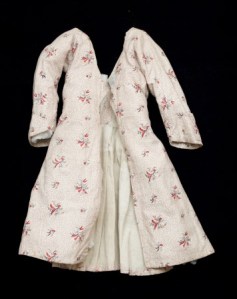
What’s behind that green suit?

The American School, by Matthew Pratt, 1765. MMA 97.29.3

Mr S. has a green linen suit in the making; that is, he has breeches which mostly fit, and a frock coat in need of serious alteration. Since I will need to alter this coat eventually (that is, take it apart, re-cut and re-assemble it) I have started looking for images of green suits.

Portrait of a Boy, probably of the Crossfield family. William Williams, MMA 65.34
Portrait of a Boy, probably of the Crossfield family. William Williams, 1770-75, MMA 65.34

The green linen the suit was made from is no longer available, so there will be no matching waistcoat. If I can get the thing tweaked to an approximation of ca. 1763, we should be set for the August event (if that happens) and for Battle Road next year, though I know he might want wool. The taunts of “bet you wish you had the rest of that coat” from this year linger in my mind, at least.

The jacket is, admittedly, too short. I begin to wonder if I need to cut it down even more, like a workman’s short coat; the Massachusetts line “Bounty Coats” are cut shorter, and similar to a coat at the Connecticut Historical Society (1981.110.0, search by number here, the links are not stable).
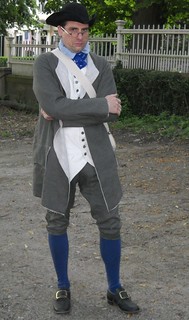
Mr S last June, in the unfinished 36-hour-frock coat

The problem with that plan, at least for 1763, is that the cuffs are clearly larger and coats longer, in 1763, than they are in 1775, at least for gentleman. I realize that this means I am better off starting over completely for the 1763 coat from a muslin up (which against all instinct and principles, I did not do for the 36-hour-frock coat). So I’m waffling here, as Mr S doesn’t always want to portray the day laborer/tenant farmer, but would like some pretensions to artisan and property owner. That means more fabric, and that means starting over completely is in order–breeches, waistcoat, frock coat and all. But wait, there’s more!

The events in the queue before the August 10th event for 1763 include Monmouth on June 15-16 (for which overalls and hunting frock are in production), Washington’s Arrival in Cambridge on July 14, which requires militia clothing, and Old Sturbridge Village the first weekend in August, for which a regimental coat is requested. Somewhere along the line, I’d like to make myself something…but it looks more and more like a summer of menswear. Perhaps cutting down that green coat and altering the breeches for July 14 is the most sensible plan…though where that will leave 1763, or the regimental coat, I do not know.

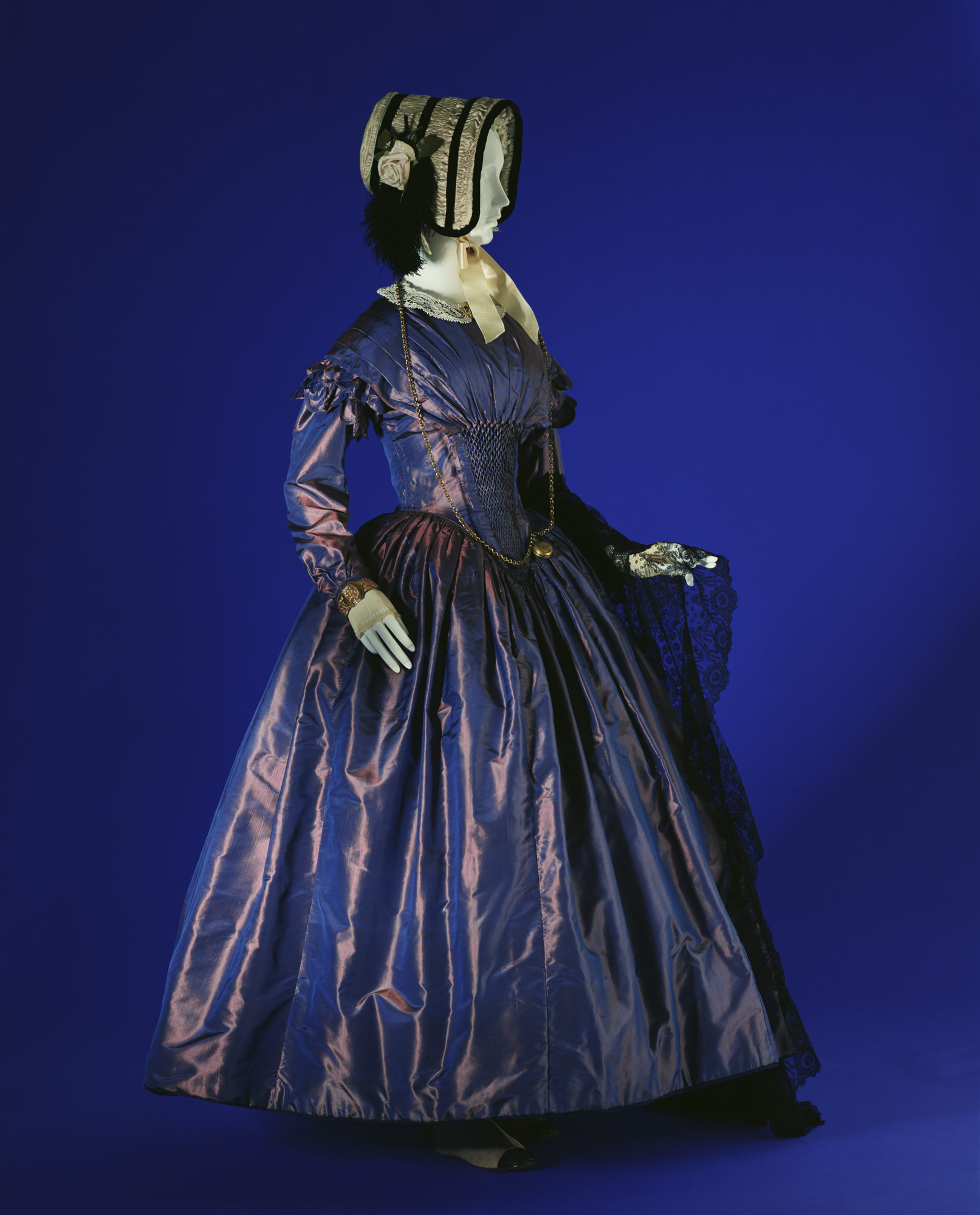
Sweet Little Dresses

Bellville Sassoon rang no bells for me, being American. So I did the google and ended up at the V&A, of course. They have a Bellville Sassoon evening gown, which is a lovely column of froth and beads, but not my taste.

V&A T.17-2007
V&A T.17-2007

This led me to gifts from David Sassoon,including this miniature dress, a quarter-scale couture reproduction of a Jean Dessès dress.

Whoa. That’s really interesting!

There’s a Madame Grès as well, and the V&A catalog record notes:

“These scaled copies use the same fabrics and show the superb craftsmanship as their full size equivalents. The V & A have four of these miniature dresses which the donor acquired from the archive of the wholesale house of Dorville. Wholesalers would buy the copyrights to couture dresses so that they could sell modified ready-to-wear copies. It is thought that these quarter-scale dresses were sold alongside the patterns to show how the dress looked when made up.” Ever see the Newman-Woodwar movie A New Kind of Love?

What I love about the the Dessès dress is how much it reminds me of these dresses:

KCI 1845 English Day Dress
V&A ca. 1895 T.17-1985

That’s one of the fun things about fashion, and about history. Details emerge and re-emerge in style and design (yes, historicism) and connect our present with the past. Museums strive to do that every day, but fashion can do it on the street and in your closet. That’s another kind of living history.

Dutch Treat

I started thinking about calico jackets, short gowns, and bed gowns because OSV is around the corner, and it will be hot. At Dighton, I took off my jacket and worked in my stays because it was cooler, and at OSV I may wish to do the same thing cooking or washing. And what better thing to make than a jacket or short- or bed gown which takes little fabric and not much time.

For short gown/bed gown patterns, I’d been looking at Duran Textiles’ Newsletter, even though it is European. The general principles are the same, and I need to tweak my pattern as I don’t like the fit over the petticoat in the back.

And then I looked at images of women in bed gowns, and the paintings by Chardin, (above, 1738, right, 1747) show women in short garments over petticoats. Lovely. The rich solid of the brown with madder and the print are both attractive and practical, and I have a madder petticoat and pink striped petticoat. I could easily be a Chardin.

To get more grounded, North American Colony-based ideas, I looked through my Vogue for the Lower Sorts, Wenches Wives and Servant Girls, and found a woman running away in a Dutch calico jacket or short gown. She is a Dutch bound servant, but Catharine Mum takes off in New York with “a callicoe short gown, a green camblet gown, two striped camblet petticoats, a Dutch chintz jacket, one white and some ozenbrig aprons, a black bonnet…” and is described in an ad in the New York Gazette, 17 January 1774 (WWSG, p. 69). In Pennsylvania, a Dutch servant girl takes off in a Dutch jacket and a striped lincey petticoat (Pennsylvania Gazette, 30 March 1774, WWSG, p. 74).

Dutch chintz? Interesting–could the white ground bed gown/short gown be made of Dutch chintz? Browsing the Snowshill Collection, I found this:

Place of origin? Holland.

Is this Dutch chintz? Snowshill calls this a caraco, 1780-1800. Is it? It is a jacket? Is it a gown that is short? Is the blue Dutch jacket blue chintz, or is the style Dutch?

What are the links between the 1747 Chardin, the woman running away in 1774 New York wearing Dutch chintz, and the ca. 1780 Snowshill garment? Maybe there aren’t any, but it seems like there is a thread of some kind, though it may be a twisted and evolving thread.

None of this answers or solves my very local working fashion dilemma, except that I feel more confident that a short, skirted garment made of patterned cotton is a reasonable garment to make. I chose some kalam kari fabric and we shall see what I can make.

But first, a muslin.