Newport Friends

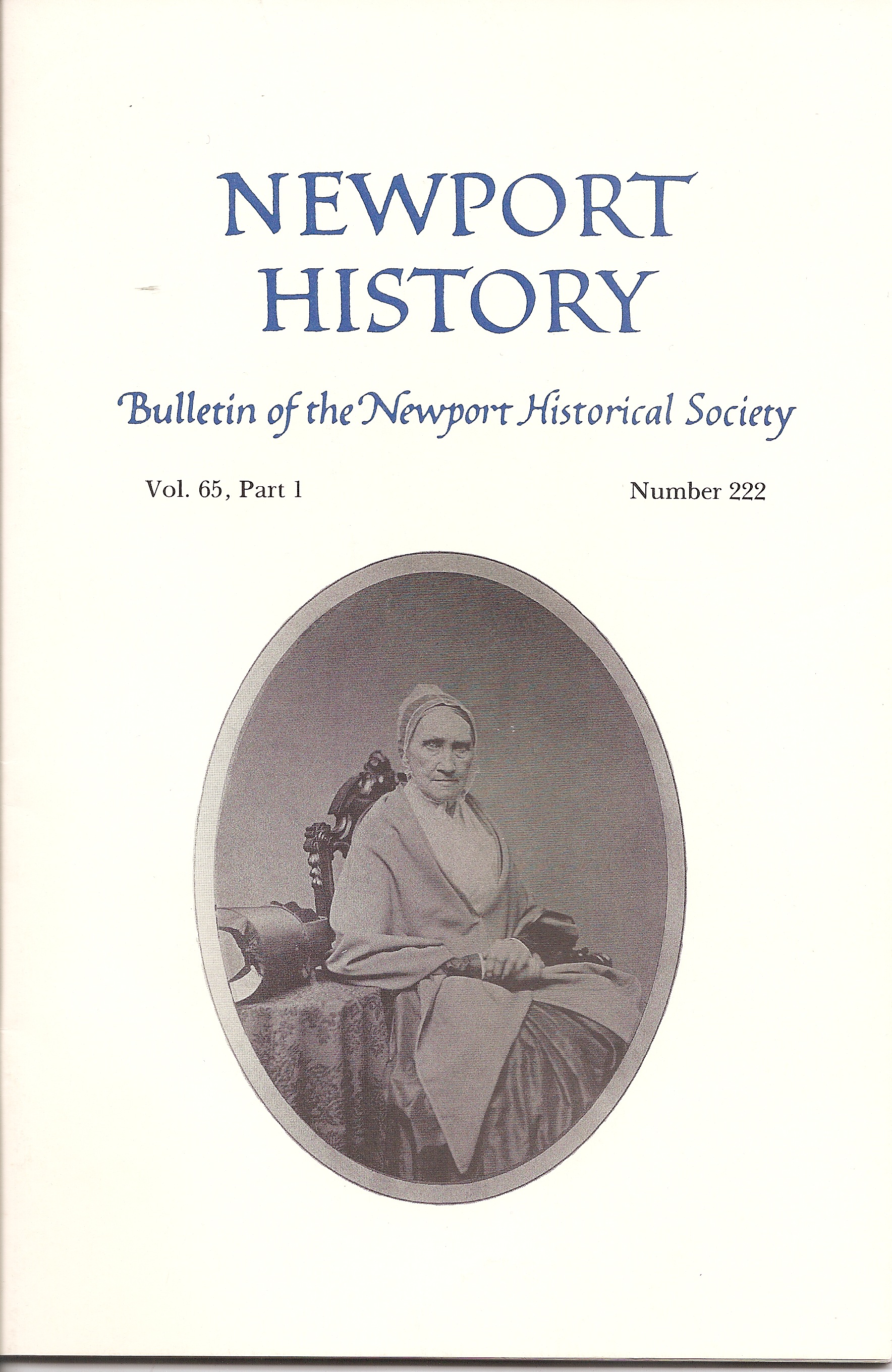
Newport History, V 65, Part 1. Number 222.

I had a bit of a surprise when details emerged about the program Sew 18th Century and I will be doing in early March at her workplace. I’ve known about this since late October, but only started focusing on this last weekend, when I realized just how close March really is, and how much time I’ll be spending on well-chlorinated pool decks in February. I’m so glad I asked, because it turns out that we’re reading letters from a family of Quakers. I was not expecting Quakers, and had what is probably a completely inappropriate fabric in mind! (Off-white meandering red floral vines, to mimic a V&A gown.)

Still, there is no surprise that cannot be managed by research. There is an article about the family in Newport History, and they were kind enough to send it to me, and it arrived yesterday. Yay, mail in a small state! The article is helpful in providing context and family history, and there is even a photo, probably from a daguerreotype, of one of the women in the family.

Ruth Williams silhouette, Newport Historical Society, 91.14.4

So, what did Quaker women in Newport wear between 1800 and 1820? Lappet caps, for one thing. Lappet caps appear to have been a common cap in late 18th and early 19th century Rhode Island, and Ruth’s silhouette seems to bear that out.

These caps are also seen in many images of Quaker women, and borne out by the images in the collection where I work (sadly not appearing the catalog record, but still stable in the blog post on caps).

I can’t read letters in just a cap and a shift (it’s not that kind of event), so I need a dress. Newport Historical Society has two possibly Quaker gowns from the early 19th century, and they seem like plausible models.  But they raise questions quite aside from what you might find out by digging into provenance. What’s up with collars?
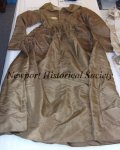
The form, a brown or drab front-closing, high-waisted (but not too high) gown, with long sleeves and a pieced, shaped back, is consistent with images of Quaker women from the first quarter of the 19th century. The color and material (brown silk) is consistent with those images, and with earlier im,ages of Philadelphia Quaker women, and that all matches up with a gown that was worn by Sarah Brown of Providence. But the collar is curious, and without putting the garment on a dress form, it’s hard to tell exactly where the collar would fall, and how it would lie.
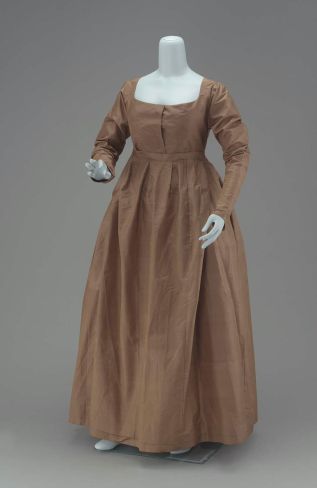
A Quaker's dress of greenish-brown taffeta American, Early 19th century. MFA Boston. 52.1769
A Quaker’s dress of greenish-brown taffeta
American, Early 19th century. MFA Boston. 52.1769

This gown at the MFA seems iconic to me, and I can imagine it underneath the white linen, cotton or silk kerchiefs and shawls of the portraits.

To learn more about Quaker aesthetics, I’ll be taking a trip down the hill to the RISD Library sometime this week, to look at books and articles. of particular interest is Quaker Aesthetics: Reflections on a Quaker Ethic in American Design and Consumption, 1720-1920. I’m also interested in an article by Deborah Kraak, Variations on ‘Plainness’: Quaker Dress in 18th Century Philadelphia. It’s not Newport, but at least it’s this continent.

I have read The Quaker: A Study in Costume, by Amelia Mott Gummere, and found it to be a pretty challenging work. It is possible that paint fumes made the writing seem more disjointed than it is, but I thought Gummere’s time-skipping references made it hard to follow the changes in Quaker dress in America, beyond what I do expect from a book published in 1901.

Book Notice: Wearable Prints, 1760-1860

This just in, literally, from the mail carrier: Susan W. Greene’s long-awaited book, Wearable Prints, 1760-1860. It’s discounted (and out of stock) at Amazon, but should be shipping soon, since I have one right here on my desk.

It’s fair to call this book lavishly illustrated (1600 full-color images in almost 600 pages), and while I have access to a copy at work, I am seriously thinking of buying my own copy, based solely on about 10 minutes skimming the book. There are images not just of fabric samples but also of garments, paper dolls and illustrations that help put the fabrics into context. Images of garments from collections I can’t get into? Delicious! Information to help me understand how to use a printed cotton? Even better.

The book is organized in three main sections: Overview, Colors, and Mechanics. Appendices include timelines, prohibitions, price comparisons, print characteristics, and more, as well as a glossary and an extensive bibliography.

The photographs are amazing, and show a range of print designs of greater variety than we may have credited heretofore. Particularly useful is the section on evaluating and identifying printed dress fabrics, and the questions one should ask about fabrics. I think that the criteria could be used forensically on modern as well as historic textiles, and we could think more critically about the fabrics we use.

ETA: I wrote this while the downstairs room was being painted with oil paint, and it’s loopier than I expected. The book is still an excellent resource, and I highly recommend it. While it’s heavy for carrying to the fabric shops, it would be dead useful while shopping online. I have definitely seen bolts of fabrics very similar to those illustrated in Greene’s book. As Anna notes on her blog, Ms Greene’s collection is now at Genessee Country Village.  Wow. It’s amazing. If you can’t get there easily, well, the book will certainly help, and the images will you visual access to a plethora of collections. 

Temporal Anxiety

First draft, heading towards a Pierrot jacket.

I like to have a selection of things to wake up and panic about at 4:00 AM, don’t you? If it isn’t sewing, it’s some weird noise I think the car is making, whether the post office has lost a package, or if that noise is not the cat but instead a pending disaster. My brain generously provides me with a Whitman’s Sampler of anxieties.

To start with, that ball. For one thing, Mr S will probably have to wear his Saratoga coat, which means anything nice that I have won’t match him, temporally. For another, anything nice I think I could make in time is French and not American. So I have temporal and geographic anxiety disorder about something that is supposed to be fun. But there is this jacket I think I could make (and want to make), so I started playing with the pattern in my “sketching in muslin” method.

I haven’t got a lot of the purple, but I might have enough.

I know this is not party wear. I know KCI says jackets like this were worn with white muslin petticoats. But I note that this woman in a Pierrot is not wearing a white muslin petticoat, and I carry on. My other option is my brown wool gown, and perhaps I will wear that.

Mr S still needs a frock coat, so that has to be patterned and fitted; his breeches are still being sewn. He’ll need a wool coat no matter what, but whether it will be done by February is up for grabs.

The last two parts of my current crazy are a program in Newport on early March, with an early date of 1813, and programs in late March in Providence, which I have yet to develop. At least in Newport I don’t have to create the program, just dress and deliver.

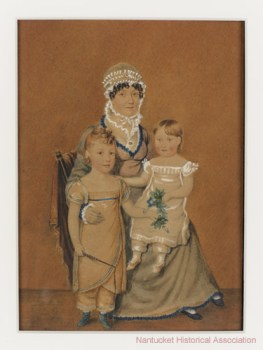
Portrait of Sarah Comstock Coffin and Children, ca. 1815. Nantucket Historical Association, 1917.0034.001

1813 is a fun place to start, and I have been looking at images for inspiration.

At right, Mrs Coffin  is a nice example of a New England woman in 1815, wearing the kind-of cross-over, v-neck, apron-front gown I’m thinking of making. I have some fabric reminiscent of a gown at the V&A, and I have some purple sheer cotton, as well as some green silk, so there’s a whole set of what-ifs? to enjoy.

Because that’s the rub: I enjoy all this planning and fretting and picking over details. I just wish it let me sleep a little longer some days.

Pinner Aprons

Mr & Mrs Thomas Sandby. Watercolor by Paul Sandby. RCIN 917875, Royal Collection Trust.

On Saturday, Sew 18th Century and I went out for lunch and fabric shopping. Along the way, I brought up pinner aprons, and that I’d seen them in British prints. She said, “You should blog about that!” and I went back to check my sources. Fail! There was an English print after a French original, and that doesn’t count!

So I shelved that idea, and went about looking for more Paul Sandby images of soldiers and maids and tents, and found instead Mr and Mrs Thomas Sandby. Ahem. Pinner apron alert.

Fluke, right? Well, no, not exactly.

Lady Chambers and child. Watercolor by Paul Sandby, RCIN 914409. Royal Collection Trust.

Because here is Lady Chambers and child, with Lady Chambers in a pinner apron.

The thing to note, though, is that “apron” here is a decorative, almost ceremonial garment made of black silk, while the maid engaged in Domestick Employment is wearing a working garment of [probably white] linen.

Domestick employment, washing. Mezzotint by Richard Houston after Phillipe Mercier, 1736-1775. British Museum 1876,0708.23

Well, can I wear a pinner apron as a Continental army laundress or not? Probably not, though I will be going back through all the images of laundering I can find. It would be so useful and protective a garment!

No, instead, it looks as if the black silk pinner apron was a fashion adopted by the British upper class probably in imitation of the aprons worn by young girls. These fleeting, black silk accessories were probably adapted to some other use when the fashion had fallen from favor. (You could make a lot of mitts out of one of those.) Sadly, I don’t care enough about the elite to go chasing inventories and more images, but someone else can. I think I have seen a few other examples of this style, but cannot immediately place them. My sense is that these are not common.

I’m much more interested in laundresses and maids. Doesn’t she look sassy? We could call her Bridget. 

A country girl, full-length, facing front, leaning against a fence & a tree. Watercolor by Paul Sandby. RCIN 914438. Royal Collection Trust