
Hair-raising

An old gown, with new sleeve ruffles and petticoat.

We are going to a ball tonight, and while I am looking forward to seeing Sew 18th Century and the lovely Mr and Mrs B among other friends, this is a different kind of experience for Mr S and me. We are, after all, more accustomed to crashing parties than attending them. (There are photos of the Riot Act Night here.)

The biggest difference is in presentation. I ended up making a changeable blue silk petticoat to dress up a cotton print gown, to which I’ve added sleeve ruffles made by the incomparable Cassidy. While I once had plans–dreams–of finishing and wearing the silk sacque in time for this, I was overtaken by events  and have settled for an ensemble more suited to my persona, and Mr S’s planned outfit, the Saratoga coat and breeches. I feel just OK with center front closing cotton print for late 1777, and have seen enough cotton print gown and silk petticoats at Williamsburg to brazen it out.

This is a marked upgrade from linen petticoats that smell like woodsmoke (sigh!) and print neckerchiefs that you shouldn’t smell.

Perhaps the biggest change, though, is to my hair. (Yes, the pun is finally paying off, like a loaded gun in the first act.)
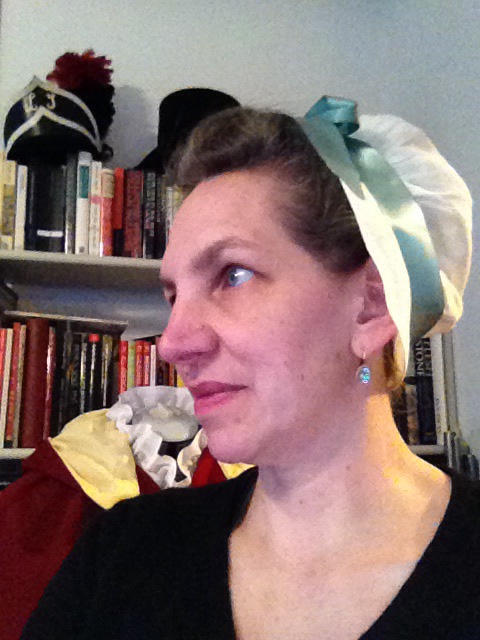
All cleaned up with someplace to go.

I started this day with wet hair, curlers, setting lotion and bobby pins, swearing like a sailor and convinced/hoping the world might end right in our bathroom. Last night I watched Jenny La Fleur‘s 18th century pouf tutorial, and thought I had the basics down.

Wrong. Or half-wrong. I should have gone looking for a don’t-lose-your-mind video, plus one on how to make pin curls in exacting detail. True to my ability to over-think anything, I began to wonder which way I should spin the pin curls– clock wise? Counter-clock wise? Is it opposite if you’re in Australia and New Zealand? My brain is a cluttered place.

In under an hour I had achieved a lop-sided mound of curlers and curls, which I thoughtfully covered with a kerchief to spare my family from death by Medusa. They refused to take me to Walmart, though I finally had the hair for it. Eventually, I pulled out half the bobby pins in the known universe, and had a head full of snakes. Silver snakes. Apparently there’s more grey in my hair than I realized.

Another half-hour of pins and hairspray later, I had a slightly more upscale version of my usual hair style, accented with a shiny green ribbon. Underneath that demure cap, my hair is doing terrible, feral things. Of all the things I learned today, I know with certainty that despite my small head, the next time I’m gonna need bigger rollers, and when I get home from the ball, I must wash my hair.

Quaker Dress

Costume in Detail by Nancy Bradford, page 372.

I’m still struggling with the Quaker Dress conundrum, both because I want a challenge and I want to be as accurate as I can be.

So, not unlike my stubborn cat, I got an idea, and I just can’t shake it. The kind-of-cross-over, apron-front, v-neck day dress.

I’ve tried and failed before, but I got a little farther Saturday. When I went looking for the original, I was pleased to find that it had ended up at Killerton House, as part of the National Trust Collection.

You can find it here, but you can’t see it yet. 

WOMAN IN GRAY DRESS John Brewster Jr. (1766–1854) New England 1814 Oil on canvas 29 1/2 x 24 5/8 in. (sight) American Folk Art Museum, promised gift of Eric D.W. Cohler, P3.1998.1
WOMAN IN GRAY DRESS
John Brewster Jr. (1766–1854)
New England
1814
Oil on canvas
29 1/2 x 24 5/8 in. (sight)
American Folk Art Museum, promised gift of Eric D.W. Cohler, P3.1998.1

I think it may look something like the dress in this portrait, but without the collar.

Bradfield’s notes indicate that the front, sloping edge is a “fine, 1/10″ selvedge very narrow of rich dull orange saffron.” Based on this note, I have tried using the selvedge for that edge in the lining. (Better to fail on the lining than on the silk, right?)

We’ll see… the next trial will be a drawstring, just to see if I can get this business to fit.

HSF #2: Innovation

For this challenge, I initially thought I’d be working on the compere fronts for a silk sacque, but then I took another look at the calendar and realized March was awfully close! Instead, I opted to spend the past week working to better understand the Quakers, especially Quakers in Rhode Island, in advance of a program in early March. (I did do #1, Make Do and Mend, but do you need to know about re-stitching a petticoat binding?)

'Quaker' bonnet
‘Quaker’ bonnet

To help get myself out of a sewing rut and panic, and a general malaise, I made a bonnet. A ‘Quaker’ bonnet. Bonnets are like cupcakes: delicious, sugary, but lower in calories and committment than a full garment.

Quaker bonnet ca. 1800, Nantucket Historical Association, 1928.54.7

Quaker women in the late 18th and early 19th century did not, as far as I can tell, wear the black ‘sugar scoop’ bonnet we now associate with Quakers.

There are numerous entries in Amelia Gummere about bonnets, and types of bonnets, and the reflection of particular sects of Quakers in the pleating of the bonnet caul. But early in the 19th century, at the dawn of the Age of Bonnets, Quaker and non-Quaker styles seem to have been closer.

Fashion Plate: Promenade Dresses, 1801. Museum of London. 2002.139/1397#sthash.YsOpwKG2.dpuf

The fashion plate from the Museum of London presented a style that I thought I could approximate, and that made sense to me for 1800-1810ish, but I chose an olive green silk (actually yellow and black sort-of-changeable taffeta) because I have seen Quaker bonnets in olives and tans, especially earlier bonnets. Going with a color that was less distinctive, and a form that was undecorated, seemed to me to strike the best balance between plainness and style in this time period.

I chose this for innovation because the new bonnet forms of the early 19th century are departures from the full, round, pudding-on-the-head styles of the late 18th century, and the Quakers took it a bit further. In standardizing the appearance of their bonnets (simple, unadorned, eventually ossified in form and signaling sect in pleat patterns), the Quakers were innovators in clothing as  outward symbol and sign of inner faith and affiliation.

There’s your rationalization, how about some facts?

The Challenge: HSF # 2, Innovation

Fabric: Sort-of-changeable black and yellow silk taffeta in olive green for the body and ribbons, white linen for the caul lining and brim interlining, white poly taffeta for the brim lining, and pasteboard for the brim.

'Quaker' bonnet, view two.
‘Quaker’ bonnet, view two.

Pattern: Modified Kannik’s Korner Bonnets, View E

Year: ca. 1803

Notions: Thread, PVA (acid-free white glue for book binding)

How historically accurate is it? Well, white poly taffeta aside, pretty accurate. All hand-stitched and assembled in a period method. Gentlewomen can disagree about accuracy of style, but we could call this a plain bonnet ca. 1803 and be safe. After March, I can decorate the bonnet. The poly will remain, so, well, 60%? (How many points from Gryffindor for using the right weave in the wrong fiber?)

Hours to complete: Five, perhaps? These are quick, so five would be from start to finish, not including agonizing in advance.

Mr S's day took a bit of turn.
Mr S’s day took a bit of turn.

First worn: First by Mr S, who wasn’t feeling well, but to be carried along by me on March 7.

Total cost: All supplies came from the Strategic Fabric Reserve and chip board depot. It takes so little of anything to make a bonnet…maybe $2.50 in silk, $3.00 in linen, .50 in chipboard, so $6.00? (The silk came from the remnant table at $10/yard, chipboard is $2.00 a sheet, and linen about $12/yard.)

Consider the Collar

The Newport dresses seemed a little strange to me, in that the collar treatment was more like what I would expect to see on a pelisse than on a gown. But I am willing to be wrong, and delighted to be wrong if that’s how I will learn something.

@silkdamask (that’s Kimberley Alexander’s twitter handle; she has a blog you might want to follow if you don’t already) posted a photo of the dress (above left) she imagined a young woman she’d been writing about might have worn. Housed at the Met, this embroidered American cotton and wool gown ca. 1806 has a cross-over bodice and collar.

Another day dress from the Met (above right) has a ca. 1820 date, but looks very much like the gown worn by Mrs Amelia Opie (she was a British Quaker) in this engraving after an 1803 portrait. (Other, similar gowns and portraits are pinned here.)

Amelia Opie (1769-1863). Engraving by Ridley after painting by [John] Opie, 1803. Massachusetts Historical Society, Photo. 81.490

Nantucket and New Bedford  both hard large Quaker populations (remember Moby Dick?), and the Williams family in Newport had connections to New Bedford, so I looked in collections in Nantucket and New Bedford as well.

The gown below, now in the collection of the New Bedford Whaling Museum, was worn by Susan Waln Morgan Rodman (Mrs Benjamin Rodman), while pregnant; using a genealogy, we can establish pretty solid date ranges for the dresses at New Bedford Whaling Museum. It looks 1820s in style, and her first two children are born in 1821 and 1822.

Maternity gown worn by Susan Waln Morgan Rodman (Mrs Benjamin Rodman). New Bedford Whaling Museum, 1991.45.5.

A date range of 1820 to 1822 seems plausible. Susan Waln Morgan Rodman would have been about 20 with her first pregnancies. (Genealogies are on Google books.)

She seems to have kept up with style and to have liked clothes; a search for her name in the NBWM catalog returned some interesting items, though the catalog does not allow for linking to item records or searches. Mrs Rodman’s appears to have kept pace with style changes; that is, her wardrobe did not ossify in 1820-something, but evolved as fashions changed, and was appropriate for different situations.

Does that mean that all Quaker women kept pace with style changes? It’s hard to say; each of us today updates our wardrobe according to our fancy, our purse, our inclinations and our age. Are those Newport gowns going to turn out to look more like the Met gowns than I imagine? I don’t know, but it seems possible.