
The Business

Sotheby's sale June 11 2013
Fine Books & Manuscripts, June 11, 2013

I’m in this business, so I shouldn’t be bothered. I have been a seller and a buyer, and I’m a card-carrying member of Team Hoarder, AKA the Curators. So why does this bother me?

This sale features a strong selection of modern authors highlighted by Property from the Descendants of William Faulkner, including the manuscript of his Nobel Prize speech with the gold Nobel medal and diploma (1950), autograph letters written to his mother from Paris in 1925, the typescript book of his poem sequence “Vision in Spring” in a handmade binding by the author, drawings, corrected typescripts and other items.

You’d think I’d know better by now: Life isn’t an Indiana Jones movie, and no amount of saying “It belongs in a museum!” will help matters along.

More and more I see the cultural economy–and the disposition of cultural goods–following the “winner takes all” pattern of the larger economy. I give you Walmart, and Walmart gives you the Crystal Bridges Museum of Art. The FAQ’s deny any tie to Walmart stores, but Alice Walton founded the museum. For a lot of people, that’s a connection to Walmart. The claim that there is no connection seems even more disingenuous when you visit the homepage and read “General admission to Crystal Bridges is sponsored by Walmart. There is no cost to view the Museum’s permanent collection, which is on view year-round.”

The people of Arkansas deserve a nice museum; everyone does–that’s not my point. My point is that private collectors can buy, and keep from public hands, important pieces of material cultural and cultural heritage. Faulkner’s work post-Nobel may have paled compared to earlier work, but he won the Nobel–score one for Southern Literature and the power of Faulkner’s words, the sway he held over American letters.

Also in what is shaping up to be a very wordy sale: “[O]ne of possibly as few as three intact 1924 recordings of Joyce reading Ulysses.” Joyce reading Ulysses. That’s pretty damn cool. Lucky for you and me, if we’re word fans, you can listen to another recording here, thanks to The Public Domain Review.

Would an online photo, or a magazine photo, of Faulkner’s medal ever be as good as the online version of Joyce’s reading? No,  I don’t think so.  Because there is a power in the authentic, in the real. And the medal is material, three-dimensional: sound waves over an internet speaker wouldn’t be as frisson-inducing as listening to a recording in a darkened library, but they’re still sound waves.

Authenticity will be the subject of an upcoming session at AAM’s Annual Meeting in Baltimore, and though I can’t be there, I’m following as best I can.

Authenticity is something reenactors strive for in their work. Museums present authentic– real– objects and experiences. I sit the gallery and one of the most common questions people ask is, “Is it real?” and when told, “Yes, it is,” they gasp a little.

So when museums and libraries are priced out of the auction or private sale market, what does that mean? It means less public access to authentic items, to the “real,” three-dimensional evidence of the past.

We’re choosy, of course: it could well be that the University of Virginia did not want these items. Perhaps they did not contribute materially to Faulkner scholarship–the medal wouldn’t, really, would it? But the additional papers and letters might, but would be hard to justify at $250,000-$350,000.

Private collectors, people who can afford a $286,000 watch, drive up prices. Museums that can attract major donors attract more major donors.

MET MFA RIHS NHS
2011 Income $470,048,040 $157,082,067 $3,440,281 $615,008

That’s a chart of the 2011 income for the Met, the MFA, the RIHS, and the Newport Historical Society. All four have decorative art, art, and textile collections. All four would be interested in pieces of Newport furniture. Two are art museums, two are historical societies. Only one has the financial power to bid for major pieces.

And then there’s Crystal Bridges: 2011 revenue? $625,995,749. Sorry Met, you were just outdone by $155,947,709. Over one hundred and fifty-five million dollars. Dr. Evil is beyond impressed. The Crystal Bridges Form 990 includes a donor list with $700,000 from Cisco Systems. Nicely done. With endowment return of just a little more than $16 million, and  $37 million for “museum procurement expenses,”  they need those donations to stay healthy financially. But that $37 million buys a lot of art.  And where does that leave smaller museums and collecting organizations?

Pretty much where Walmart left small businesses: highly specialized but small.

And what does that mean for Faulkner’s papers, or a Plunket Fleeson chair?

Chances are they’ll be in private hands, accumulating value.
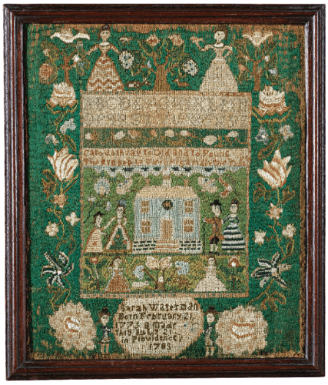
Sampler Resources

Sew 18th Century had a fun post recently about “Which State House is it?”

Sotheby's Sale N08832, Lot 563: The Sarah Waterman sampler
Sotheby’s Sale N08832, Lot 563: The Sarah Waterman sampler

I’m not usually a sampler fan (you know this is not an area in which I shine), but I have learned a lot more about samplers through work than I ever expected to. And what do you know? Some of it stuck!

I thought I would pass along some helpful resources for sampler fans. Last year, one of the (if not THE) premier sampler collections was sold at auction by Sotheby’s. Through the magic of the interwebs, you can see the catalog online:

Important American Schoolgirl Embroideries: The Landmark Collection of Betty Ring 

Even I say “Yum!” to all those pictures. I like color and texture, but sometimes samplers make me feel like all the air has been sucked out of the room. Walker Evans has the same effect. But when you look at them like this–or arrayed on a worktable–they turn into pictures, and those I enjoy. You page through the catalog and see what Betty Ring had, and whimper a little about these going in to private and not public hands. I know we whimpered…how I covet a green-background sampler!

But wait–there’s more! Be sure to check out  American Needlework Treasures, and Girlhood Embroidery Volumes I & Volume II which are available as full-text PDFs with images. In Girlhood Embroidery, you can read more about the Mary Balch School.

If you like samplers, and want to learn more or support sampler work, visit The Sampler Consortium website. You can become a lifetime member free of charge, and enjoy email updates with sampler news. The Consortium is connected to The Sampler Archive Project, which is funded by the NEH. We’re pleased to be part of the SAP’s first phase, and I am pleased to have learned so much just by cataloging.

Holy time piece, Batman!

From Sotheby's Preview magazine
From Sotheby’s Preview magazine

We had some fun with this at work on Thursday. The slightly awful truth is that these catalogs and publications for the super-rich and fabulously fat-walleted arrive with regularity at the historical-cultural complexes that comprise the workplaces of under-paid and over-educated aesthetes, fueling their impotent rage about the eroding American dream. We had several performances of the Reading of the Watch Ad, appreciating the high craft and art of the copy and design.

I’m a Mad Men addict for all the wrong reasons (management tips! vicarious vices!) but long-time fan of advertising, copy writing, and graphic design. As a child, I launched, wrote and self-published F.U.S.S., the members’ newsletter of the Felix Unger Sympatico Society, for which my mother served as managing editor and my father the sole subscriber. This was really direct marketing, or taunting, as the case may be.

But we made a kind of cult of design in my household, so I knew as a kid what Y&R stood for, or DMBB. Mad Men sucked me right in, so when this turned up, I was ready.

This ad is the inside front cover and first page of the Sotheby’s Preview magazine which features Jeff Koons’ vacuum cleaner sculpture for $15M or so. This is serious walking around money, and if you are going to recline in your Manhattan penthouse (hope it’s pre-war) admiring the Koons while your maid vacuums before a party, this is the watch to time her with.

Copy Writer's dream, or nightmare?

The copy combines naughtiness with auction catalog sentence structure, like a sexed-up museum label.

High feminine complication, this flying tourbillon decorated with the motif of the camellia, a tribute to Mademoiselle Chanel’s favorite flower, beats away discreetly and almost secretly at the heart of the Première watch.

That last clause screams affair. When I read, all I can think of is Roger Sterling in a hotel room with his mistress. A colleague said this kind of watch was only given to rapper’s girlfriends—the serious ones—but at $286,814 (last year’s price), perhaps it’s a “don’t divorce me and take half my empire” celebrity wife present. Tisch and the Winklevoss twins were in the event pictures of this Preview, and this watch does scream nouveau riche, not Astor money (that was a fur trade fortune, originally).

Where it gets really fun, I think, is when the text takes on the style of an auction catalog lot description:

Having no upper bridge, the carriage decorated with a camellia appears to be rotating in a weightless state. Limited edition of 20 numbered pieces. 18-carat white gold, set with 228 diamonds (~7.7 carats).

“Having no upper bridge” is a technical description that reminds me of the dentally challenged with poor memories and no mirrors. Note that camellia is repeated here—perhaps to help you recognize the motif, because I’m not sure it reads very clearly.

There it is, the quarter-of-a-million-dollar watch, advertised in a magazine promoting artwork for tens of millions of dollars, pieces that a colleague noted would be displayed in the penthouse for a party and then put into storage as an investment until the art advisor said it was time to sell for a profit. Art as commodity, produced like commodities now, from Warhol to Koons to Hirst.