
 To be honest, I would love to wrap my self up and take this silk, but it is for a museum to display, so instead the box is wrapped and ready to ship.
I was lucky to be included in a message group started by a friend asking if any of us had a banyan or wrapping gown to loan. Well, no… but I can make one!
So I did.


My version is based on this 1750-1760 example at the Victoria and Albert Museum, of silk designed by Anna Maria Garthwaite ca. 1740-1750. To be honest, this is one of my favorite gowns, despite the fact that it bears no practical relationship to any part of my daily or living history life. A girl can dream, though…
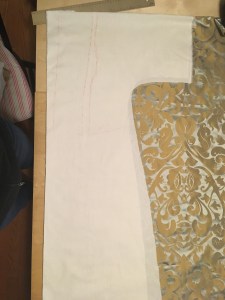
In particular, I like the way the style combines the t-shape of a basic banyan with the pleats used to shape European women’s gowns. Tricky, right?
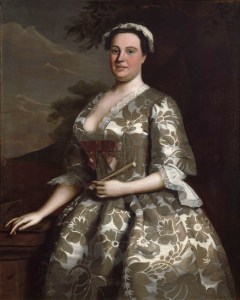
I made a pattern in muslin (it took two) primarily by draping, reading the V&A description, and looking at the original images as large as I could get them. By the time I had a pattern, I was mostly convinced, but still intimidated by the silk. I’ve had my eye on this ever since I saw at the local store, for it reminded me strongly of the Anna Maria Garthwaite silk worn by Ann Shippen Willing (Mrs. Charles Willing) of Philadelphia in this portrait by Robert Feke.
In the interest of economy, I machine sewed the long seams and the interior (lining) pleats, though I would not if I wear to make this for myself. Once the main seams were done, I pleated and pinned again.


Then it was time for my one of my favorite activities, hand-stitching pleats. It’s impressive how the look of a garment changes (and improves) as you continue to work on it. The fullness of the gown with the inserted pleats is pretty impressive and very satisfying to wear. It sounds fabulous as it moves with your body.


Once the gown is fully dressed on a mannequin (that is, over a shift and petticoat), I know it will assume the more correct shape of the green gown at the V&A– it looks better even on me, although it is too small, being made for a mannequin representing an 18th century woman.

Oil on canvas
40 x 32 5/16 in. (101.7 x 82 cm)
Restricted gift of Mrs. Harold T. Martin in honor of Patrice Marandel, 1981.66
Art Institute of Chicago
Along the way, I found another green silk wrapping gown or banyan, this time worn by a French artist.I can guarantee you I would never wear silk to paint in, but your mileage may vary, and if I had a maidservant and unlimited cash in 1760, perhaps I would emulate the Mademoiselle at left.


 Kirsten Hammerstrom
You must be logged in to post a comment.