Wrap it Up, I’ll Take it: Made for Someone Else

Banyan, 1750-1775. T.215-1992, V&A Museum
Banyan, 1750-1775.
T.215-1992, V&A Museum

Disclaimer: This is an adaptation of an earlier post, so if you think you’ve read this before, you probably have.

Banyan or wrapping gown: both terms are used,  but the wearer and I call this a banyan for brevity’s sake. Despite its simplicity, this project took longer than I wanted, mostly because I have a tendency to take on too many things at once and promptly get sick. I like to think of this ability as a very special talent.

In any case, this simple garment was made more fun by piecing– it’s the challenge that keeps you awake, when the majority of the work is in teeny-tiny back stitches.

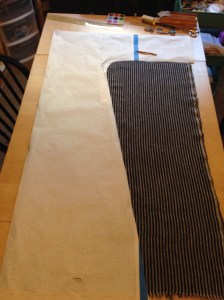
I took the subject’s chest, arm and back length, and bicep measurements, and made up my own pattern, using the chintz banyan in Fitting and Proper and this one at the V&A as models.
img_6554

Measurements in hand, the patterning was straightforward: you know how wide to made the body, the center back length you need to achieve, how wide to cut the neck hole, and how wide and how long the sleeves need to be. Really, not that hard.

You can use a diagram like this to start you off. I did wing the bottom width, guessing at the angle to give the garment a fullness similar to the chintz at the V&A.

I didn’t have quite enough fabric to accommodate the recipient’s full height, nor could I get enough of the red print lining material; I had to piece both the stripes and the lining.  Trying to match up the stripes was remarkably satisfying, both when I succeeded and when I was  little off. Life Goal: Dizzying, please.

It contrasted well with a blue woven coverlet, making a nice bright note as I prepped rooms for What Cheer Day 2016. This was the effect I had hoped to achieve waaay back in April 2016 when I failed to finish anything I wanted for the After Dark program thanks to a bout of strep throat.

Jimmie and Billie, unwell and unable to dress themselves without Gideon’s aid. Photograph by J. D. Kay

By October, though, I was able to finish the entire item and make a matching cap, allowing Billie Bowen to recuperate in style from an evening at the Cold Meat Club. I’ve drifted away from making things for other people (except to sell) in part because the Giant, heading to college, has drifted away from living history and thus occupies far less of my sewing time.

Bad, Mad Skillz: An Origin Story

Aragorn: one of many modified patterns

I’ve been sewing clothes off and on for while, and sewing pretty constantly since the 1990s—baby quilts, piped slipcovers for vintage chairs, knitting needle cases, costumes for the Giant, and sundry other items. Making calms me, and since I tend to operate at a pretty high RPM, I make a lot of things.

Historical clothing took off for me after the Giant decided he wanted in on the living history thing. Hunting frocks, overalls, and shirts gave way to stays, petticoats and gowns. I’m largely self-taught, and although workshops with Sharon Burnston and Henry Cooke helped immensely, much of what I learned about fitting and draping I learned by reading (books and tutorials, especially Koshka and Sabine) and by making mistakes.

The best way to succeed is to fail, and I am an accomplished failure —you have only to look through the archives here, and you will find waistcoats sewn by drunken, crack-addled monkeys , upside-down Spencer collars, and stays gone wrong. I’m okay with those mistakes, because they helped me (and, I hope, some of my readers) make progress towards better sewing.

Really, I’m not sure how this happened. But there it is: upside down.

I’ve made things of late of which I am proud, or at least pleased with; I have taught myself new skills over the years from pad stitching (still working on that) to hand knotting (getting better) . I’ve gained patience (which is a skill itself) as I’ve learned new techniques, and that counts for a lot.

Hand-knotted lapis bead necklace: a new, slightly frustrating skill

Way back when (for the true origins), struggling through a design studio, I realized that the greatest frustration typically comes just before a breakthrough. That understanding is really the origin of my historical sewing: getting frustrated means you’re making progress. And what’s more frustrating that replicating a historical garment?

The ‘Nancy Dawson’ Dress

Miss Nancy Dawson, aquatint print. Victoria and Albert Museum. E.4968-1968

Hat tip to Mr B for pointing out the resemblance; I know the print and never connected it to this fabric.

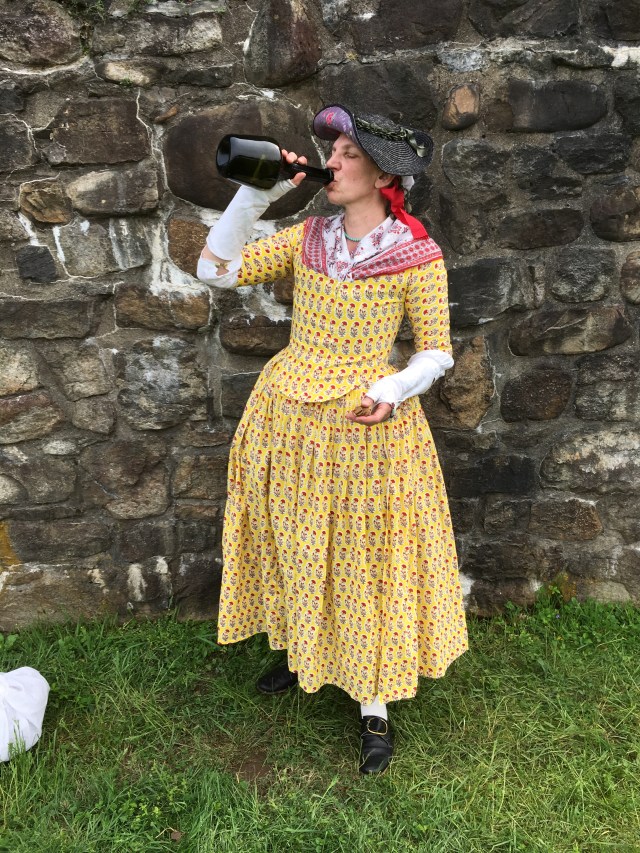
It’s been almost a year in the making, this bright yellow billboard of a gown. I’m not sure why I dawdled over the making; usually I’m pretty quick with a needle, but perhaps it was in part because the goal kept changing: first December, and then, it seemed, never, would I have an occasion to wear this. Federal exploits intervened, work intensified, things changed. But late April presented itself as an opportunity, so finally I had a goal, a deadline.

It was hot. And humid. That’s only water.

And I met it, with Drunk Tailor’s help (setting hems by yourself is a pain).

This is a fairly straightforward affair. I did use the Larkin and Smith “fashionable gown” pattern because I know how it fits me, but the front is modified to a simple closing and the skirts aren’t meant to be drawn up. This gown aspires to pretensions– though you can tell I’m fairly prosperous by the number of different prints I’m wearing.

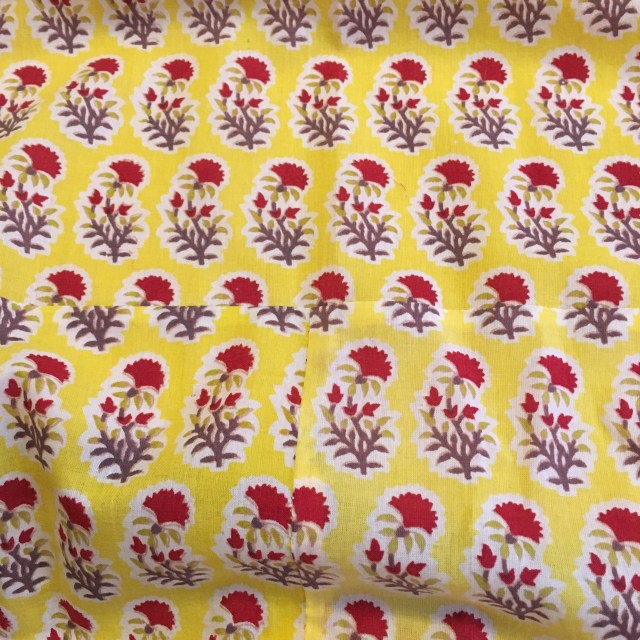
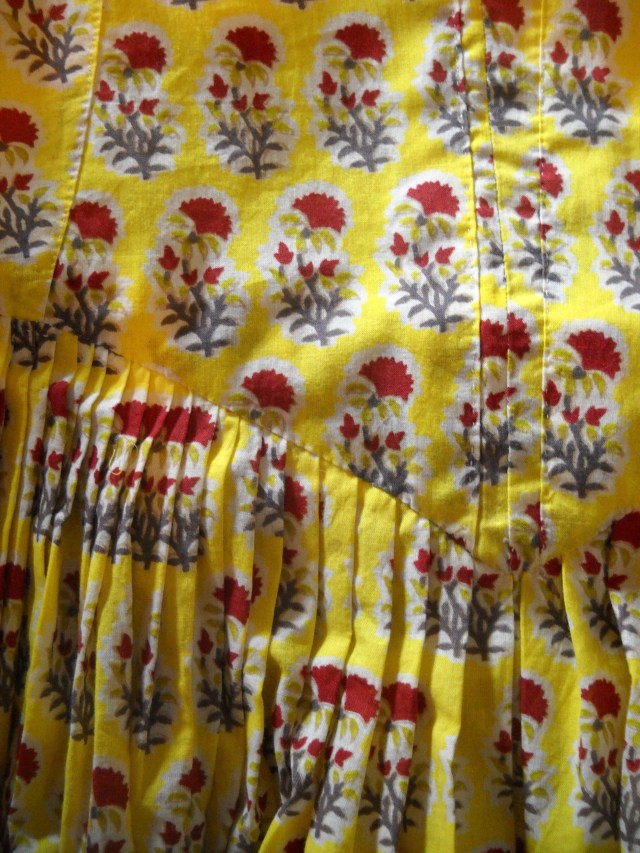
The petticoat did require piecing– at my height, 44 inch wide fabric often needs to be pieced to achieve the lengths or width I need in historical skirts.

Happily, the piecing matches and doesn’t match, in a fairly satisfactory way. When this fabric arrived on my doorstep, I determined that it needed to be used in the most obnoxious manner possible– and since I’m not a small woman, a gown and matching petticoat seemed the best possible use. (I have other obnoxious fabrics for later time periods).

I did take care as I made it up, though, stitching with white thread and trying to make the pleats small and correct to the fashion and fabric. Any failures or flaws make it, to my eye, better as an article of aspiration to a rank and style I really can’t pull off.

One thing I forgot to pack was a bum roll– though wearing that on the drive to Fort Frederick would have been extra interesting– which was unfortunate, as it is truly required. These new (they’re a year old, and I expect to call them “new” for a long time to come) stays make a different shape in the back than the old stays, and now my own padding no longer negates the need for a bum roll. Still, I’m pleased with the result, even if it still wants cuffs. Not bad for eleven months of work.

Cross my Heart

The goal is on the left. How far have I made it? Well… I have been busy. We started on the right, remember?

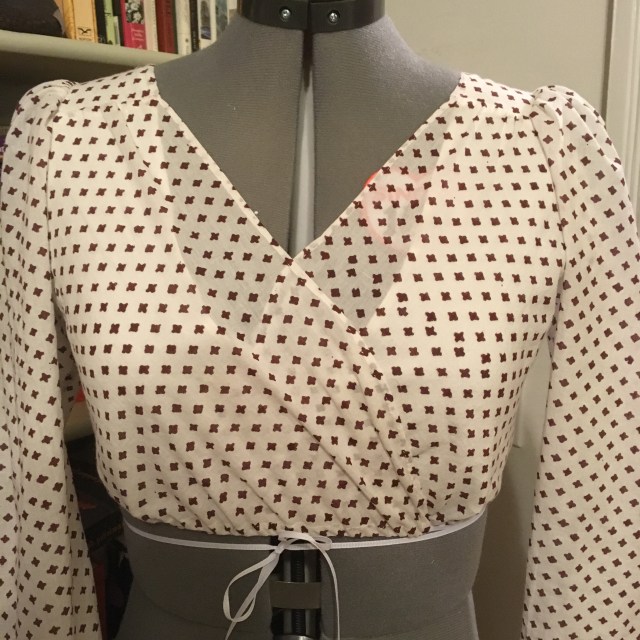
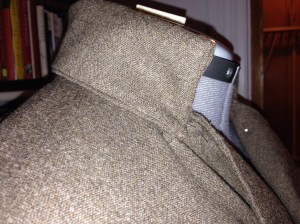
In executing the final plan, I did choose to cut a lining to support the lightweight fashion fabric; I didn’t think it would look, drape, or wear well without a lining.

The adaptation is truly that, and not a copy, in this instance. The lining means that the finished piece will have more of the appearance of a drawstring fitting than an actual drawstring across the back.

The sleeves, thankfully, were pretty straightforward, and I’m one of those odd people who really enjoys cutting and setting sleeves, so there you are. It took me about six days to get to this point, and then work came to a halt. I have other centuries I’m playing in, and am determined to finish that yellow dress to wear this weekend. When and where else can I look like a person of means than the Fort Frederick Market Fair?