Luxury and Fashion


Sometimes this is a hard hobby to love. My hands hurt, my creativity feels dead, and there’s no place to go all dressed up. After a long, unpleasant spring, I finally feel like sewing and playing. Drunk Tailor and I definitely missed some things we very much wanted to do, but now we’re reinspired, we could take baby steps back to our normal semi-hectic pace– except of course, we are plunging back in with three events in August after a whirlwind trip to Ticonderoga.

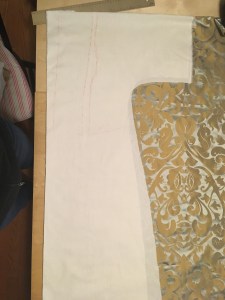
Wedding dress in cotton muslin ca. 1797. Nationalmuseet Danmark.

With the summer heat in mind, I ordered batiste and voile, thinking I would make the Tidens Toj gown, but when the fabric arrived, it seemed that the purveyor had confused the two fabric types, so a new plan was required. Alas, the trials of costume research and falling down the fashion magazine rabbit hole for hours at a time…

1798 Gown, watercolor by Ann Frankland Lewis, 1798. LACMA, Costume Council Fund (AC1999.154.1-.32)

Next up: an open robe or wrap-front gown over a matching petticoat, trimmed in blue-and-white Greek key trim, with a pair of pointy-toed ribbon-tied slippers and a sleeveless blue silk waistcoat, in three weeks or so.

The waistcoat construction is finished, scaled up from the original garment patterned in the DAR’s “An Agreeable Tyrant” catalog. I chose to line mine, possibly from pure habit of making men’s clothing, possibly because I’m not that great a teeny-tiny hemming and require a lining to hide my sins. With gold silk cord trim and covered buttons, I think it will have a pleasantly military vibe.

For the gown and petticoat, cotton in Virginia’s August heat seems like a solid choice, though by the time the layers are on and the sun is up, it’s possible that nothing will be really cool. (The majority of the day will be spent in air conditioning, so really, anything would be okay.) The trim arrived last night, and has a body that will need batiste (and not voile) for support. The combination causes me to entertain fears that this aesthetic is a little too boat-shoes-and-belts-with-embroidered-whales for 1797-1799, but when topped with something not unlike Drunk Tailor’s militia cap, the aesthetic will tilt from yachting to the Good Ship Lollipop.

Wrap it up, I’ll take it

To be honest, I would love to wrap my self up and take this silk, but it is for a museum to display, so instead the box is wrapped and ready to ship.

I was lucky to be included in a message group started by a friend asking if any of us had a banyan or wrapping gown to loan. Well, no… but I can make one!

So I did.

My version is based on this 1750-1760 example at the Victoria and Albert Museum, of silk designed by Anna Maria Garthwaite ca. 1740-1750. To be honest, this is one of my favorite gowns, despite the fact that it bears no practical relationship to any part of my daily or living history life. A girl can dream, though…

Just a little bit scary, despite being able to get more silk if I really messed up.

In particular, I like the way the style combines the t-shape of a basic banyan with the pleats used to shape European women’s gowns. Tricky, right?

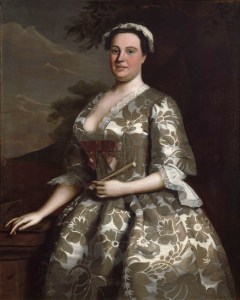
Ann Shippen Willing, oil on canvas by Robert Feke, 1746. Winterthur Museum Museum purchase with funds provided by Alfred E. Bissell in memory of Henry Francis du Pont. 1969.0134 A

I made a pattern in muslin (it took two) primarily by draping, reading the V&A description, and looking at the original images as large as I could get them. By the time I had a pattern, I was mostly convinced, but still intimidated by the silk. I’ve had my eye on this ever since I saw at the local store, for it reminded me strongly of the Anna Maria Garthwaite silk worn by Ann Shippen Willing (Mrs. Charles Willing) of Philadelphia in this portrait by Robert Feke.

In the interest of economy, I machine sewed the long seams and the interior (lining) pleats, though I would not if I wear to make this for myself. Once the main seams were done, I pleated and pinned again.

Then it was time for my one of my favorite activities, hand-stitching pleats. It’s impressive how the look of a garment changes (and improves) as you continue to work on it. The fullness of the gown with the inserted pleats is pretty impressive and very satisfying to wear. It sounds fabulous as it moves with your body.

Once the gown is fully dressed on a mannequin (that is, over a shift and petticoat), I know it will assume the more correct shape of the green gown at the V&A– it looks better even on me, although it is too small, being made for a mannequin representing an 18th century woman.

Portrait of a Woman Artist, c. 1735
Oil on canvas
40 x 32 5/16 in. (101.7 x 82 cm)
Restricted gift of Mrs. Harold T. Martin in honor of Patrice Marandel, 1981.66
Art Institute of Chicago

Along the way, I found another green silk wrapping gown or banyan, this time worn by a French artist.I can guarantee you I would never wear silk to paint in, but your mileage may vary, and if I had a maidservant and unlimited cash in 1760, perhaps I would emulate the Mademoiselle at left.

Squirrel!

It’s astonishing to me, in a way, that I haven’t posted about this before, but shockingly, I have not. Remember the need to keep warm in Princeton? Tested on at Ti? A compromise?

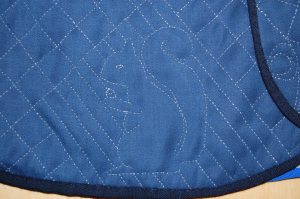
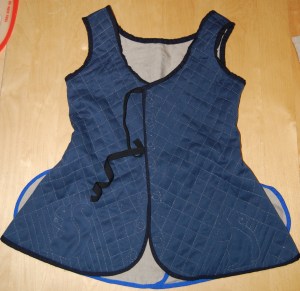
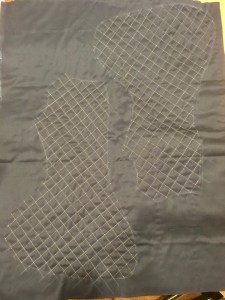
I updated that garment and wore a nearly-completed version at Ti last February but never wrote about the new version: the Squirrel Waistcoat.

Wool hand-quilted to a wool backing and lined with wool, I wore this almost finished at Fort Ti last February, and found it comfortable and cozy. I had imagined its state to be far worse than it was: with a lining in need of piecing, mangled seams, your worst nightmare come true. But no: all it really needed was some binding adjustment, not surprising considering that I stitched the binding by candlelight while chattering away with friends over cider.

The back pieces weren’t bound at all, but because I’d imagined this needed so much more work than it did, I put it aside until now, when I know I will want it for a weekend in Trenton, and another at Ti in December. All it took was a little time, and accepting that the bindings will not match.

This wasn’t a long, involved project, really, though I spent lunch hours and evenings working on it last January and February. It is, as so many things are, about patience. Patience and good needles.

The construction was based on the quilted waistcoat I made two years ago, with a pattern derived from Sharon Burnston’s research, using fitting adjustments I’d made to an earlier jacket pattern (long since abandoned due to living in New England).

I don’t fully remember how it fits best, over or under my stays, but I’ll get a couple of opportunities to test drive the layers in the next two weeks. And in the meantime? Squirrel!

Gathering Thoughts

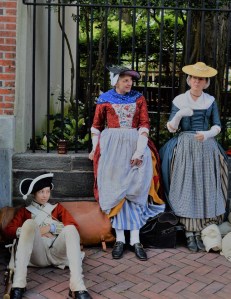
Someone must watch the baggage.

You only live once, as they say, so you might as well enjoy yourself, and have a nice apron while you’re at it.

At last I have finished the one I made to serve as a demonstration model for the apron class I taught for Crossroads of the American Revolution. Plain, unbleached linen (osnaburg), it will be a good, serviceable garment well suited to getting dirty through use. There’s a lot to be said for filth, and my first-ever apron has acquired a fine patina of stains and wear.

So why make a new one, aside from needing a teaching aid? Especially when you already HAVE a checked apron that’s looking used, and you have others in your wardrobe: why? One reason was the sheer cussedness of making the plainest, dullest, least-pretty item as finely and carefully as I could. Another was that the more I looked for apron data and examples, the more I noticed plain linen aprons. Yes: the preponderance of aprons are check, but looking at Sandby again made me realize that plain was documented, and under-represented in living history.

Sandby shows working women in checked and in blue aprons, but he also seems to depict women in plain, unbleached linen aprons, particularly the women in the street scenes. All the more reason to make up a plain apron, when your preference is portraying the urban underclass.

It’s also a good chance to hone one’s skills and keep in practice when you’re avoiding sewing the things that need sewing, like new shifts. And a basic project is meditative in a way that a new pattern is not: making stitches small and even is to sewing what scales are to piano playing or singing.

The first supervised apron I ever made is described here, and I’m pleased that my skills have improved since.

Stroke gathers are worth practicing, since they’re used on shifts and shirts as well as aprons; I’ve even used them on early 19th century garments to evenly distribute fine cotton lawn across the back of a gown. Sharon Burnston explains them here. I don’t know that there’s any one “trick” to them aside from patience and even stitches, but that “trick” will take you far in assembling pretty much every hand-made garment.