Tuning Frocks

You’ve washed, mended, ironed, darned, and sorted.

Now what? Now, my friend, the hard truths: the assessments and upgrades.

The hard stuff. Winter is a good time to frankly assess what you have, what you need, and what you already have needs. Could that sleeve be re-set? Stroke gathers re-done on an apron waistband? When you’re finally not planning and packing every few weeks, you have the time to really think about what you have and what you want.

There are two primary areas to assess, fit and appropriateness.

Fit:

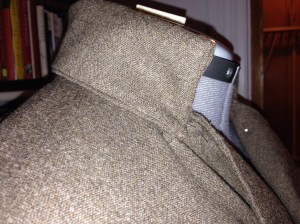
How well do your clothes fit you? Are your skirts long enough? Short enough? Are your breeches tight enough? Cut correctly? Waistcoats long enough? Getting dressed and taking a good look at your clothes can be enlightening. I find that photographs help me figure out issues with fit. As Drunk Tailor and I work, we take photos (especially of backs) so that whoever is being fitted can see what the fitter sees. This has proven more useful than attempting to turn around to see one’s own back like a cat chasing its tail. I’ve also used mirrors and selfies to achieve similar results, but even a non-sewing friend can take a picture of your back.

Period-correct clothes fit differently than modern off-the-rack clothes (you know this), so looking at period images will help you figure out what you need to change. Typically, I find that sleeves are too loose, backs too wide, or bodices too long. Making the changes you need to make can be intimidating, but even 20th-century guides can help you get where you need to go. (The Bishop Method book is super useful if you want to sew vintage clothes, or just get better at sewing clothes in general.) More online sources for 18th-century techniques include the Early Modern Dress & Textiles Research Network , and Burnley and Trowbridge’s videos.

Appropriateness:

Do you have the right gear for your impression? Are the fabrics correct? Do you have the accessories you need? You know I’m not going to tell you what you need: that’s for you to figure out, but there are some good methods for figuring how what to wear and carry. (Soldiers have it easier: the sergeant tells them, and there are manuals.) For the rest of us in the 18th century, runaway ads are helpful and can be a good source of inspiration for ensembles.

For other centuries, fashion plates and portraits can provide guidance and inspiration, and eventually, there are even pattern books and sewing guides. Small upgrades can make a big difference: in the course of a year, I improved my shoes, upgraded the scarf, and made both a cap a new and better bonnet. It took two more years, but eventually, I really upgraded everything. Sometimes it takes a while to get things right, and that’s okay.

It takes research, and there are some pitfalls (like confirmation bias) but Drunk Tailor lays out some avenues to pursue.  What you choose depends on who you are, so that’s always the place to start: who are you, where do you live, and what do you do? With those questions in mind, you can embark on making the changes to perfect your impressions.

Starting Over, Again

Autumn is my favorite time of year, a time for fresh starts and new beginnings. Surely for many, that season would be spring, but for me, after summer’s dreary end, when the world seems stale, flat, and unprofitable, autumn is something else again.

This year, it was the time when my Kickstarter campaign succeeded, I quit a job I hated and stumbled into another that paid twice as much for fewer hours and was situated completely within my competencies. All of that was unexpected and probably hinged almost completely on taking the leap to quit a thing I hated doing.* The most successful moments– the most satisfying ones– come when I start something entirely new that scares me completely and for which I have no script. Those are dramatic and risky: big gestures, where failing will be public and painful.

There are other ways to change, smaller, incremental, but still meaningful, and sometimes still painful. Failure is always an option.** So this fall, in addition to the big changes, I took on some small ones.

I signed up for a Burnley & Trowbridge workshop, An Introduction to Mantua-making. When I signed up, I knew I would need to quit the job I had in order to take the workshop– and I had zero regrets. (There was no way to take three days off that included non-negotiable Sundays). I also knew I would be making a dress in miniature rather than a full-size gown, and I was thrilled: I do not need another gown.

What I wanted from the workshop was a skills reboot. I’ve been sewing and fitting clothing off-and-on since I was in middle school, and after a few years making my own clothes, toys and quilts for my son, and exhibition props for work, I took up historical costuming. Along the way, I took some workshops, did a lot of research, and developed habits both good and bad. What I wanted from the workshop was to unlearn my bad habits and acquire new skills, and Brooke Welborn delivered. I understand construction in ways I didn’t before, and now that I’m back home, my sewing is fast again (thank goodness!).

The joy of taking a basic workshop when you’re experienced is that you have a higher likelihood of completing the project, and you get to see a technique laid bare, broken down, and simplified. Sometimes we forget how important a regular, fast, backstitch can be– and how lovely it can be.

Ballet dancers take classes at all levels: they are always working on technique. Apollo or Coppelia: both are built on basic steps repeated endlessly unless perfect and apparently effortless. There’s always something to refine, perfect, polish, re-examine, or an old habit to break. Dancers also take classes in different genres: jazz, modern, ballroom, hip-hop: these require movement and gestures very different from classical ballet, but help expand a dancer’s abilities and understanding. And to that end, I took up something new as well.

I signed up for a new-to-me event at Fort Dobbs, the military timeline. Muskets and guns really aren’t my thing anymore, but the possibility of embarking on a new time period, and a character full of laments, appealed: the Lost Colony of Roanoke. This requires a new realm of research and new garments to make.***

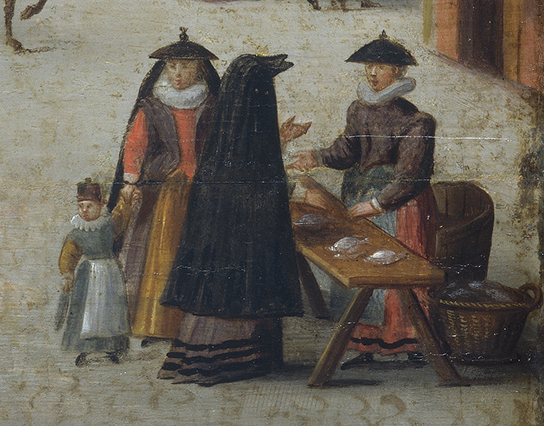
Attributed to Abel Grimmer, The Marketplace in Bergen op Zoom, Flemish, c. 1570 – 1618/1619, probably 1590 and 1597, oil on panel, Gift of Mr. and Mrs. Earl H. Look

Working in the 16th-century aesthetic is pretty different from my usual comfort zone of the last half of the 18th century. Bodied petticoats or kirtles instead of stays; smocks with square neck openings or even collars instead of the more open shift neck; transitioning silhouettes; waistcoats and doublets as well as gowns; coifs and forehead cloths instead of caps: all pretty different. But all helpful in thinking about how fashion evolves, how we get from loose gowns to bodies to mantuas to open robed gowns to chemise gowns. Looking back can help us see the present more clearly, and so it is with fashion.

Detail, Attributed to Abel Grimmer, The Marketplace in Bergen op Zoom, Flemish, c. 1570 – 1618/1619, probably 1590 and 1597, oil on panel, Gift of Mr. and Mrs. Earl H. Look

It has also been an interesting look at the effect of climate on economy, society, and dress. In addition to reading about Roanoke and the archaeology of early English settlements in North Carolina and Virginia, I picked up Nature’s Mutiny from the Library. All the wool and layers make more sense in a period when temperatures were 2℃ colder than they are now. Blom’s arguments began to tire for me (the Times review is fair), but overall, thinking about the push of lower harvests on European exploration of the “new” world was a helpful angle to consider.

Riverside, Jan Brueghel (I) (copy after), 1600-1650.oil on copper. SK-A-68, Rijksmuseum, Amsterdam

Finishing all the pieces I need to be a sad shopkeepers wife who wishes she’d never set foot on the Lion is a challenge, but the effort has definitely been worth it for all the things I’ve learned along the way.

*Retail was hard the first time I did it of necessity, and several decades in public service made it only slightly easier.

**I am a big Adam Savage fan, and if you’re a maker or just enjoy my blog, I recommend Every Tool’s a Hammer. It was a birthday present this year, but you can likely find it at your local library. Short version? Keep learning, be adaptable, and put your tools away.

***Yes, an entire 1585 wardrobe at the same time I am working on patterns, researching the Lost Colony, finishing commissions, starting commissions, and starting a new short-term contract untangling collections. This kind of load is not new and is a habit that needs unlearning.

Memento Mori/Memento Vivere

Late August is the time when kids go back to school, and nostalgia  grows for summers past and the months just gone, and for what you didn’t get done that you wanted to. It’s a time for transitions and remembering, when we’re on the verge of a fresh start. Even at my age, decades out of school, fall represents a fresh start, a time to begin something new. Now it’s more painful to drop my son at the airport than it was to take him to his first day of kindergarten: I won’t see him again until Thanksgiving or Christmas, depending on his class schedule. So to distract myself, I turned to a new-old project: the circular reticule with a pasteboard center.

I’ve been working on a version of the abolitionist reticules made in the 1820s, but recently came across some delightful earlier reticules offered by Skinner, one of a lady and a lamb, and one a Memento Mori.

My disused painting skills just stretch to the naive style of early nineteenth century schoolgirl painting, though it is hard to capture the full style when one has a modern eye. (Once you’ve seen Picasso and Warhol, can you ever go back?)

If/when I make another of these, I’ll definitely make some changes in techniques and materials, starting with the inscription. (Where is my historically correct ink? Where are the pen nibs?) For now, though,I’m happy enough and even ok with the off-centeredness of the painting on the circle. Lesson learned: do not rush through a project without planning all the steps.

I figure I’ll even it out a bit when I attach the bag.

I still have to paint the opposite side, and then decide what silk to use for the bag (I have some embroidered silk that I’m saving for a 1790s ball gown, but should have enough for a bag) and whether or not to line it. The catalog descriptions don’t mention linings, and the images appear to show only a layer of silk, with no lining.

It’s hard for me to wrap my head around an unlined anything, and for embroidered silk, a lining will help keep whatever I’m carrying from tangling in the threads on the wrong side of the fabric.

This isn’t a quick project, and I have to put it aside to work on commissions, but it does give me something to look forward to working on– a small memento vivere, if you will.

Failure is Always an Option

Or, if not failure, at least screwing up.

The big cold box….

In my more exhausted moments, I make interesting mistakes and choices. Once, I engaged in an argument at work in which I repeatedly used “orange” when I meant “blue.” Another time, I lost the word “refrigerator” and had to coin the phrase “big cold box where we keep the food.” My brain is an interesting place.

When I sat down to start on a commission for some officers’ white linen sheets to be 60” x 85” I was tired. I chose not to do the math on paper as I measured, but in my head. And using a 60” tape measure, I measured and marked 60” and then added 16” to make up 85” plus seam allowance. Yes, I measured 60 + 16 = 85 finished inches.

Obviously not.

Round two of thread pulling to cut the second sheet correctly.

But it was not obvious to me until I held the fabric up, ready to iron, and realized it was just a little bit longer than I am tall. Since I am not 7’ tall, something was clearly wrong. I dropped the fabric to the ironing board, messaged Drunk Tailor, and took to bed in mortification and hope of a nap.

I tell you this story not just to make you laugh, bring you a modicum of schadenfreude, or to make plain that we all screw up sometimes, but to remind you that mockups are good, and so is math on paper.

Really, I’m not sure how this happened. But there it is: upside down.

Starting a project without laying down some ideas on paper or making a muslin is a quick trip to madness, or at least dismay. Creative problem solving will undoubtedly result, but that’s energy you could put into planning your next project instead of salvaging your current one (as I have salvaged my sheet).

Here are some measures I’ve learned to take to prevent repeating hilarious mistakes:

  • After hemming skirt fronts that put pocket slits upside down, I now pin notes to the panels so I know which make up the left, and which the right sides of the gown skirts.
  • I have been known to mark linings extensively in pencil or chalk; I sometimes pin notes to sleeves to denote left and right, front and back, especially if I cut pieces long before I will get around to sewing them.
  • I make lists of which pattern pieces I need and must cut, and then tick them off as I go, to make sure I have all the pieces I need.
  • To make sure I’ll have enough fabric and can minimize piecing, I will do a rough layout of all the pieces before I do actually cut anything.

It is by no means an extensive list, but once you know the types of mistakes you are most likely to make, you can take measures to prevent them. You know, like measuring twice and cutting once, or doing math on paper to double check your work.