
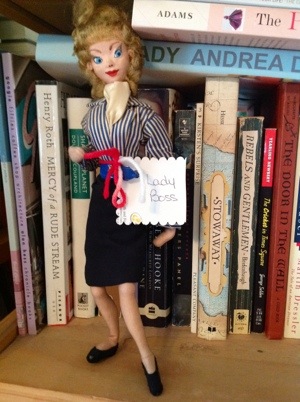
Lady Boss

20120619-075738.jpg
The exhibit opens in a little more than a week, and I think we’ll make it. Along the way, we’ve cataloged hundreds of items, photographed dozens, and discovered several in need of conservation treatment ranging from intensive to manageable in house. These are all good things, and I’d say my sole regret is the probability of not getting the 20th century’s world wars into the cases by June 28.

That, and having to dress for the opening.

Hence a crazy scheme: 1940s dressing. My mother gave me Lady Boss for Christmas a few years ago, purchased from her church’s annual jumble sale (it’s C of E in Main Line Philadelphia, so I think I can use that term). Lady Boss resonates on several levels: my mother knows I love vintage, I used to collect antique dolls, my grandmother Elsa was a Lady Boss in the 1940s, and now I’m a Lady Boss.

I could dress as Lady Boss for the opening, or some variant of 1940s style, and would probably feel more comfortable in recreated vintage than in my own work clothes. It makes a better armor, these re-enacting clothes, than my skirts and blouses. Now for a pattern….
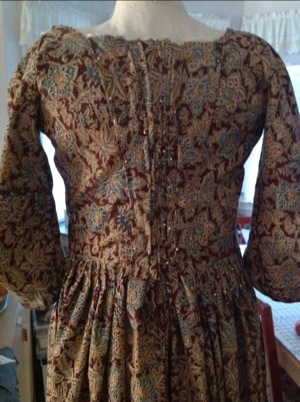
Bodice in Progress

20120615-061615.jpg

Pleated back: of course, I managed to pleat in the opposite direction of most gowns, though there is one extant pleated this way (towards center back, not away from center back).

What to do? Mr. S says, It’s pretty.
I say, there’s only one gown pleated like this.
He says, You’re one of them.

The problem is, I have always been one of them, but I’m also a woman who wants a dress to wear and spent some time pleating already. So I think I will. Baste the pleats and try this one, and see what I think. If the back doesn’t behave properly, then I’ll re do it. What better way to spend a vacation day at home than sewing and annoying the lad on his first day home from school?

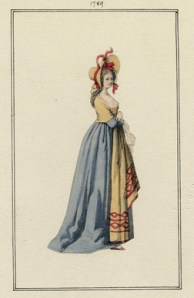
Fashion Plate Treasure Trove

The interwebs: evil bringer of spam and annoying chain emails, but also home to fantastic surprises like the Casey Fashion Plate Collection at the LA Public Library. I can sit in New England and browse thousands of images from 1780 to 1880, a virtual time warp J. Crew catalog of “I have to make that!” and “Color! Regency in Color!”

You can’t blow them up to the kind of size you’d want, but if you know clothing, the enlargements they allow are probably enough to get you where you need to go.

Now I have more ideas than I have time, but at least some will use up fabric I bought at the silk store in Pawtucket, and remnants from Wm. Booth Draper (I think I have enough wool/silk “stuff” for that blue spencer.)


Red. I love red. And that’s a lot of detail that holds up pretty well under zoom. Thank you, LA Public Library!

Shake Your Tail Feathers

Men’s 18th century coats amaze and delight me. On some of the earlier fine suits, the pleats are exuberant but controlled, layers of fabric tucked together in the skirt.

You could argue they’re feminizing, and somewhere I read that men’s suits have evolved in cut and design to make the male body less threatening. You could argue that they have the formal appeal and function of a peacock’s tail, signaling financial health and status.

This is perhaps most true of the tails on court coats, fancy and fine yet restrained, conservative, and non-threatening. After all, you cannot exceed your rank.

Fortunately for me, I need only construct a simple linen coat by tomorrow. The back seam was sewn this morning, and I started on the pleats. The pattern lines did not clearly mark the peaks and valleys, so I’ve played with it four times.

This evening, Costume Close Up will be my guide, and with any luck, a coat will be “done enough” for an event twelve hours from how. The coat may not be lined in 12 hours, but it will be wearable enough for an evening march that recreates part of the Gaspee incident of 240 years ago tomorrow.  I’ve only known since Wednesday night that I was needed, but with any luck, some of the Second Helping Regiment will come and help.