Trouser Saturday

Cutting out makes me think of freeing mastodons from glaciers

If this is Saturday, I must be sewing trousers. I’ve managed overalls in a day from cutting out to made up, lacking only buttons and buttonholes, so I have hope for the trousers. It is true I am starting a new pattern, and so I am considering adapting the pattern I already use for breeches and overalls…. except that the style is 20 years out of date for where these are going. At least the first pair is for the kid, for whom oddly-fitted clothes are the norm now because of his size and personality, and would have been then, since he’s not the son of gentry.

He’s got shoes, though, and they fit! His feet stopped at size 12 in fall 2011, and the 12.5 Fugawee straight-lasted Ligonier shoes fit him over his winter socks. His feet are just too big not to put into better shoes–no one can help noticing them, and there are no gaiters to hide them under.

We’ll see how leather-soled shoes go. Expect slipping and falling.
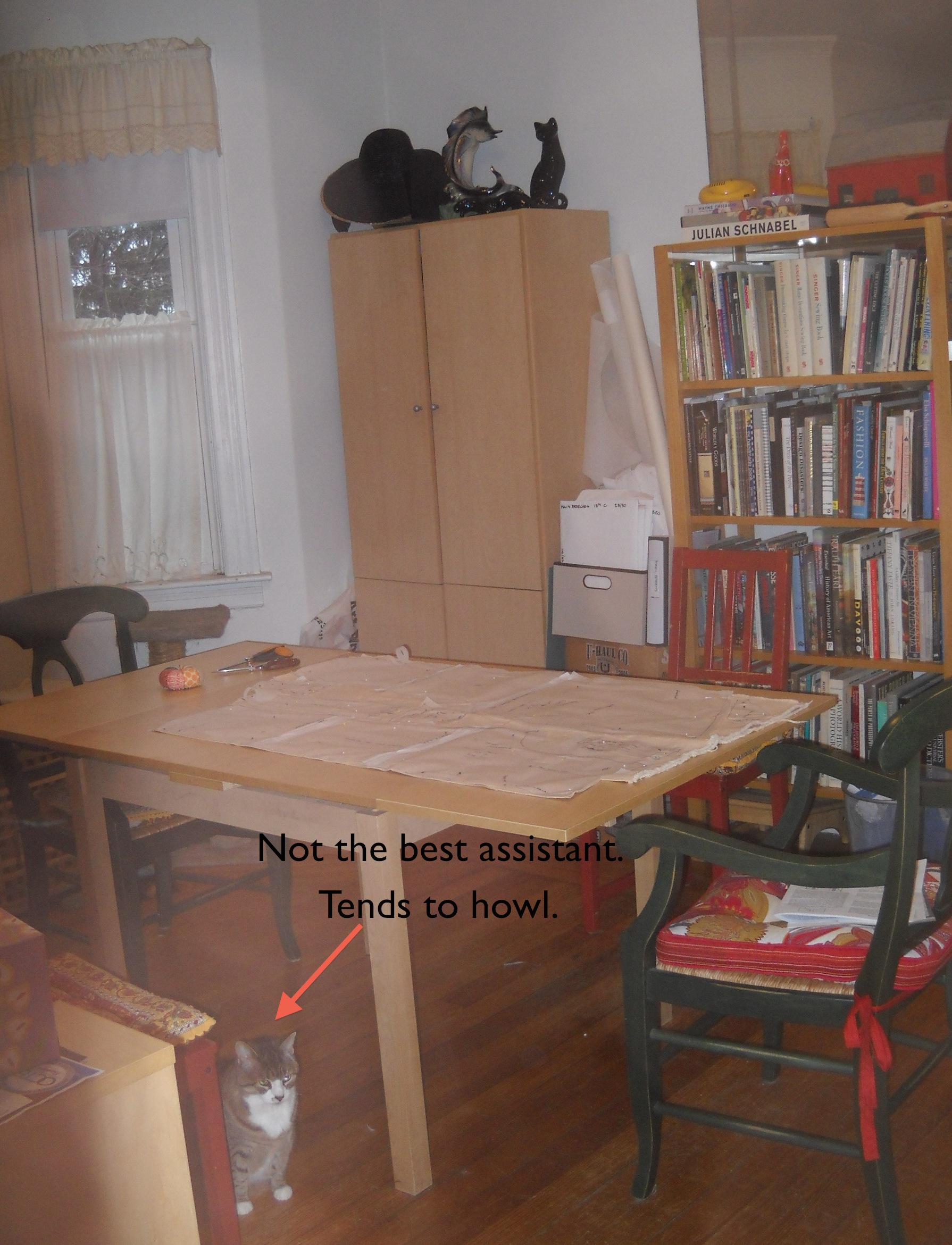
Dining/sewing/library room with "assistant"
Dining/sewing/library room with “assistant”

My plan is to knock out the trousers today to the point of finishing work, and then finish the waistcoat tomorrow (it lacks only buttons and buttonholes). Having spent Tuesday on costume research scrutinizing seams, and blinking at buttonholes from 1788-1800, I feel better (and less self-conscious) about my sewing skills. They’re not as awful as I think they are, and the worst part of the tan waistcoat was the placement of the buttonholes, not their actual execution. Of course, the placement is the part I can’t fix…

On another note, on Tuesday I also looked at a number of ways to do pockets in breeches and jackets. Some were chamois lined, and then I wondered, how do we know what kind of leather the pockets are lined in? Aren’t they more likely to be deerskin than actual chamois? It doesn’t take long before you’re down the rabbit hole of historical wonderings.

Projects & Supplies

From the Franklin Mill store

On Saturday, my friend Dana and I went to the Franklin Mill Store in, yes, Franklin, MA. Their 20% off everything sale ends this coming Saturday, when Dana is working and I am taking the Young Mr to an admissions open house at a local school. So off we went, and here’s what I came back with.

From the left:

  • Green English broadcloth for Mr S’s frock coat.
  • Dark blue Italian linen-cotton blend heavy weight plain weave for Mr S’s summer frock coat, to be modeled in part on one at work that a historic costume specialist calls “Joe Providence.”
  • Interfacing for waistcoats and frock coats, already successfully applied to the Young Mr’s new waistcoat collar.
  • Green ribbon for a black taffeta bonnet to be made from the black taffeta seen here, and enough taffeta for a petticoat.
  • Brown wool for buttons. Expect tangling.
Magasin des Modes, June 1787, thanks to Dames a la Mode

The taffeta for the petticoat seems out of character for my linen and wool life, but I have a plan. At the Artee Fabrics store in Pawtucket, I picked up a remnant of green silk taffeta, but not enough for a full dress or gown. There is enough for an open robe, though, and I got an idea watching The Duchess.  One costume is dark redingcote over a rose petticoat: not my colors. But then I found this fashion plate, with green over black, and there you are. Pure costume fantasy, but  fun to make. Or at least fun to think about making–there’s always swearing.

To keep track of these insane plans, I started a projects page to list the schemes and deadlines. We’ll see how it goes.

Start Your Needles!

LAPL- Casey Collection

I haven’t sewn anything in nearly a month, and it has been delicious. Really. No buttonholes, no hems, no seams. Nothing! I ripped a button off my winter coat and pocketed it, people. I didn’t sew it back on. That’s cold turkey.

But spring beckons, or so I’m told it will, eventually, and the sewing must start again. There are many, many things I want to make and several I need to make. Wants and needs…and more meditation.

I’ve been watching the Historical Sew Fortnightly that The Dreamstress is running, and I’m in. What the heck! I need another kick in the pants,  breeches, what-have-you, to get back to sewing. I really do enjoy it, so why not?

To start with something simple due by midnight? Hmm. I have at least two ideas already, but one garment under construction might allow me to meet the deadline. Well, the North American midnight, anyway. I’ll have to cheat to start, and that isn’t usually the Calash way…

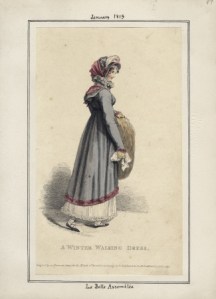
Looking ahead, I see a possible 1813 garment in my future. How about this 1813 Winter Walking Dress? I could make it just for fun, which would be a good task for me.

Linings, perhaps not Silver

MMA, 2011.104a–c, Silk & linen suit, 1780-1790

The house is cleaned up for Christmas, which means all the sewing things have been put away, which is rather sad. Cassandra is banished to the basement, fabric stashed and stacked. It’s only ten days: better if I don’t count all that lost time when I could be pleating! Better to finish up some portable plain sewing, like shift and shirt.

On Friday, I spent part of the morning in the Cave of Wonders known as Textile Storage with a historical costume expert who specializes in men’s clothing. He had already promised to leave and sworn not move in before I opened the door, and that was probably a good thing. But I got a chance to ask some questions and here are the answers.

The frock coat tail linings of calendered linen: Nancy wanted to know if they didn’t stick to men’s breeches, linen catching on broadcloth, in the plainer suits. No, my source says, because the linings were slick. That was the point of the glazing. When it was new and fresh, it was much slicker than it is now. After 220+ years, slickness will fade. Calendered fabric has been pressed and heated, and that process makes it slick. If you’ve ever pressed a wool dress with too hot an iron, you might have achieved a glossy, slick finish that you weren’t expecting. Calendering is similar, but on purpose.

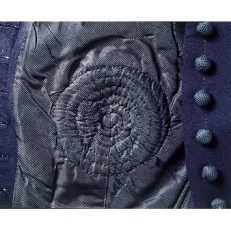
Incroyable-No3-detAnd then there’s padding. Sabine made an amazingly beautiful jacket based on an original. The lining is really interesting, because it is padded. Well, that padding is about style. In the plate at left, the shoulder line of the jacket is high, and the collar rises up as well. The chest is rounded, as we can see along the side. The way to achieve that look is through tailoring, including the use of padding.

The militia jackets in the collection at work include one with some pretty intense (several inches thick) padding in the front. That was for line, not repelling bullets, or even so much for warmth. The padding we find in men’s and women’s tailored clothes is about style, and maintaining a line. You’ll see this often in women’s riding habits or “Amazones.”

V&A T.158-1962
V&A T.158-1962
V&A, T.158-1962, overview

On pages 160-161 of Nineteenth-Century Fashion in Detail, there are two examples of padding used to shape garments. The first is a riding habit, seen here in detail and in overview. (Click for the record & larger views.) The padding here has been used to create the smooth, conical silhouette.