
Better Backstitching

Almost ready for fitting!

Practice: that’s the key. That’s the only key. Just keep stitching…and eventually, the stitches will get smaller and you will get faster.

I spent the week transforming last Monday’s stack of pieces into overalls. This sewing business is amazing! Flat pieces turn into something wearable, and it’s all made out of string in various arrangements. (I may need to get out more…)

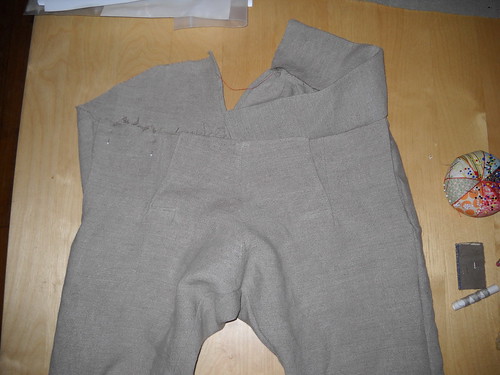
The pattern from Henry Cooke goes together very nicely. The pockets are a nice element, and their installation is simpler (I’d call it elegant) than other breeches or trouser pockets I’ve made thus far (this is pair six of breeches/overalls/trousers, pattern four).

That sounds like a lot, doesn’t it? Here’s the spool of thread I bought 18 months ago on the left, and the new one on the right. Along the way, I’ve also used up several spools of colored linen thread, a couple of silk and a few of cotton. The new spool is 1150 feet of linen thread, which seems like a lot to start with. It goes fast, though. The used-up spools were smaller, but when you aim for 10-12 spi, that’s a lot of stitches. Best not to count.
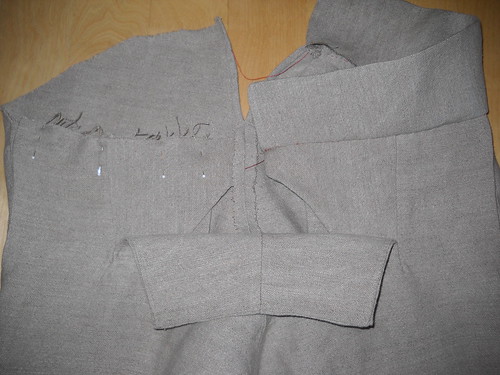
With the fall dropped, you can see the bearer/waistband connection

Very cleverly done, this pocket-bearer-waistband arrangement. My sewing has improved, and luckily for me, these are heavy plain weave linen (acting as osnaburg, here) rather than heavy drill. Heavy drill kills my hands, but this has been pretty pleasant to stitch thus far. Who’s to say what fresh hell the buttonholes will bring–but that’s another week away, at least.

And then it will start all over again on pair number two…but not before I’ve altered the frock coat and possibly breeches, made a jacket and a hunting shirt, and, I hope, a gown. Six weeks to go!
Shoe Envy

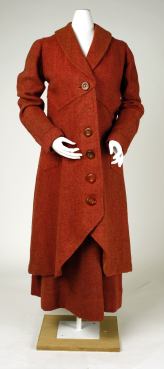
Suit, 1914-1918. MMA

Yes, I am as shallow as stereotypes might suggest: I see shoes, I often want shoes. Even my current co-workers know about the red leather Cuban-heeledAdrienne Vittadini pumps I passed up when they were on post-Christmas sale at Marshall Field’s way back in the Dark Ages. They would have gone nicely with this red wool suit from the Met.

There’s a Steam Railway in Essex, CT and when we went on Staff Day, we were told the train car was from 1914, an excellent year for fashion–at least before that August. It seemed like a great plan: make 1914 clothes and ride the train again next fall, possibly carrying vintage luggage or a basket with a delicious picnic. Really, who’s in? Let’s book it!

The World War I era has fascinated me for a long time, from Vera Brittain to Siegfried Sassoon,  from Wobblies (perhaps because I grew up in Chicago) to war memorials, so the Steam Train Outing in Period Dress was particularly tempting, and I started a board for early 20th century costume. Downton Abbey fans will enjoy it, too, and while I tired of Swedish murders and finally caved to Downton’s charms, my film choice for the period is Testament of Youth.

Libby Hall Dog Photo from flickr

When I saw the American Duchess pre-order for Gibson shoes, I was sorely tempted. (They’re quite similar to what the lady on the right is wearing.) Fortunately, I am saved by my pedal extremities, for which my size is not yet available.

But what really holds me back is the thought of sewing the corset. It’s like the hip surgery I don’t want to have: I know how painful it is, and how inescapable. There is no way to properly dress in the past unless you do it from the skin out. But shoes–and those fantastic Edwardian hats–might just get me to make that corset. Shallow, isn’t it?

Curtains for Gowns as Menswear Beckons

Curtain Along Gown…so close!

Or perhaps bellows, considering it’s soldiers’ clothes I’ll be sewing for a while.  I made significant progress on the Curtain Along gown since last weekend, when it was a mere bodice. It’s meant to be worn with the fluffy Ikea curtain petticoat for maximum “I’m not a window, but I dress like one” effect.  There’s a set on Flickr to show you the pitfalls of 18th century sleevils on Cassandra (without a scapula, poor thing, she can’t really fill a sleeve).

1795-1800, V&A
1795-1800, V&A

It’s based on the chintz gown from the V&A seen here before. For a pattern, I used the Past Patterns Front Closing Gown because I know how it fits. The waistline has been dropped on the bodice just as I did on the wool version I made, to suit my age. There’s more to do than the hem; I plan to add a thin band at the bottom edge of the bodice to carry the drawstring and drop the waist in front just a bit. I think it will fit better, and hide the petticoat’s waistband.

It won’t be done today, but I think I have made enough progress for something I won’t need until the end of May. It’s time now to switch to menswear. We have an overall appointment this afternoon, which could diverge into fitting coats. I’ll be seated at the feet of a master, and for that I am grateful. Scheming about how to get a wool gown down by April while basting and stitching and buttonholing, but grateful nonetheless.

HSF # 3: Under it All: A shift, and a petticoat

Done at last: the shift. Plus bonus bonnet

Remember that shift I couldn’t finish in time for HSF # 2, UFO? I did get it finished for HSF # 3, and a bonus petticoat as well. They don’t go together, but in honor of the excessive amount of snow we got this weekend, they’re both white. The snow is also how they got done: nothing like snow days and travel bans to keep one home and sewing.

How ‘Bout Them Facts?

Fabric:

  • For the shift, lightweight linen, probably this one.
  • For the petticoat, one of a pair of Ikea curtains found on sale one day. The light-weight cotton appealed to me and suggested filmy late 18th century petticoat better than anything I had seen at a fabric store.
The petticoat, over another petticoat. It’s that sheer.
Back view (again with cat bowl)

Pattern:

Shift:

Year:

  • Shift: 1775-1783
  • Petticoat: 1795-1800

Notions: Both: Just thread. And some left over white cotton twill tape.

How historically accurate is it?

The shift is pretty close. The fabric is, well, not the linen they had, but it’s as fine as I could afford. It is entirely hand-sewn, and the sleeves have bands and tie closed.

The petticoat is also hand sewn, and uses a historic garment for a basis. (I also looked at bodiced petticoats at the Met.) However, it is made from a curtain and while I unpicked all the seams, the machine stitching holes remain. It gets the job done that I wanted it to do, though: fluffy white stuff.

Hours to complete:

Shift: Killer. Started it last August and have worked on it off and on since then. It went to so many events in the basket that it smelled like woodsmoke. Intensively completing it probably took 24 -30 hours, so it could be a 40+ hour shift. After a while I stop paying attention.

Petticoat: Like candy. Started it Saturday morning, finished it Sunday afternoon. Best guess, about 10 hours.

First worn:

Shift, probably April 13.

Petticoat? Probably Dress U.

Total cost:

No good way to know…the fabric was bought so long ago! The petticoat curtains, when not on sale, are $20, so $10, because I only used one. For the shift, it’s harder to say. I piece aggressively when cutting out, so I bought less than the pattern recommends. Remnants were used for the petticoat bodice and various linings, including the Curtain-Along robe currently underway.