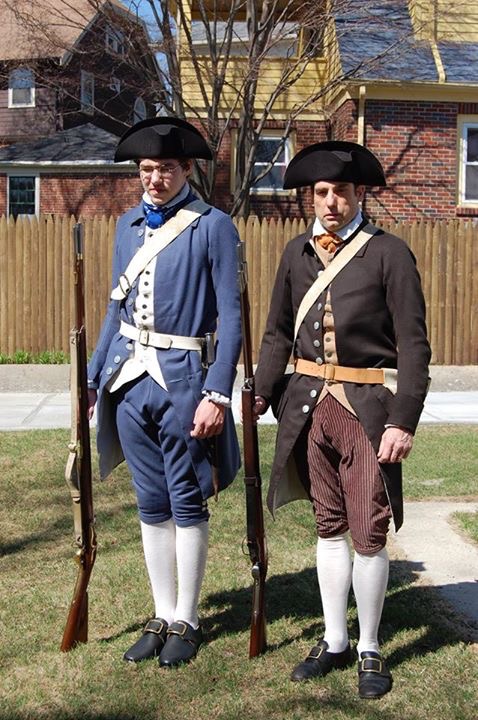
I managed, with sore fingers and considerable snake-eyed concentration, to get breeches and coats finished enough to send these two off to Battle Road better dressed than ever before. I’m pleased indeed with how the blue suit turned out, and planned to make a blue wool waistcoat to complete the set. Except…the Young Mr prefers some contrast in his clothing (a change from his prior preference for complete camouflage) and now wishes for white. I ask you.
Mr S is need of a new waistcoat himself, and he’s registered for a workshop with Henry Cooke to make a new waistcoat for himself. He was awfully taken with Mr B’s clothes two Saturdays ago, when he dressed as George Claghorn, the Naval contractor who supervised the building of the USS Constitution
Plush. No, really, it’s made of plush.
.
L’Hermione is coming to Boston and Newport in July, and then we have An Afternoon in 1790 planned, with What Cheer Day not far behind, so there’s plenty of need for new waistcoats in a variety of styles– 1780, 1780, 1800 each have their variations.
Why not join us May 2nd and 3rd in Providence, and make your own fabulous waistcoat? There’s still a space or two left! Register here.
When all else fails, sew. And if that fails, sew something else. After a mad rush to get the gents into their new clothes for Saturday’s Battle Road business, I found myself at loose ends Sunday morning. I toyed with sleeves on the Space Invaders gown, and stitched a shoulder seam on the coat Mr B gave me last weekend. (It does not fit his shoulders, but his guess that it might work for the Young Mr was correct: somehow, Mr B cut a man’s coat to a boy’s frame.)
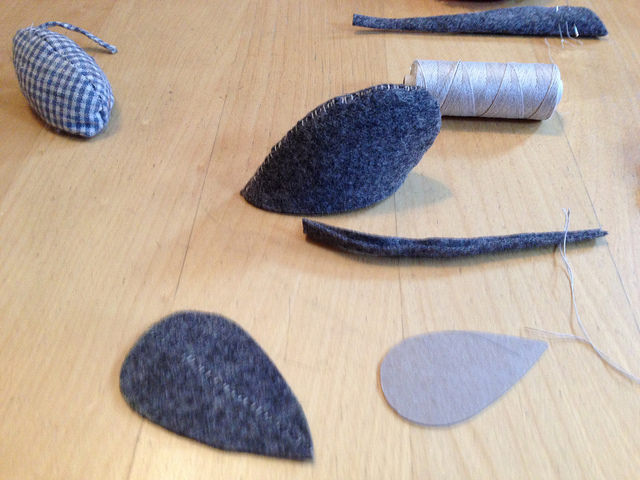
Original mouse and upgraded mouse (now with whiskers!)mouse parts
The bonus of this, aside from my amazed gratitude at a lovely coat well on its way for the boy, was an upgrade to reenactor mouse. Poor reenactor mouse was made at the farm from clumps of wool and scraps of check linen. New reenactor mouse is far fancier, being made of cleaned wool batting, catnip, and a scrap of broadcloth that is probably the $65/yard mixed grey wool I think it is. Lucky kitty, no?
The pieces are simple: two mousey-shaped backs, a roughly oval pasteboard base, a strippy scrap for a tail, wool batting, and catnip. Linen thread for stotting, whipstitching, and whiskers. Stitch the backs together (I had to piece the base from a scrap, so stotted bits to look like a mouse hide. Why not?)
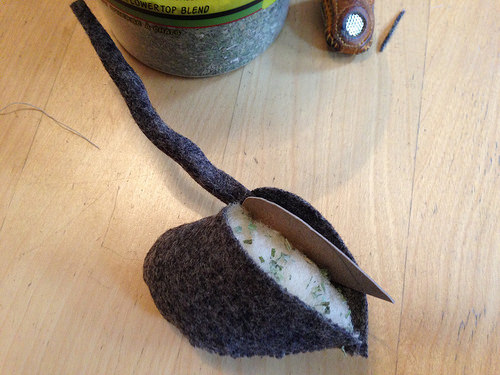
Whip stitch the tail to the inside of the mouse base. At this point, you’re ready to stuff the mouse. I rolled the wool batting in the catnip and stuffed the back, poured a little more straight catnip in, and then finished off with another bit of catnip-rolled batting.
This is where the little pasteboard or chipboard base comes in. You slide this in to the mouse sandwich before closing the last base seam. (It helps stabilize the mouse, so that it skitters across the floor more satisfactorily when batted.)
nearly there. full of wool & catnip.
Stitch the final seam. Make sure the seams are sturdy, as they’ll be going up against claws. I like to thread doubled linen thread through a large-eye needle to make whiskers; be sure to knot on both sides of the mouse’s nose.
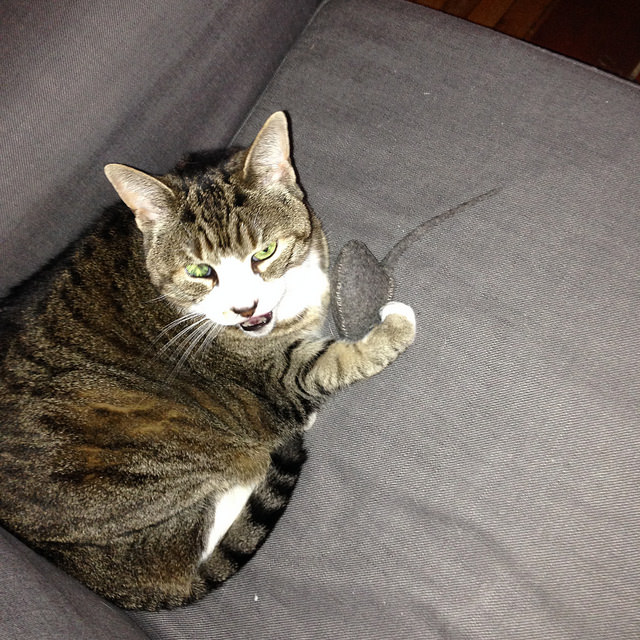
All you need to do now is hand the mouse over and back away. Kitty requests some privacy with her new mouse. There’s a flickr album if you want to see the progress photos of a quick and silly project and make your own Wooly Mouse for Progressive Pussy Cats.
Not that this is an exhaustive or final chronicle, but Jackie asked about the apron.
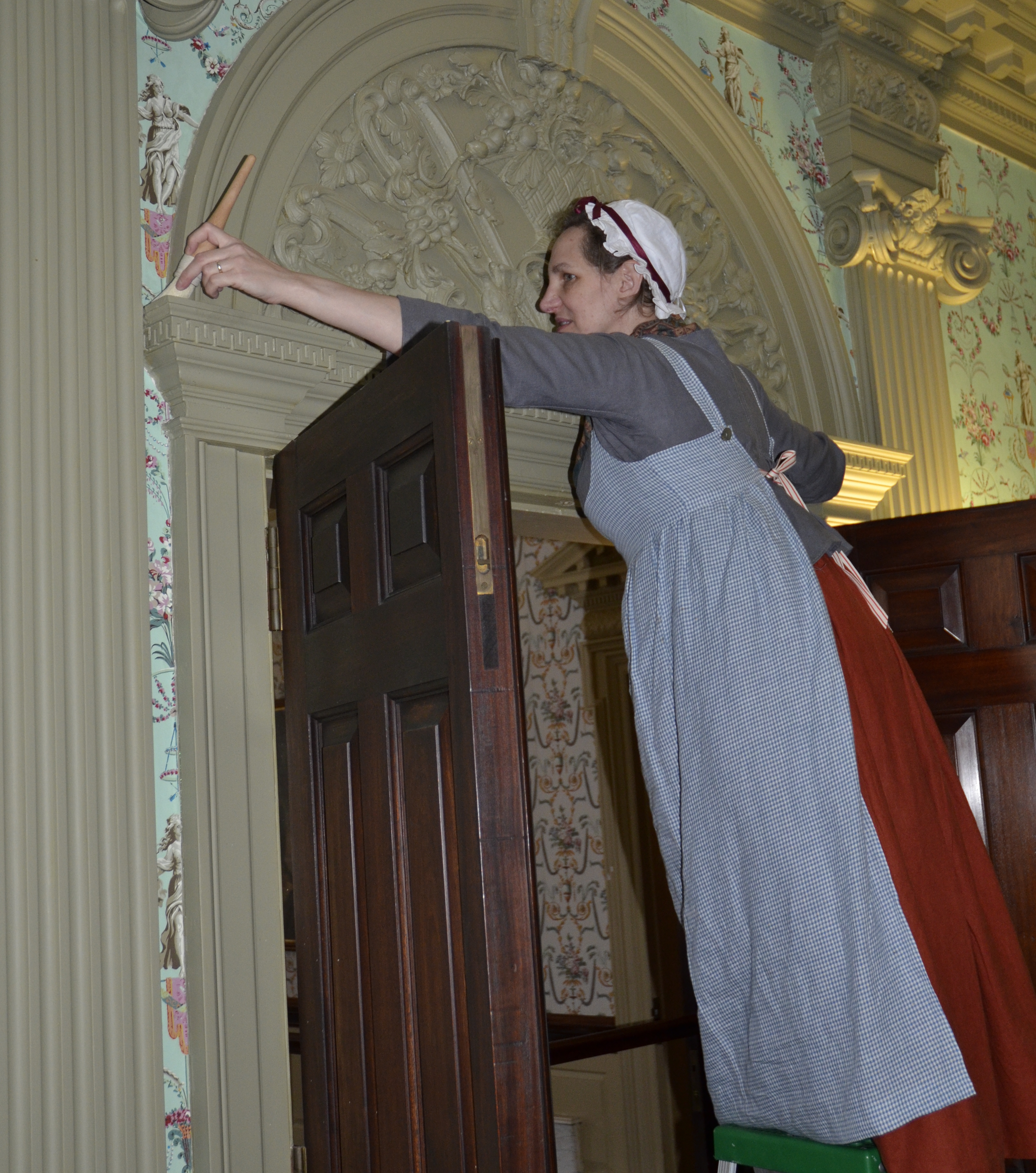
Spring Cleaning, 2012
I first encountered this form of apron at Old Sturbridge Village, on display in the Firearms and Textiles exhibit space, which I think of as “Muskets and Muslins.” The accession number given on the exhibit label was 26.39.4, but the object does not appear in the OSV online collections database (they do warn that it contains just a selection of their total 60K-plus object holdings). The original at OSV, as sketched and described by me in April 2012 has a drawstring at the neck, straps that button, string at the back opening, and is slim, without gathers. That means the bodice is very similar to the gown bodices of the early part of the 19th century.
Smock, 2000.01.869 PVMA
There is another original checked bodiced apron in the Pocumtuck Valley Memorial Association collection in Deerfield, MA. This original appears in color in The Needle’s Eye by Marla Miller. As you can see in the images of my apron, I mashed the two styles together to suit the amount of material I had on hand, the skills I had three years ago, and the amount of time I had between seeing the apron and the day of the program, which was probably two days during which time I had pleurisy.*
This is also wrong, but funny.
To refocus: I chose to wear this apron at Whitehorse House in 1820 for a really wrong reason: it was what I had.
Papering the Saloon at Tickford Hall, watercolor by Diana Sperling, 1816.
Since we deal in confessions here, I will tell you that I did buy material for a black apron, and I planned to make a strapped or bibbed one, much like the one Sabine made. The appearance of the dark apron in Diana Sperliing’s watercolor of the ladies papering the saloon at Tickford Park put the dark strapped and sometimes bibbed apron the in English-speaking world. And still I did not manage to make one. If I were to do an 1820 program again, or even an 1813 or later millinery shop again, I like to think I would find the time to make a black strapped and possibly bibbed apron. I do think they were the height of fashion, and are likely to have been worn by women in shops, and by maids.
Do I think the checked apron is wrong? Given that I can rationalize anything, of course not! I think a checked apron is probably reasonably appropriate within the context of a kitchen, even in 1820, especially in New England. Since we did not cook on Saturday, the black apron would have been ideal, but I think the checked apron passes. To make it pass with a higher grade, I will freely admit it requires button and tape upgrades. Since the next dates on the horizon are 1775 and 1780, chances are good those upgrades won’t happen anytime soon. * Do not attend an all-day outdoor event in the cold when you are not well. Do not attend said event without your cloak, or in stays you have laced up a little too firmly. Do not deny that the cold you have might actually be the start of something bigger, when it includes a productive cough. Lo, the lessons of living history are many.
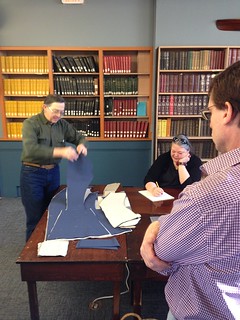
Scheduling being what it is, we plunged right in to hands-on work with Easy Grace and Comfort, a two-day man’s frock coat workshop with Henry Cooke. We saved enormous amounts of time in the workshop by having Mr Cooke cut coat kits for participants, and I know it was well worth every penny.
There is much less on-body fitting when Mr Cooke cuts a coat for the kid than when I do. (I think the Young Mr grows while I am trying to figure it out, but Henry cuts fast enough to head him off.)
Buckram and button stands
The most painful part of the whole thing (if fitting is largely done) is stitching on the buckram interfacing and the button stand. The zig-zag stitch as demonstrated by Henry was fairly easy to get the hang of when you caught the rhythm, but the tightness of the Red Edge stand tested my needle and even my fingertips.
There were some complaints at one table, largely voiced by the Fifer Formerly Known as Lambchop, who awaits his 10th Mass name.
Sleevils!
We made it all the way to sleeves, which is impressive, considering that some of the gentleman had not made more than a haversack or knapsack before. But if you can backstitch, and have some help with your fitting, you can make a coat.
I happen to like sleeves, myself, stitching them up and setting them in the garment. I think it’s the three-dimensionality of them that appeals to me– and I like a good challenge.
And here we are: sleevil one.
It’s critical to pay attention, though, so you make one left and one right sleeve, and to keep track of them as you set them to the garment body. I sometimes mark mine with chalk, and have even pinned notes to the pieces when feeling especially daft.
I’ve made it to an assembled coat body and sleeves, with one sleeve basted on. Before Saturday, I plan to baste on the second sleeve and test fit sleeve set on the boy. I’ll also try to get pocket flaps made. Since I have a talk to write and a bedgown to finish as well, I’m probably dreamin’ big.
When this suit is done, the Young Mr will have a very nice blue ensemble that includes breeches (join in the fun here) and a waistcoat. I think he’ll look rather nice, and better than he has previously. I still want to make lower-class* clothes for him, but first he does need a nice suit.
*I said urchin, but Mr Cooke said urchins can’t be over 6 feet tall. Basking sharks are big, but in this blue-grey suit, perhaps the Young Mr will finally be a grey reef shark.








 Kirsten Hammerstrom
You must be logged in to post a comment.