Cold Comfort Compromises

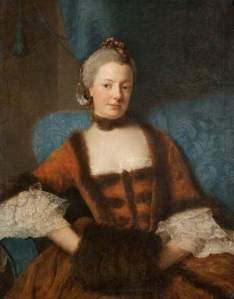
"Henrietta Diana, Dowager Countess of Stafford", Allan Ramsay, 1759; Glasgow Museums 3026 (c) Glasgow Museums; Supplied by The Public Catalogue Foundation
Henrietta Diana, Dowager Countess of Stafford, Allan Ramsay, 1759(c) Glasgow Museums. Fur: cozy, but not for me. Also too early.

Winter is bearing down upon us, and while I was not in Connecticut last weekend, nor will I be in New Jersey two weekends hence, I do have winter history plans, barring the proverbial 50 feet of snow, which even a Subaru cannot handle. The Noble Train: I could not resist, for, as regular readers know, I prefer my history to hurt.

Still, I try to avoid cold-related illness and extreme discomfort, so I’m making sensible preparations. Of course, I have not finished my quilted petticoat, and lack the time to make a proper hand-quilted silk under-waistcoat. Reader, I have done a terrible thing: I have compromised.

The saddest part of all of this is that the waistcoat I’m making is the most feminine and luxurious item, and the only item even close to lingerie (aside from shifts) that I have ever made myself, or even own, no matter its inaccuracies. There is a kind of irony built into this project, hence a post while the irony is hot.

Waistcoat. Silk quilted and bound with silk grosgrain ribbon. ca. 1745. V&A Museum, T.87-1978

The waistcoat: an item of occasional debate, these are not the most common beast in museum collections. Fortunately, Sharon Burnston has a handy article and pattern posted on her website. To be clear, I am not recreating the Atwater-Kent waistcoat. I am cobbling together my own inappropriate but satisfying item. I am also using the absolutely inexcusable excuse that no one will see this garment, as well as previous bouts of pleurisy after long, cold events in stays when I had the merest hint of a cold. (My boss kindly offered to cup me for a cure when I had to take time off work, but I declined. The look on her face suggested a lack of appreciation for my historic ailment.)

But here we are, “confessions of a known bonnet-wearer” and all that, so onward to the project. I started with Sharon Burnston’s scaled diagram of the Atwater-Kent woman’s waistcoat. The shapes are very similar to a basic woman’s jacket of the period, bonus: loose fitting, no sleeves. It was easy enough to pattern up in an afternoon, with limited fitting (I did test it over stays, just in case.)
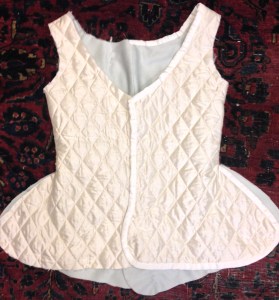
overview

The compromises I made are in the materials: pre-quilted silk (with a cotton backing), lined with wool-cashmere, and bound in silk grosgrain ribbon. The size of the diamonds and the machine quilting, plus the wool lining, make this an inauthentic, inaccurate garment. The shape, construction, and binding are at least correct, as far as they go. But the lusciousness of that remnant table cashmere and the soft colors please me immensely, and I do expect to be warm.

corner

This has been a quick project, with the majority of time spent on the binding. As in the Atwater-Kent waistcoat, I’m top stitching with a running stitch on the inside, folding the ribbon over, and hem stitching on the outside.

Will this feel like a hair shirt of shame under my gown, compromise as it is? Maybe, but at least it’s cashmere.
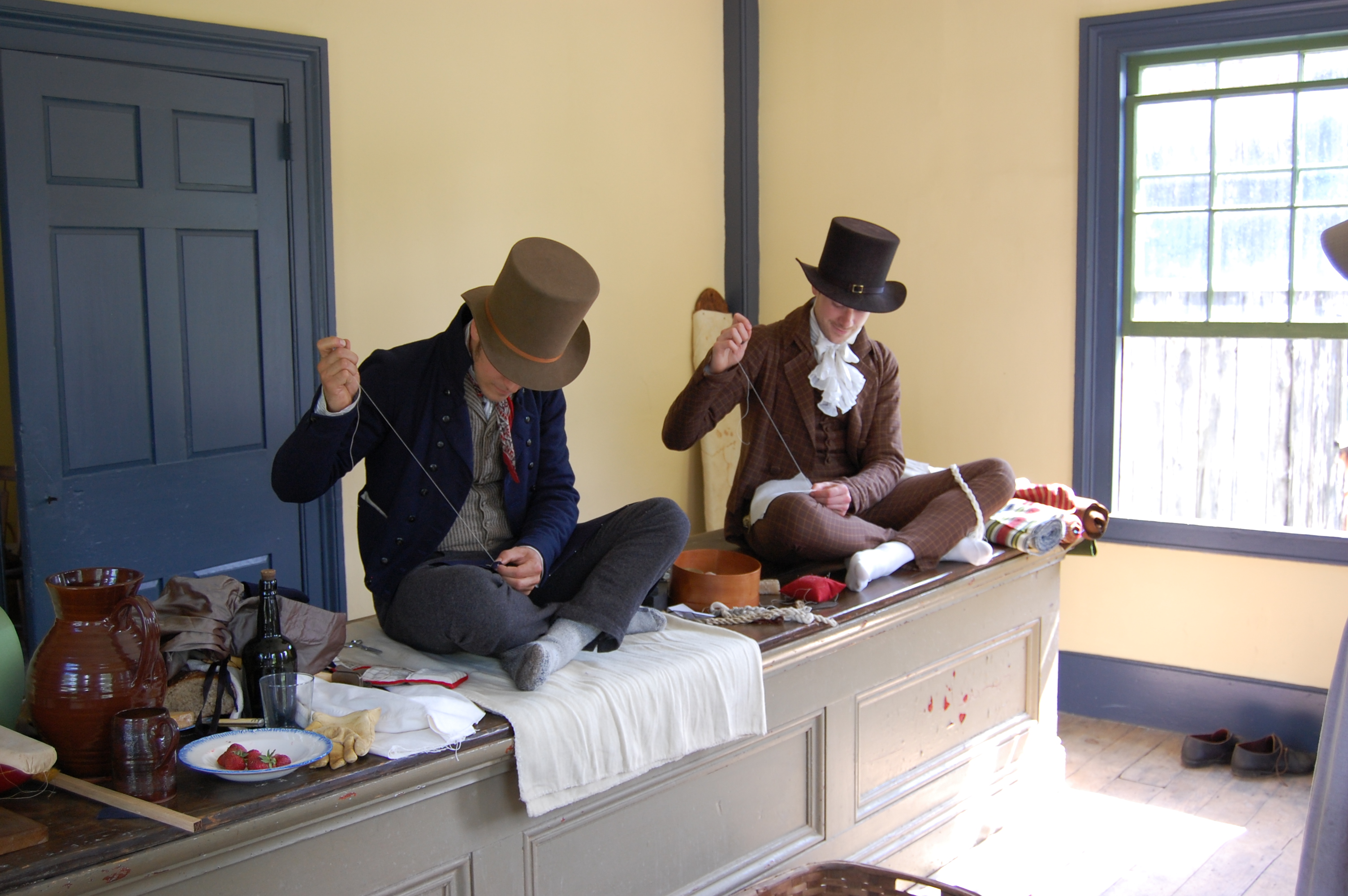
Proper Sewing for Proper Garments

Synchronized sewing
Synchronized sewing

Tailoring: It’s the thing, right? A well-cut, well-fitted, and well-crafted garment fits like no other. Why do you think I prefer my historical clothes? They’re fitted to me, so they feel right.

There are lots of resources, if you’re willing to dig a bit. Last year, thanks to Mr Cooke, I brought you The Taylors’ Instructor. Good stuff, right?

But wait: there’s more. So much more. Not just the V&A Tailoring Reading List. Actual media. You can watch tailors using thimbles properly, and pad stitching with grace and ease. Prepare yourself for the bona fide English accent as Rory (winner of the 2009 Golden Shears Award) Duffy teaches you a thing or two in these videos.

Just want to know about thimbles? Here’s Savile Road Training to teach you technique.

Sheer Madness

Mercury is retrograde and the schedule is tight, even for me, as I made the plans I’ll put into action at the end of this week: a special event Thursday night at work, followed by mad packing and a drive pretty far into New York.

I did say sheer.

Yes: I am going to Genesee. It’s a long drive from here, so I’m happy to be picking up some friends in Albany (neither of whom live there) for company and some relief behind the wheel. Of course we’re taking our car: it’s the Quartermaster cart.

Since this is one of two occasions when I can portray someone in trade rather than in service (and a better trade than selling fruit on the street), I made a new gown. And a new Spencer. And a new reticule. And cut out a new coat for Mr S, with a newly (fingers crossed!) patterned collar, based on plates in Lapsley and Queen and images texted from a friend.

Yes, I am a little crazy, but it does make life interesting.*

Finished –even hemmed– days before the event!

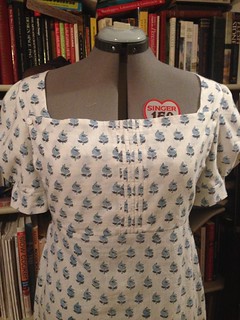
The gown is made from fairly sheer block-printed Indian cotton found on eBay. The pattern is based on one in Nancy Bradfield’s Costume in Detail with a bib front and tucks in the center back. To help with measurements, I also referred to the bib-front dress in the back of Bradfield’s book, as patterned on the fabulous 19th US site, as well as Janet Arnold.

The first bib-front gown I made ended up a little slanted: your mileage may vary, but I find patterning on opioids is not recommended (I sewed while recovering from hip replacement surgery). This one seems a little better, though the fabric came in for some commentary when I was working on this in a room full of light infantry “men.” We devolved from “chicken on flower” to “Seagull on a bush” in describing this buta-like shape. I only bled a small amount on the tucks, despite texting while sewing.

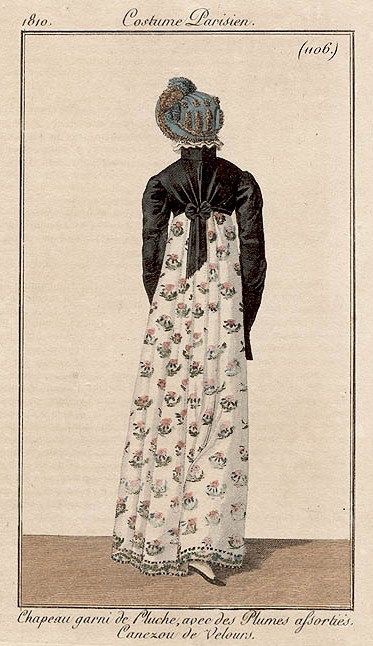
Canezou de Velours, 1810

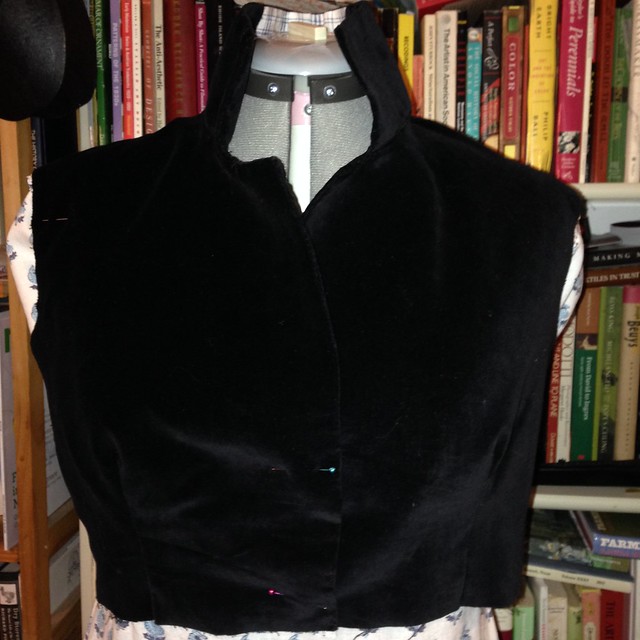
Inspired by this 1810 fashion plate, I made a black velvet Spencer as well. That’s finished, save for the buttonholes, though there will be no texting while button holing.

Men’s waistcoats often have cotton or linen at the CB neck.

It got pretty matchy-matchy when I did the lining.

You will note that the plate describes a “Canezou de Velours.” Canezou was new to me, and while I don’t trustthe internet too much, here we are with Larousse: Vieux. Corsage de femme en lingerie.

Huh. It seems to be a lightweight-bust length garment for women.

Here’s the OED:

Oxford English Dictionary

canezou canezouHist.

(ˈkanzu)
[Fr., of unknown origin.]
A woman’s blouse-like garment of muslin or cambric. Also attrib.
1827 Lady’s Mag. Sept. 510/2 A canezou spencer of embroidered muslin. Ibid. 511/1 Muslin canezous over high dresses. 1893 G. Hill Hist. Engl. Dress II. 241 A cambric canezou..with sleeves full to the elbow. 1898 Daily News 26 Sept. 6/4 When the Restoration came in 1815,..Fleur-de-lys appeared on everything… The canezou replaced the hideous spencer.


Ah, the hideous Spencer. I rather like them, myself.


*A very long time ago, I had a drawing teacher who said there is never an excuse for being bored. There is always something to do, to see, to observe. That was my first lesson in being present. Perhaps I take this statement a bit too literally.

Some Velvet Morning

Sewing velvet is a strange experience. I’m working with a cotton velvet from a remnant table; it has a nice hand, but still crumbles and covers the table with fabric soot when I cut it. It’s not easy sewing black fabric with black thread, even in strong morning light, and “Some Velvet Morning” is an unhelpful thing to have stuck in your mind (especially the Lydia Lunch rendition).

With just one yard of 44″ wide stuff, cutting a Spencer took a little doing and some minor piecing. I borrowed techniques from some waistcoats I’ve seen recently, and pieced in linen at the back collar lining. That seems to be pretty common, and makes sense from a wear and hair perspective.

I patterned this on Monday morning before work, basing the pattern shapes on an 1810 fashion plate and an original at the MFA Boston. The MFA’s Spencer is particularly satisfying because of its connection to Lexington, Massachusetts. A New England-made Spencer is a happy find.