Hair a la Titus and the Resting Bingley Face

Reader, it is hot where I live. June, July, and August are tiresome months here, humid and warmer than what I became accustomed to in New England. After a year, I realized I’d had enough of trimming my hair myself. I texted a friend with good hair, and found someone to liberate my neck. Excellent, right? Well…it’s all good until you want to dress up.

19th century history hair being somewhat mullet-like, my short in the back bob was not going to get the job done for last weekend’s Jane Austen Ball at Gadsby’s Tavern. What to do? Cap it, of course– there’s no way I could figure out how to tie a turban elegantly and reliably without giving up the hope of finishing some other projects I really want to finish this month. So, a cap/hat/sewn headdress. Aside from the examples seen in film adaptations of Jane Austen’s novels, what evidence is there for these concoctions?
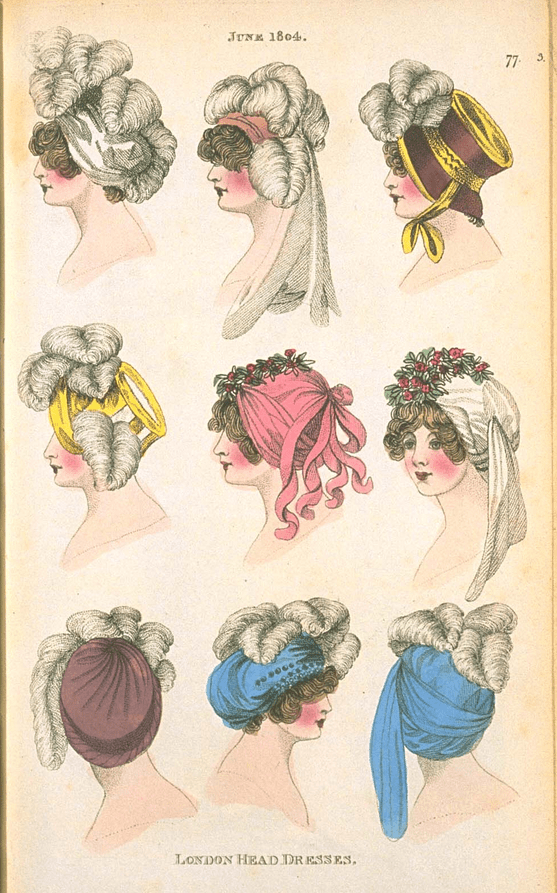
ladies heads with various wraps and feathers
London Head Dresses, June 1804
woman in a gray tam o-shanter cap
Detail, Plate 11, April 1799 Journal des Luxus und der Moden.

Enough, it would seem, to be getting on with. In addition to the 1804 Ladies’ Head Dresses plate, there are plates in the Journal des Luxus und der Moden showing headdresses and wraps, as well as an image of a pelisse and matching tam-o-shanter-like hat. These are simple enough to make, and I managed one in less than 24 hours.

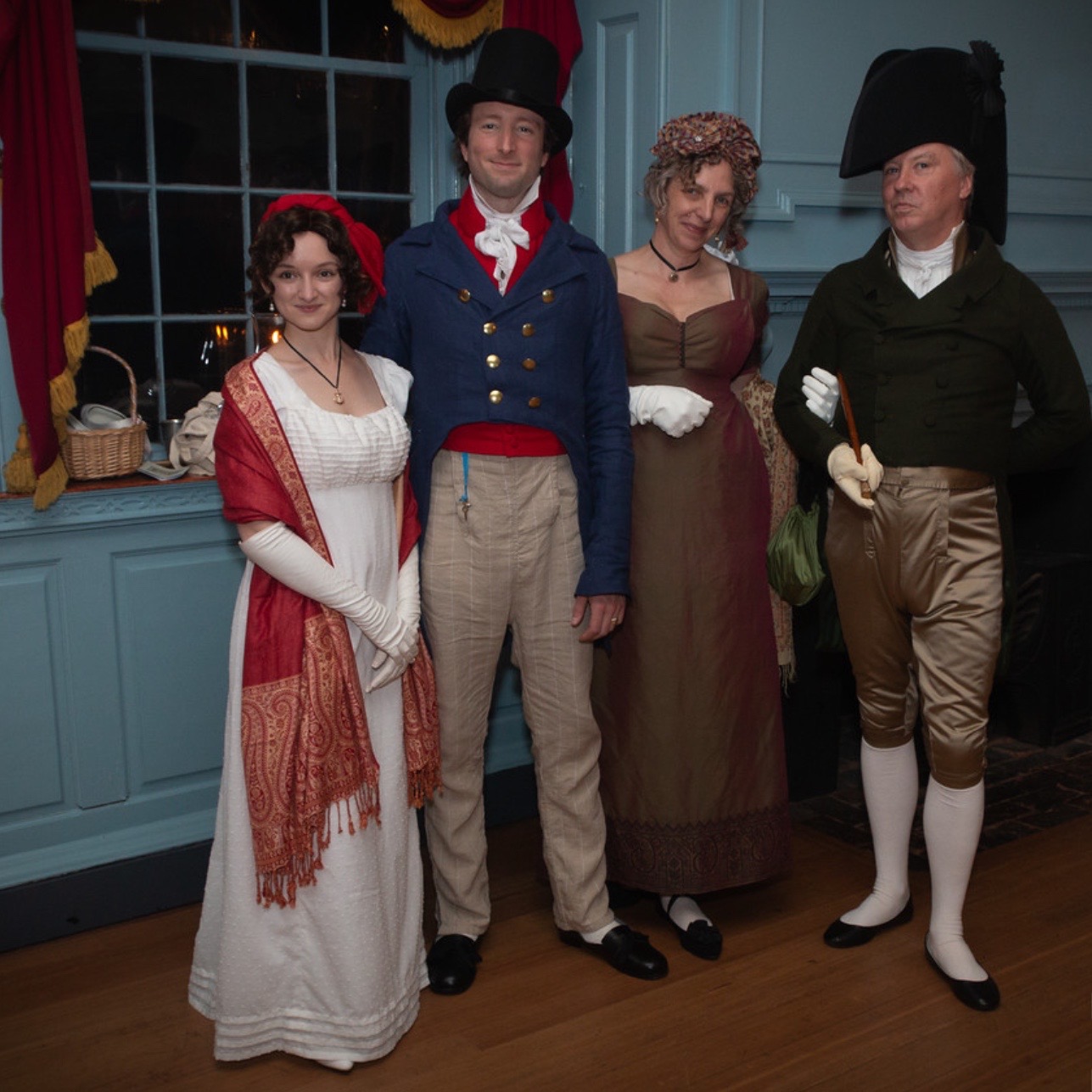
two couples in historical dress
I had no idea Drunk Tailor and I would color coordinate so well. Also, Dat Hat.

The fabric is left over from a gown I made to wear to a dance in Salem one spring, , but which happily coordinated well enough with the sari gown made for a photoshoot, and also worn to Salem for a dance. Briefly, the cap is made from scraps, ornamented with a two-layered rosette centered with a paste button, with the bulk of the caul gathered up and stitched down to hold the shape and embellished with three coordinating tassels looped onto a gold silk-wrapped cord. In the end, not too resting Bingley face, and a satisfactory cover for what I’ll call my hair a la Titus when I’m not in the current century. Drunk Tailor’s hat covered, somewhat, here.
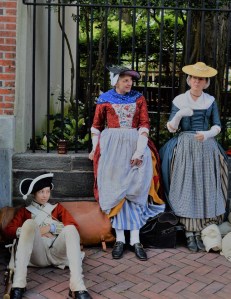
Gathering Thoughts

Someone must watch the baggage.

You only live once, as they say, so you might as well enjoy yourself, and have a nice apron while you’re at it.

At last I have finished the one I made to serve as a demonstration model for the apron class I taught for Crossroads of the American Revolution. Plain, unbleached linen (osnaburg), it will be a good, serviceable garment well suited to getting dirty through use. There’s a lot to be said for filth, and my first-ever apron has acquired a fine patina of stains and wear.

So why make a new one, aside from needing a teaching aid? Especially when you already HAVE a checked apron that’s looking used, and you have others in your wardrobe: why? One reason was the sheer cussedness of making the plainest, dullest, least-pretty item as finely and carefully as I could. Another was that the more I looked for apron data and examples, the more I noticed plain linen aprons. Yes: the preponderance of aprons are check, but looking at Sandby again made me realize that plain was documented, and under-represented in living history.

Sandby shows working women in checked and in blue aprons, but he also seems to depict women in plain, unbleached linen aprons, particularly the women in the street scenes. All the more reason to make up a plain apron, when your preference is portraying the urban underclass.

It’s also a good chance to hone one’s skills and keep in practice when you’re avoiding sewing the things that need sewing, like new shifts. And a basic project is meditative in a way that a new pattern is not: making stitches small and even is to sewing what scales are to piano playing or singing.

The first supervised apron I ever made is described here, and I’m pleased that my skills have improved since.

Stroke gathers are worth practicing, since they’re used on shifts and shirts as well as aprons; I’ve even used them on early 19th century garments to evenly distribute fine cotton lawn across the back of a gown. Sharon Burnston explains them here. I don’t know that there’s any one “trick” to them aside from patience and even stitches, but that “trick” will take you far in assembling pretty much every hand-made garment.

Upgrading Reenactor Mouse

When all else fails, sew. And if that fails, sew something else. After a mad rush to get the gents into their new clothes for Saturday’s Battle Road business, I found myself at loose ends Sunday morning. I toyed with sleeves on the Space Invaders gown, and stitched a shoulder seam on the coat Mr B gave me last weekend. (It does not fit his shoulders, but his guess that it might work for the Young Mr was correct: somehow, Mr B cut a man’s coat to a boy’s frame.)

Original mouse and upgraded mouse (now with whiskers!)
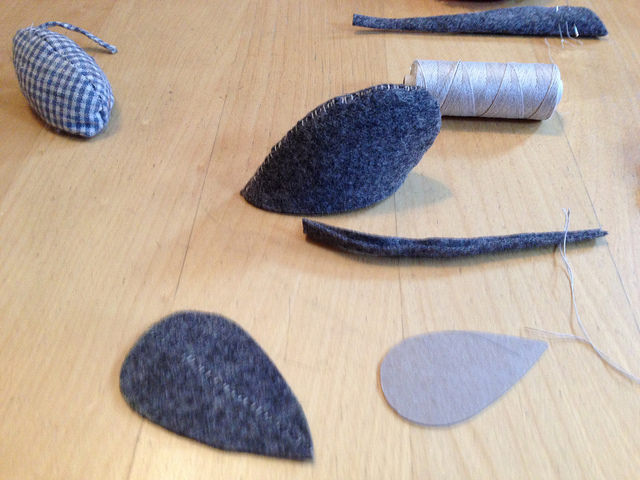
mouse parts
mouse parts

The bonus of this, aside from my amazed gratitude at a lovely coat well on its way for the boy, was an upgrade to reenactor mouse. Poor reenactor mouse was made at the farm from clumps of wool and scraps of check linen. New reenactor mouse is far fancier, being made of cleaned wool batting, catnip, and a scrap of broadcloth that is probably the $65/yard mixed grey wool I think it is. Lucky kitty, no?

The pieces are simple: two mousey-shaped backs, a roughly oval pasteboard base, a strippy scrap for a tail, wool batting, and catnip. Linen thread for stotting, whipstitching, and whiskers. Stitch the backs together (I had to piece the base from a scrap, so stotted bits to look like a mouse hide. Why not?)

Nearly stitched up mouse

When the backs are stitched, turn and press. Pin the base to the body on one side. Stitch to near the center back seam.

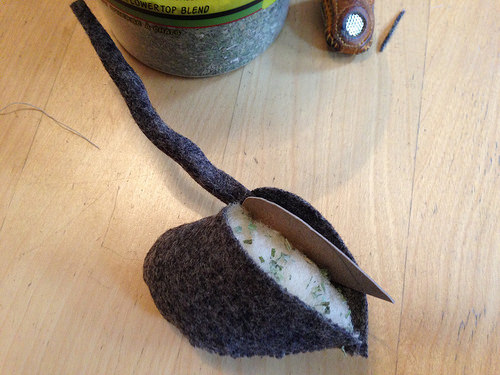
Whip stitch the tail to the inside of the mouse base. At this point, you’re ready to stuff the mouse. I rolled the wool batting in the catnip and stuffed the back, poured a little more straight catnip in, and then finished off with another bit of catnip-rolled batting.

This is where the little pasteboard or chipboard base comes in. You slide this in to the mouse sandwich before closing the last base seam. (It helps stabilize the mouse, so that it skitters across the floor more satisfactorily when batted.)

nearly there. full of wool & catnip.

Stitch the final seam. Make sure the seams are sturdy, as they’ll be going up against claws. I like to thread doubled linen thread through a large-eye needle to make whiskers; be sure to knot on both sides of the mouse’s nose.

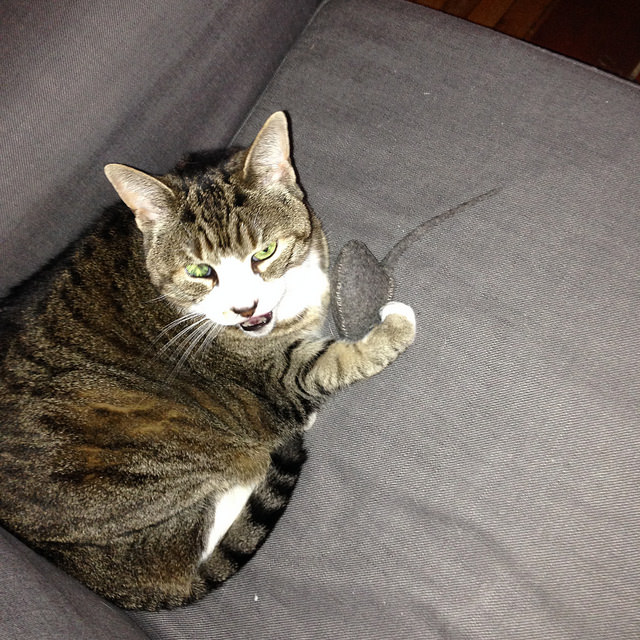
All you need to do now is hand the mouse over and back away. Kitty requests some privacy with her new mouse. There’s a flickr album if you want to see the progress photos of a quick and silly project and make your own Wooly Mouse for Progressive Pussy Cats.

a little privacy, please?

[Not Quite] Good Enough Coat

When not working on the Unified Theory of Living History,* I’ve been sewing for the February program in Newport. You know about the skritchy brown gown, and then there was the Great Coat Obsession. Well, here it is, in unpressed previews.

The photographer and I had barely achieved emotional détente by the time these were taken after a foray out of doors in the late afternoon, but we survived on willpower and the promise of strong beer and here you are. Two and three quarters yards were not quite enough at this length, though perhaps the coat does not have the close in the skirt. For $13, I think I’m still okay with where this is headed, though buttons will be the very devil.

My finger tips are so calloused that working touch screens is getting hard, and silk thread practically shreds when I try to make deaths head buttons. It’s still too early to give in and buy buttons, but there will be swearing ahead.

Back to the coat: there is enough wool for a cape or two, if one is pieced or false. It’s hard to tell how warm this will be, until the buttons are on and the body lined. Wearing it outdoors on Sunday did make me think about the wool flannel shift in a collection near me, and how nicely cozy that would be for winter.


*Stewing about recreating the past