

The dirt on Fort Ti came home on my shoes. And my petticoats. And my gown. And possibly my face, which could explain the reactions I got when I stopped for gas on the Pike Saturday evening.
It’s incredible how how dirty, dusty, and straw-filled a room can get– and that’s just the officer’s room. For all I know, a horse had been sleeping in the back corner of the barracks room we cleaned– who else would leave so much straw?
Regular readers know I have a thing about portraying women’s work in the past, as well as historical cleaning methods and what I like to call “experimental archaeology” and other people call “that crazy hobby- thing- where you get cold and dirty.” We started with mop making, of course, and when I loaded the car on Friday morning, I was pretty well pleased with my swag.

So, what happened? How did it go? What did we do? Our Girl History provides a descriptive photo essay overview of the day. My experiences were more limited, as befits someone of my status: officer’s servant.
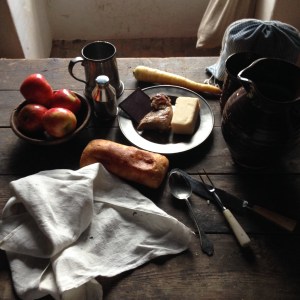
Every good experience begins with a meal. Friday night supper included bread, cheese, pork loin and apple, imported from Rhode Island. Yes, I also helped myself to bacon, to ensure none was wasted. Bedtime for officers’ servants comes early: I’m not a stranger to rope beds, but found this straw tick far more comfortable than a previous arrangement elsewhere.

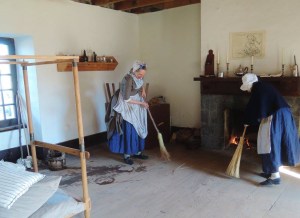
After formation, to tasks. I was ably assisted by Miss Sam, who was a better height for the brooms than I. The brooms are speculative on the one hand, and later on the other. The corn broom was markedly more effective than the broom straw, which disintegrated with use, though not for lack of care in making. We were up against some serious accumulation.
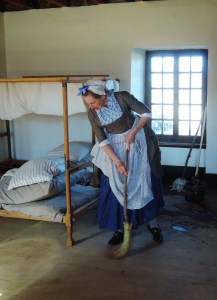
Housekeeping and servants manuals from the period, like Hannah Glasse, tell you the cleaning must be done every day. It’s certainly something I heard within my own lifetime, though an ideal I continually struggle to achieve despite the advances of Mr Kenmore. The general rule is to begin at the top and work your way down: gravity is, at last, your friend. I use brushes– a large, soft round paint brush and a stiffer circular whisk– to remove dust and dirt from upper surfaces, and cobwebs from corners, and other wall-borne detritus. Gentlefolk: your cleaning ladies know much about you in any century.
After sweeping (yes, into the fireplace or out the door, it’s that simple), scrubbing. I scrubbed the baseboards first with vinegar and water (the vinegar infused with lavender for several years). Filth, my friends. Then we mopped. Again, filth.

I would have preferred to do another dust collection on the floor– the water did pool a bit on the dry dust that remained, but swabbing seemed to work and I believe we left the floor cleaner than it had been. The three mops we tested (wool, cotton, and linen strips) each had benefits and deficits.
The cotton and wool caught on the rough floor boards, but did a good job spreading water around the floor and lifting dirt. The linen strips were better at not catching and at scrubbing.
No matter what, the water got filthy and took on the look and nearly the consistency of the chocolate we drank that day. Remember the iron museum rule: don’t lick it! That rule applies everywhere.

Everyone and everything got cleaned Saturday. Miss V broached the laundry with vigor, but discovered that possibly untoward things had been done in her laundry tub. Things that might involve shoes, and blacking. Marks were left on shifts and shirts, so even the wash tub got a scrub this garrison weekend.
Some of the best comments came after the fact: I’ve never heard cleaning called “one of the coolest things” seen all day, but when someone says it helps them see a space in an entirely new way, I’m incredibly happy. There’s so much about the everyday use– and maintenance– of space and objects and each other that we take for granted in our own lives. Surely the people of the past who had servants took all that work for granted.
But for me, enamored as I am of details and of the quotidian, transforming a space through the everyday work of women is a job with doing. Thanks to Fort Ti’s staff for giving me the chance to step back in time and enjoy (really, I mean it) a day of hard work bringing the mundane back to life.
Unless otherwise noted, all photos by Eliza West, courtesy of Fort Ticonderoga.


 Kirsten Hammerstrom
You must be logged in to post a comment.