A quintetto. Musical Amateurs. Hand colored etching by Piercy Roberts, after George Moutard Woodward, 1803. British Museum1981,U.199
E’en Age itself is cheard with Music. It wakes a glad Remembrance of our Youth, Calls back past Joy’s and warms us into Transport. Vide Rowe read the lines at the top of this engraving, and while I’m fairly confident the Rowe referred to is Nicholas Rowe, I have not connected the quote to him.
Instead, you’re treated to the image that struck me as I searched for 1820s maids at the British Museum. Happily, my household is one cat and one cockatoo short of this reality, but it pretty much sums up breakfast time Chez Calash, when I am too slow with the breakfast portions, and the beasts begin to sing.
Happy Thanksgiving, American readers. I’m taking a short break from museum thinking to wrangle our dinner to the table, attempt to finish a gown, and catch up on some sleep.
The thing about those foxes is that at first glance on my phone, I thought they were the muscular lycanthropic squirrels of historic house wallpaper, but what two squirrels would be doing with a rooster– supporting him in illness? holding him hostage for an acorn ransom?– was beyond me.
At least as roosters, this headdress makes a bit more (morbid) sense, but it’s still a satirical engraving that makes less sense to us in 2014 than it did in 1777.
A companion pl. to BMSat 9813. A pretty young woman wearing a décolleté négligé, stands with her back to the fire, her gown raised to leave her posterior naked. She holds a book: ‘The Monk – a Novel by M’ [‘G. Lewis’, cf. BMSat 9932]; another is open on the floor: ‘Œconomy of Love by Dr Arm[strong’, 1736]. A cat rolls on its back. On a table are a decanter of ‘Creme de Noyau’, and an open book: ‘The Kisses’. On the mantelpiece are flowers and an ornate clock with embracing cupids. A picture partly covered by a curtain represents Danaë receiving the golden shower. The room, apparently that of a courtesan, is luxuriously furnished. 26 February 1801 Hand-coloured etching, British Museum, 1935,0522.7.12
I’ve left that caption intact, though it seems quite long enough for a blog post itself. This image turned up on Twitter (you can follow me there @kittycalash, expect randomness) and delighted me at the end of a long, tough week. I’m particularly taken with the cat, which resonates with an lolcat that floated about the interwebs last winter. The interwebs can be a strange place…
But aside from that silly cat, there are a wealth of details in this image, some of which are explicated in the caption.
What struck me- after the cat– was the slipcover on the sofa. How lame is that– but it’s true. Floral print, I suspect, but possibly woven, it’s loosely draped and long. I’m more familiar with the checked linen slipcovers seen in representation of New England interiors, so the floral really struck me. I suppose those linen checks symbolize all the puritanical uprightness and restraint of early Federal New England dons (if you believe in that kind of thing), while the loose floral print drapery tells you everything you need to know about our Rumpford friend.
We all see what we want to see…cats, slip covers, or courtesans.
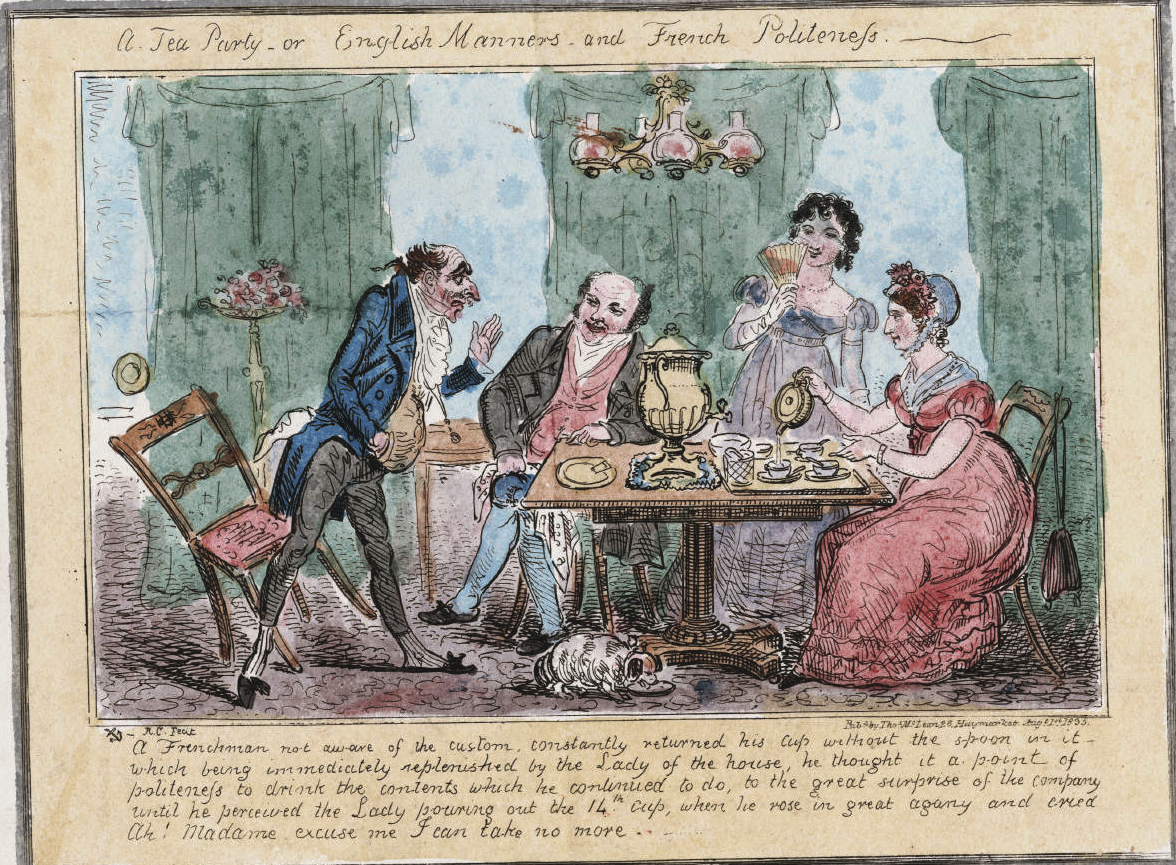
A tea party, or English manners and French politeness. Hand-colored etching on laid paper by Robert Cruikshank, 1835. Lewis Walpole Digital Library, 835.08.01.19
The story of the Frenchman who did not know the customs for refusing more tea may well be apocryphal. I cannot find the citation for the “French officer” whose cup was continually refilled by an 18th-century Providence hostess, but did find this cartoon from 1835 illustrating the same trope. Cliches and stereotypes, always with us. If there’s a lesson in here, it may well be, Don’t believe everything you remember.


![Miss Juniper Fox. [London] : Pub. by MDarly 39 Strand, Mar. 2, 1777. Lewis Walpole Library , 777.03.02.01.](https://kirstenhammerstrom.com/wp-content/uploads/2023/03/8db99-image11.jpg?w=640&h=815)
![A companion pl. to BMSat 9813. A pretty young woman wearing a décolleté négligé, stands with her back to the fire, her gown raised to leave her posterior naked. She holds a book: 'The Monk - a Novel by M' ['G. Lewis', cf. BMSat 9932]; another is open on the floor: 'Œconomy of Love by Dr Arm[strong', 1736]. A cat rolls on its back. On a table are a decanter of 'Creme de Noyau', and an open book: 'The Kisses'. On the mantelpiece are flowers and an ornate clock with embracing cupids. A picture partly covered by a curtain represents Danaë receiving the golden shower. The room, apparently that of a courtesan, is luxuriously furnished. 26 February 1801 Hand-coloured etching, British Museum, 1935,0522.7.12](https://kirstenhammerstrom.com/wp-content/uploads/2023/03/0cd30-rumpford.jpg?w=640&h=898)
 Kirsten Hammerstrom
You must be logged in to post a comment.