Sacque Rationalizations

Before I get any farther along in the process of making a sacque (and I have not made much progress) I thought I should start to really look at gowns, and try to understand them.

Not only do I need to understand how they’re made, I want to understand how they change over time, and what’s appropriate for different time periods and situations. This will, or could, have some bearing on what I make for the gentleman accompanying me to the celebrations for which this gown is being made. If I start from Mr S, whose best coat right now is the 1777 Saratoga private’s coat, then I ought to have nothing better than a second-hand sacque several years out of date, and that is reaching indeed.

SacqueBySacque_back
What good fortune it is that the LACMA dress seems to be a gown in flux! This is the brown silk cross-barred gown with an assigned date of ca. 1760, which seems to have been abandoned in mid-alterations. Trim down the rights and left fronts ends abruptly at the waist, and two halves of what might have been a compère front lack any trim but boast plenty of holes. The front skirts come close together, but it’s hard to tell if they are meant to nearly close, or if the gown is fitted to a mannequin that’s too small and not adequately padded out.

Replicating a gown in mid-alterations would be interesting, but not what you’d wear to a ball, so I kept looking. In Hamburg there is another cross-barred sacque-back gown from about this era. There are similarities and differences, and never as much information as you’d like to have. Who owned and wore these? Who made them? When and where were they worn? We’ll never know, but at least with two similar gowns one can fill in some details for another, or help us understand them both.

The serpentine trim on the pink gown in Hamburg makes clear how unfinished or mid-alteration the brown gown in LA really is despite the visual interest created by the fabric itself.

Sacque_by_SacqueFront

So, what to do for my gown? And when will it be from? LACMA is hedging their bets with ca. 1760. I think Hamburg is pushing it a bit late with ca. 1775, but a ca. 1770 date for a gown based on the two seems reasonable. That would mean that the coat Mr S wears should also be ca. 1770, or newer than his green linen coat and older than his Saratoga coat. And luckily, I already have a plan, some fabric, and a pattern as a place to start.

While the ball itself has no date per se, it is in celebration of Washington’s Birthday, which puts it after 1775 at the earliest (think transfer of command of the Continental Army in Cambridge). Does that make a ca. 1770 gown too early? It would depend, I think on how one imagined the ball and oneself. If you’re a frugal woman who has lost much in the war, you’ll remake your gown; should the flounces become the shirred cuffs of later gowns? Could the kind-of compère front of the LACMA gown be a stomacher cut in half and stitched to the sides, with the pin hole indicating where trim had been removed from a once-was stomacher? Is it reasonable to make a compère front for a ca. 1770 gown? I want one mostly to avoid the stomacher angst I always seem to have, and in a way it marks a place between stomacher-front and front-closing gowns.

These unprovenanced gowns stand without the particular context and personality of their owners; the fun and the challenge for us, as costumers and reenactors, is in trying to bring our personalities to the fact-based garments we create.

Green Indeed

Regency Green: Kochan & Philips + Robert Land = Matchy-matchy.

As expected, Mr Najekci dispatched the K&C wool before the Hook, so last Thursday evening when I arrived home after Gallery Night, there was a box of delicious waiting for me. And, also as expected though mostly hoped for, the wool and shoes were super simpatico. This will be a fun project when I get myself sorted to it.

I have not yet had the time to put all the projects into a spreadsheet, but I think it would help keep things organized and on schedule. For example, I have:

  • to work out the details and rationale of the sacque, vis-a-vis date and style
  • to finalize the Spencer pattern
  • to pattern and fit a frock coat, waistcoat and breeches for Mr S ca. 1775
  • to ask about the regimental for Mr S, which will be wanted eventually
  • to face making a tent by next summer
  • a plan for kettle bags, since I’d like us to pack lighter & more authentically
  • to fix my stays situation
  • an inordinate desire for a splashy bonnet to go with that Spencer
  • two shirts to make up for Mr S and the Young Mr
  • a red short cloak, for easier movement

Once I have a schedule and a plan, making things by deadline is somewhat easier. It’s “bridge” season now, between cooling and heating, summer and winter fashion collections, and that’s as good a time as any to work out plans for the winter. There’s nothing the guys must have for an event that they haven’t got already–for Fort Lee, they can wear their short wool jackets under their 10th MA hunting frocks and be perfectly authentic and warm. (The brown and green coat is 1777, and the Fall of Fort Lee is 1776. The blue and white short-tailed regimentals are 1781. No coat for you!)

So it’s worth taking the time to regroup, even as I rush headlong into projects…and considering I have jury duty (no scissors!) this week, maybe I should add hand-knit stockings to that list.

Sacque it to Me

Every now and then, by which I mean quite regularly, I lose my mind and agree to participate in something that I know little about (tallow candles? hadn’t dipped a candle in decades), haven’t really got time for (Saratoga coats, though I managed one in a week), or feel woefully unprepared for (my life in general). This is either madness or a form of life-long learning.

When the lovely Mrs B proposed the group Sacque-a-palooza, I said, “Sure! What fun!” and meant it, too. (We nearly went to an 18th century party last year, but it was snowed out. We would have had to wear our tenant farmers’ clothes, and we would have been embarrassed.) A sacque with a venue? What’s not to like? (For sacques-piration, which is different from what you do while dancing in a fancy silk gown, I’ve started a Pinterest Board.)

What was not to like at first was the yardage requirement: 10+ yards, and I really can’t skimp because of my height. I looked and did not find enough silk (though that didn’t stop me from picking up 7 yards of lovely pinky-lavender taffeta, because you never know when you’ll need to become a Ralph Earl painting). But, I got an afternoon when I could leave work early, and Sew 18th Century and I headed up to Boston to hit the fabric store before descending upon Mr and Mrs B. We did quite well and I like to think we were rawther restrained, considering the table of tropical weight wools at $2.99/yard…thank goodness there wasn’t enough of a grey cross-bar to make a gown for me! Despite my initial dithering, Sew 18th Century talked me into a cross-bar silk taffeta after we confirmed a very similar extant example.

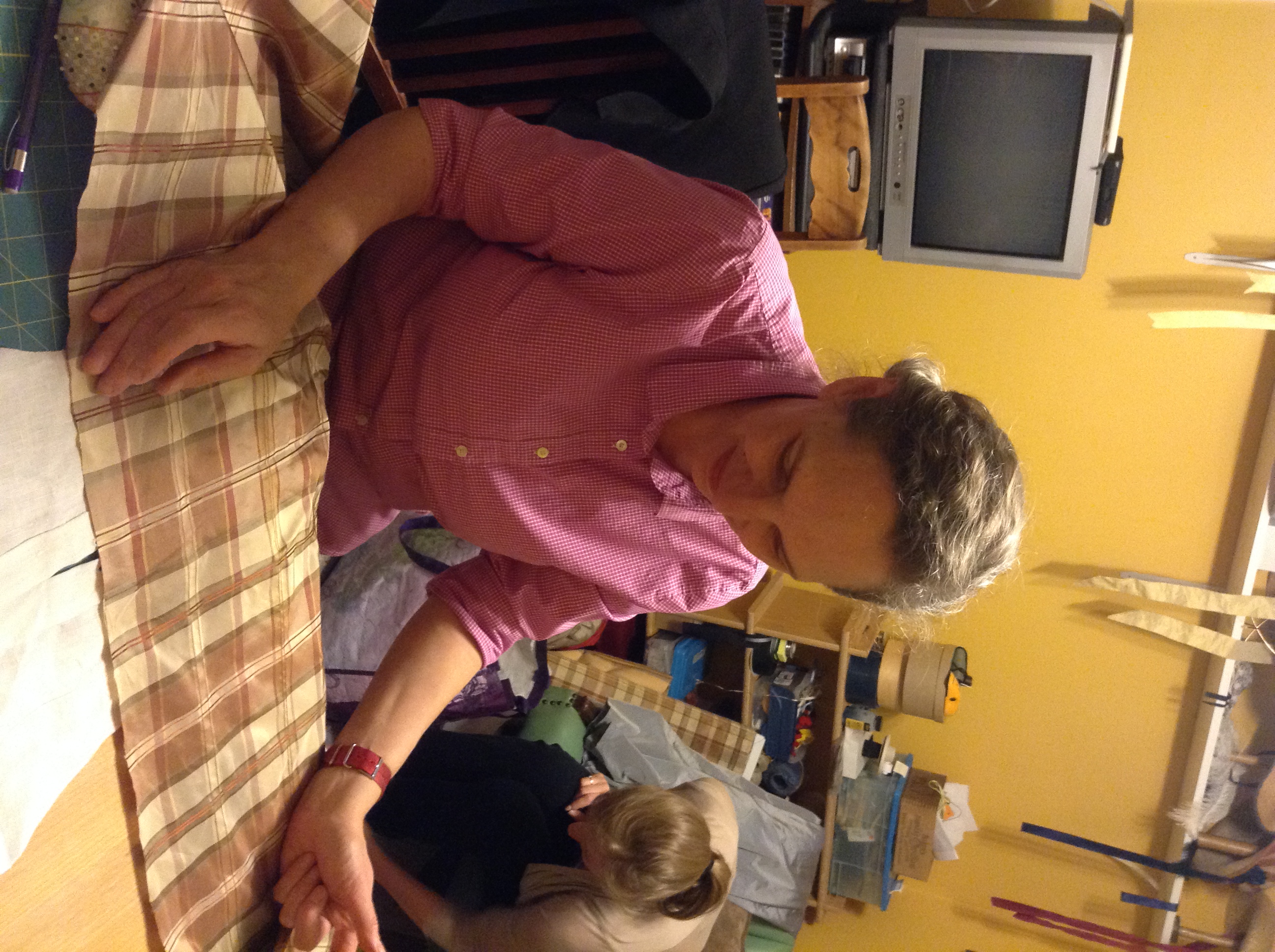
Mrs B is a patient teacher, and helped guide us through the beginning construction steps. This was fortunate for me, because I’m not sure I was qualified to  open an envelope last night, let alone pleat silk. Making a gown under tutelage is a far different and far better experience than wrangling fabric yourself on the back of a recalcitrant and unyielding dress form.

Getting the party started: find your center.
Get the party started: find your center. (Thank you, Mrs S!)

This morning, though I am a trifle bleary-eyed since the tsunami of What Cheer Day finally hit me on Thursday, I am in proud possession of a back lining and a pinned back ready to have the pleats sewn to the lining. That is quite good for a few hours work among congenial company.

I also learned a new mantra, which will be good for me, and a change from wielding the center-finding ruler: Done is better than perfect.