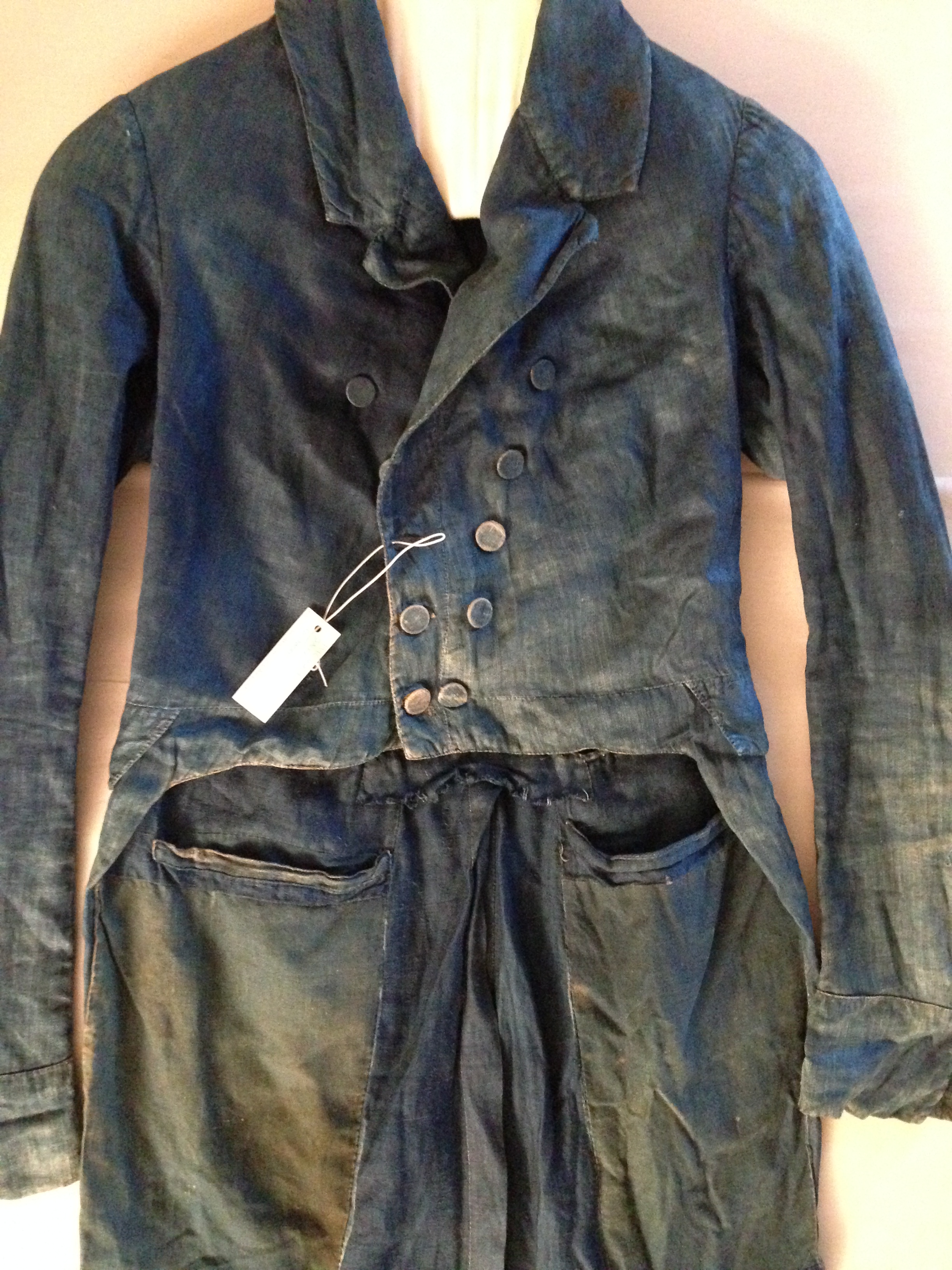
Dating Mr Darcy…

1996.66.4, RIHS Museum Collection

Or at least his coats.

I don’t know about you, but as the summer weather warms up, I like to think wool. I’ve got menswear to sew and desires beyond my knowledge, skills and abilities. Making a wool coat for an event in August seems like a patentable Bad Idea, so it’s a good thing that I have a nice piece of Italian linen-cotton denim-like fabric that I’ve set aside to make a summer-suitable coat for Mr S.

There is a Rhode Island coat, in a Rhode Island collection, of which I am particularly fond. I’ve had this coat in mind for some time now, and have inflicted it upon have shared it with experts several times.  It has a lot to recommend it: a soil mark on the collar, extensive damage and repairs to the left sleeve, fading and wear on the back, fragments of botanical material in the pocket lint, and the nicest linen fabric I’ve ever felt.

This is the coat I wanted to make for Mr S, but then I started thinking about that waist seam, which eliminates this from the style competition for 1812. Rats! But, OK, no reason that we can’t use this as inspiration and make a coat using the fabric but not the waist seam.

1956.9.3, RIHS Museum Collection

So I looked at another coat that just happened to be handy (I know, I am very lucky, and that’s part of why I’m sharing this with you). At first glance, I thought I was good. And by glance, I mean extended looking. But look again: there is a waist seam, it’s just harder to see. So much for the iPhone and lousy light, right? (I noticed the seam today, in even less light, so go figure.) This coat is made of a single twill off white wool can easily be mistaken for plain weave and that is rather light. Very summery, in a way.

Coat style found? Maybe. But I was wondering about the sleeves. I spend a great deal of time looking at sleeves and backs of much earlier coats, so I’m accustomed to a smooth sleeve head. That’s not what you’ll find on this garment, though. This one has gathers, and I thought that was pretty exciting. My closest expert probably had a weird twinge at that moment that he will soon learn to associate with an incoming email from me…

Sleeves, 1956.9.3 RIHS Museum Collection

This is a nice detail, but one I’m not familiar with. The fashion plates on Serendipitous Stitchery’s post do show increasingly full sleeves in the early years of the 19th century, but that detail didn’t fully register with me until I looked at this coat and processed what Mr C had told me about sleeves and shoulders. Seeing an extant example always makes principles more real.

So what next? At work, I’ve started updating the catalog records for these coats, and they’ll go live early next month. Every time we learn something new, we try to update and correct records so that everyone can benefit. That’s the easy part.

The hard part is reconciling style details for Mr S’s coat. In comparing these examples with fashion plates, I think it’s clear that they are both later than 1812 (waist seam) and nodding to but perhaps not fully embracing high style (see the gathers on the white coat, but the blue coat has only one gathered sleeve, which I attribute to maker error). Plausible dates for both might be 1818-1826, bearing in mind that these will be interpretations of styles, the way Old Navy knocks off adapts its sibling Banana Republic’s styles.

I may be back at that fabulous checked linen coat at the Met, with inspiration drawn from Providence’s plainest blue coat. The process always seems a compromise, in part because I do not think Mr S wants a checked coat, and in part because I’d like to use fabric I already have. Still, there is yet another coat to think about…but tomorrow is another day.

More than Just a Pretty Hat

While pretty hats were pretty important parts of the milliner’s trade, many more things were sold in a millinery shop.
Colonial Williamsburg’s Margaret Hunter shop is probably the best-known living history milliner’s shop, and they provide a nice definition and explanation of the trade. But that’s never enough: what’s the primary source information for New England milliners?

While there is documentation of a Rhode Island milliner in the 1830s, and even a thesis on her work, Sew 18th Century and I are working on an earlier shop. I started with Rhode Island newspaper advertisements, because I like the sound of “lately arrived from Providence,” and because I understand that context.

The Rhode-Island American, December 25, 1810. III:20, p. 1
The Rhode-Island American, December 25, 1810. III(20), p. 1

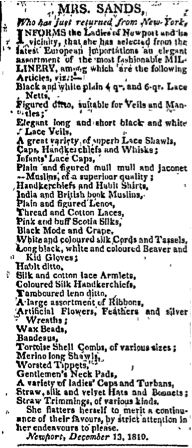
Here is Mrs. Sands, just returned from New York to Newport and vicinity, with a long list of things for sale, “selected from the latest European importations, an elegant assortment of the most fashionable MILLINERY.. viz,:–” (you have the love the punctuation, which is like the Chicago Manual of Style on New Republic crack)

What is she selling? In addition to what we think of as traditional millinery, the “variety of ladies’ Caps and Turbans, Straw, silk and velvet Hats and Bonnets; Straw Trimmings of various kinds,” listed at the bottom of the ad, Mrs. Sands carries:

  • Lace Shawls
  • Caps, Handkerchiefs and Whisks;
  • Infants’ Lace Caps
  • Plain and figured mull mull and jaconet
  • –Muslins, of a superior quality;
  • Handkerchiefs and Habit Shirts,
  • India and British book Muslins,
  • Plain and figured Lenos,
  • Long black, white and coloured Beaver and Kid Gloves;
  • Silk and cotton lace Armlets,
  • A large assortment of Ribbons,
  • Artificial Flowers, Featehrs and silver Wreaths
  • Tortoise Shell Combs of Various sizes;
  • Merino long Shawls
  • Worsted Tippets
  • Gentlemen’s Neck Pads

Whew! That’s a lot of stuff, and many different kinds of things, though all broadly in the ‘accessories’ or supplies range. I am delighted to see Habit Shirt on the list, as I buy my chemisettes, and I am intrigued by the range of handkerchiefs and by the Tortoise Shell combs, in part because I did not buy an assortment of them at a shop in western Rhode Island a month ago (kicks self).

Newport Mercury, December 11, 1811. L:2593, p.1
Newport Mercury, December 11, 1811. L(2593), p.1

In the December 21, 1811 Newport Mercury, Mrs Sands again advertised her goods lately arrived from New York. This is a less exhaustive, but no less interesting, list. “Ladies elegant green velvet mantles, with and without spencers” is particularly intriguing for a Spencer fan, and not particularly clear to me.

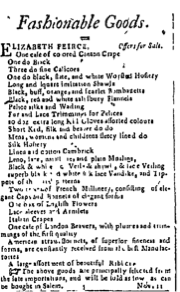
November 21, 1812. Essex Register

In Salem, which is where we will be in August, Elizabeth Pierce advertises her “Fashionable Goods” for sale. She, too, has a long list of things she will sell, from Canton crapes to imitation shawls, hosiery, lace sleeves and armlets, one box of English flowers, and American Straw bonnets.

I suspect that just as retailers do today, milliners of the late 18th and early 19h century probably had an assortment of things designed to bring buyers in to shop (new bonnet styles), and small items to tempt them into impulse purchases (English flowers). You can’t buy a new bonnet every week, but you can refresh an old one.

The East Indies Trade

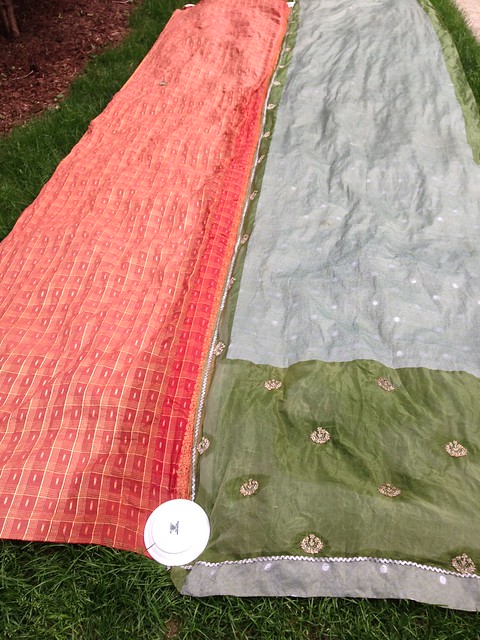
Saris drying after a vodka bath

Like any good Rhode Island trader, I am pleased to announce the acquisition of some India silks. To be fair, I have not burn tested these, so while they were sold as pure and not ‘art’ silk, one never knows till one puts fabric to flame.

As reported elsewhere, these did have an odor (as most vintage and used textiles do) but a bath in vodka and cold water solved that. They seemed color fast, and brighter after washed. It’s really nice when what you read on the interwebs is true, isn’t it? Thanks to the Laced Angel blog entry, Mr S and I found ourselves at the liquor store asking for the cheapest vodka they had. It came in a plastic bottle, and we were compelled to explain we were going to be cleaning with it. The manager seemed pleased to get the tip, since his wife has a collection of her aunt’s doilies and  things in their garage… I think Mr S was glad to drag me away, but he does get more human contact than I do, these days.

Samuel Ames, May 19, 1796

Besides just loving the fabrics and the potential for gowns and waistcoats, trading on Etsy with women in India pleases me logistically and historically. I retain a Huckle Cat fascination and delight with mail services, and am just astonished that a woman in New Delhi can wrap these up and put them into the India mail service and a week later they’ve made it to Rhode Island. How many trucks and airplanes does that take? And in the 18th and early 19th centuries, how many carts and ships and wagons?

Lopez and dexter 1809

By May 1796, the partnership of Brown & Francis was probably faltering (they dissolved that August, probably due to John Francis’ ill health), but Samuel James might well have boughtthe goods he advertised at wholesale from Brown & Francis. There were other importers, of course, in other Rhode Island ports, as Lopez & Dexter in Newport, advertising goods in 1809. Five cases of India silks! Four cases of fancy Prints!

It’s astonishing, the quantity of goods brought from the East, as astonishing in its way as the quantity of goods we bring from the East today. The range of colors, prints, and textures must have been incredible! For all the white muslin gowns of the Early Federal/Regency period that remain in collections, there must also have been numerous patterned gowns, shawls, and Spencers, and fancy ribbon trims, not to mention fancy silk waistcoats made up from the silks.   I think we underestimate the rich texture of the past at multiple class levels– these ranges of goods hint at how colorful and acquisitive our ancestors were.

Use it Up, Wear it Out, Make it Do

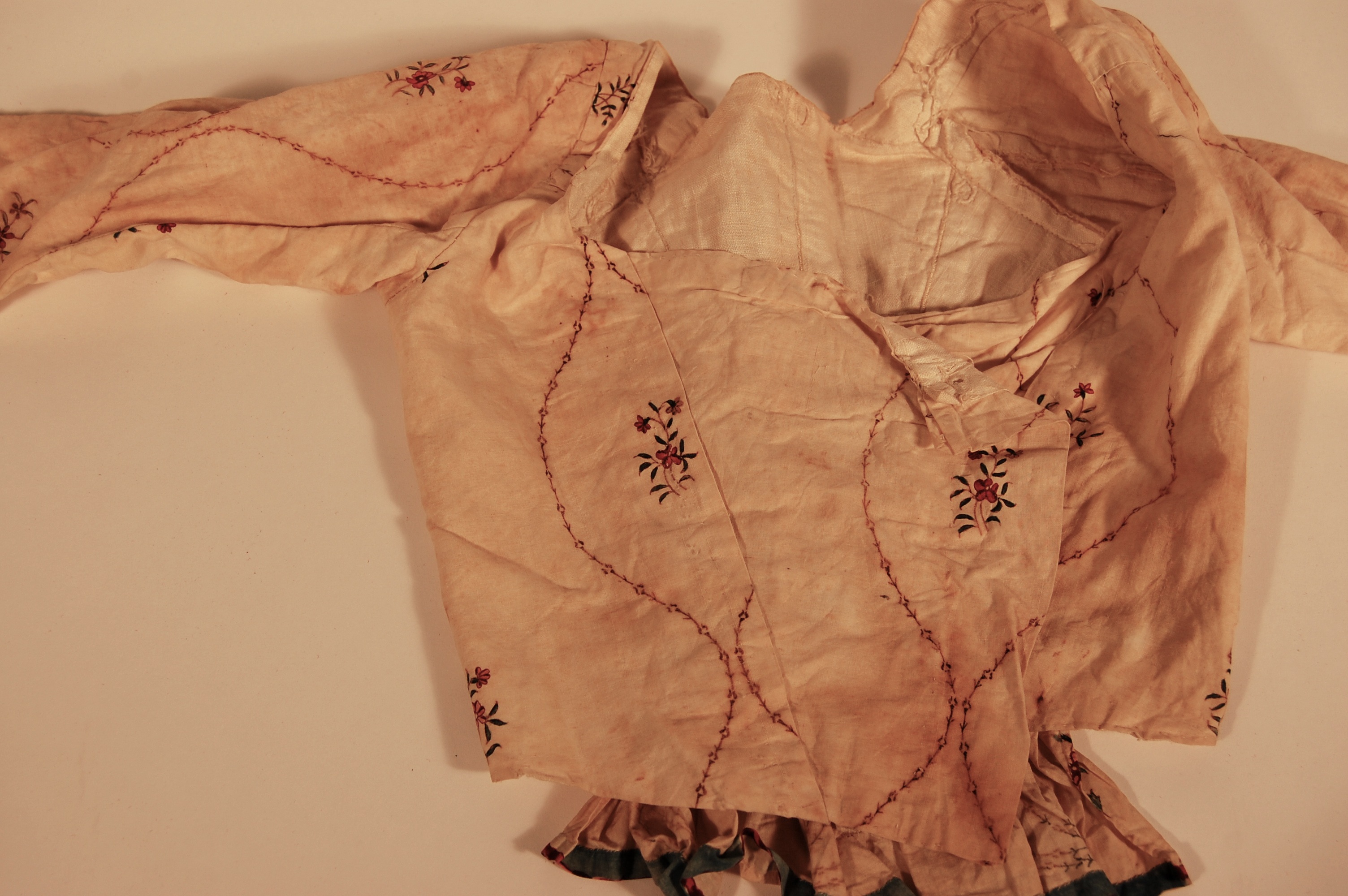
Bodice, painted Indian cotton, 1780-1795 RIHS 1990.36.27
Bodice, painted Indian cotton, 1780-1795
RIHS 1990.36.27

I’ve fallen behind again, as I spent considerable early morning time this past week working on a short presentation for a program in Worcester this past weekend. If you are among the people who do not wake at 4:00 AM panicking about the organization of your thoughts, or whom, exactly, might have worn a heavily-remade bodice, you are lucky indeed.

But I managed to present without falling all over myself, putting out someone’s eye, or causing mayhem and self-embarassment, so, phew! (I do this so much less often than I used to that my anticipatory anxiety is always high.)

Above you can see one of the items I talked about: a re-worked bodice from the collection of the Rhode Island Historical Society.

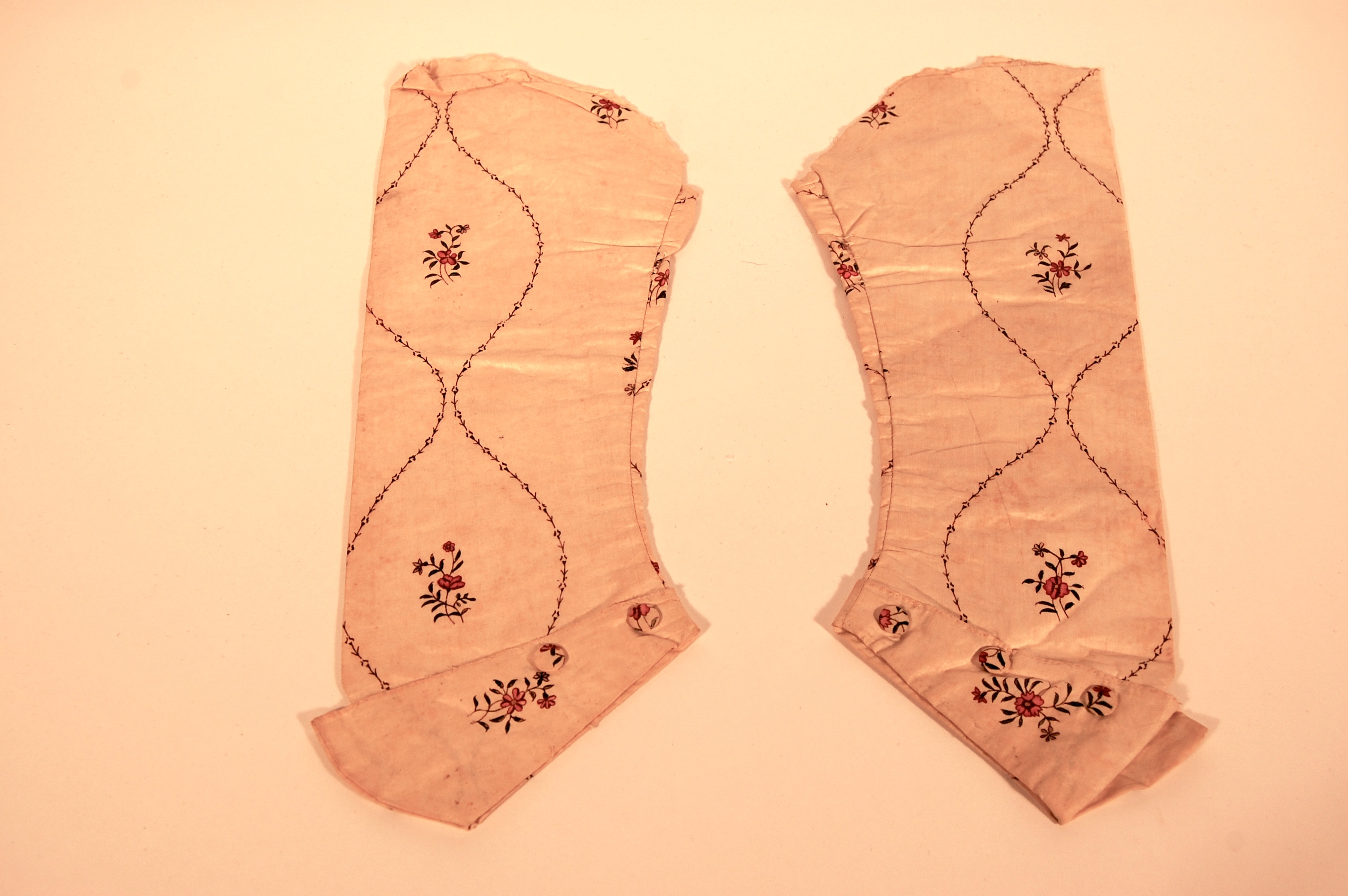
Sleeves, removed from bodice 1990.36.27. RIHS 1990.36.25A-B
Sleeves, removed from bodice 1990.36.27.
RIHS 1990.36.25A-B

I think, once upon a time, that bodice was part of a pieced-back closed-front gown with a matching petticoat.

And then I think someone decided (quite rightly) that the style was too passé for 1795, and altered the gown significantly.

Not only is there evidence of new sleeves being fitted into the gown’s armscyes, we have the sleeves-that-used-to-be. And my dear! No one is wearing sleeves like that this season!

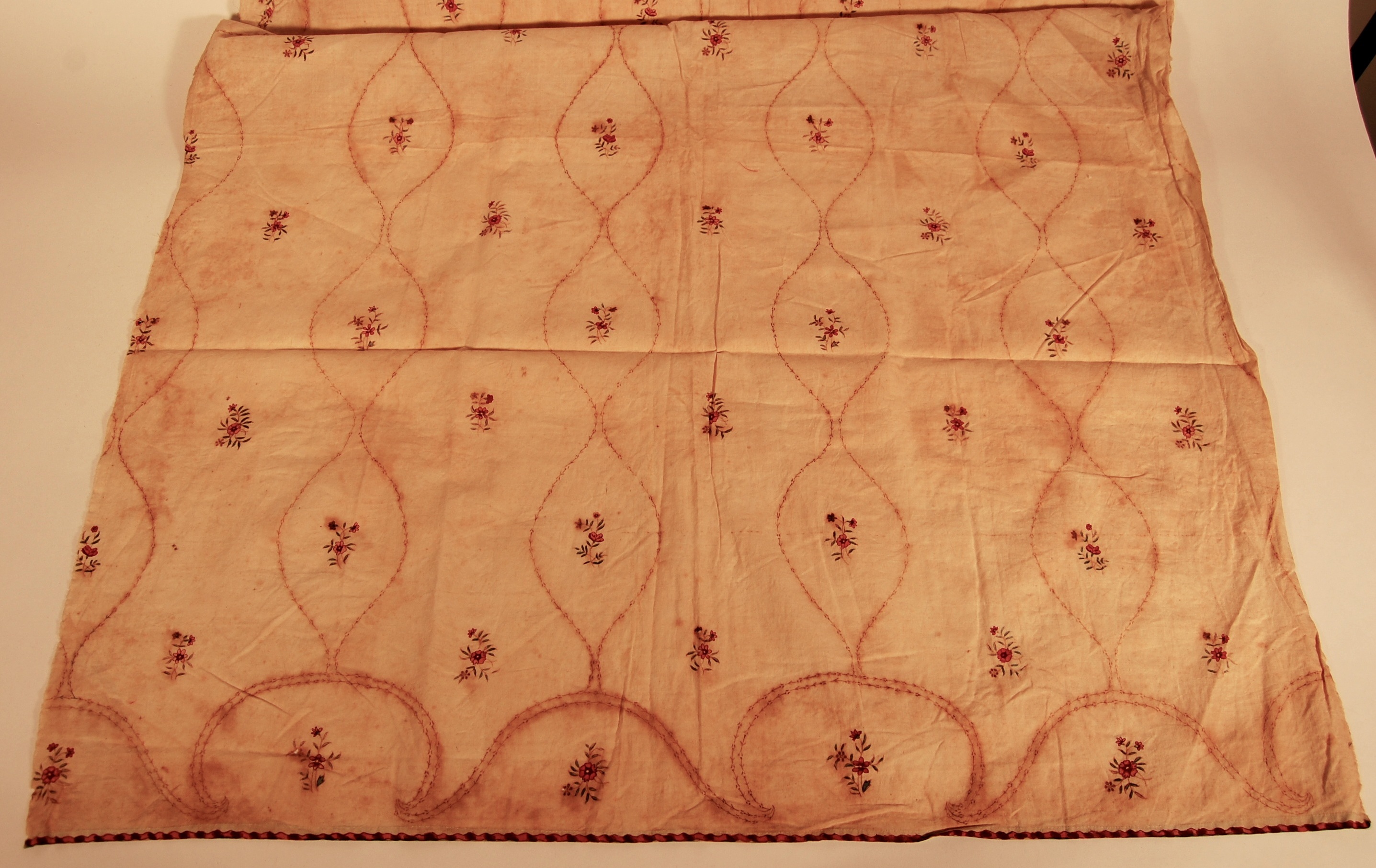
I find these garments in limbo really fascinating. Was that bodice finished and worn with a matching petticoat? (Yes, there’s a panel of that left, too; what a lovely hem!)

Skirt panel, painted Indian cotton. RIHS 1990.36.33
Skirt panel, painted Indian cotton.
RIHS 1990.36.33

Who wore the gown? Was the woman who wore it originally the same woman who wore it altered? I can only guess at this point, and may never find the smoking diary or mantua-maker’s bill. The alterations are not as finely done as the original gown, so I think there are two hands at work here– whose were those hands? There’s always more to think about and learn.

In case you’re wondering, thanks to the Met, we can see what the gown probably looked like in its first incarnation, and then what the alterations were meant to achieve. (Link to the gown on the left; link to the gown on the right.)