
 As a rule, I dislike samplers. Sacrilege, I know, but the rows of letters and numbers and tidy stitches seem to me like running in place, instead of running to get somewhere.
But I do like pictorial embroideries, and on this day, posting about a frothy bonnet in a painting in a Sotheby’s catalog seemed…well, too trivial. So instead, here’s a fantastic mourning picture from the Met. By Charlotte Brown, of Rhode Island, it memorializes Salome Brown and her husband Moses Brown, though not the Moses Brown.
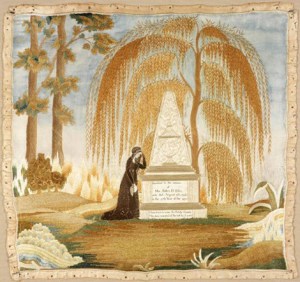 Just because I’m not a fan doesn’t mean I don’t recognize types. In a google image search, I found this item, and knew immediately it was Rhode Island. Made in 1808, it lives at RISD, and a textile designer has done wonderful things based on it. Both RISD’s and the Met’s have the weeping woman, the weeping willow, the urn/cenotaph feature, the pastoral landscape.
But wait…the provenance of the Met’s picture is minimal: “Once property of the late Florence Maine, antiques dealer of Ridgefield and Wilton Connecticut. (Advertisement of embroidery in August 1953 Antiques magazine.)” So I started searching for Moses Brown and Salome Brown in the Rhode Island Historical Cemeteries Database, and I came up empty.
Yes, there are Moses Browns. There is no Salome Brown. But I can’t find a Moses with these dates. That doesn’t mean he didn’t exist, or that this isn’t a Rhode Island sampler; not every cemetery has been transcribed and not every headstone survived. There is one Charlotte Brown with a date worth considering, and she is the daughter of Thomas and Rebecca Brown, and would have been 7 when this was made. Not impossible, but I’m not fully sold yet. I now have more questions about the one at the Met, and about the people memorialized. Those questions may well be answered in an accession file at the Met, but sitting on the public side of the catalog record, I have questions that only research can answer, and that I hope will one day be done as part of the Sampler Archive Project.
For now, I think I’ll enjoy a sense of visual literacy in Rhode Island imagery, the lasting beauty of these memorials, and let it go at that.


 Kirsten Hammerstrom
You must be logged in to post a comment.