Veterans and Votes

20121127-080442.jpg
On Wednesday last, I met with two fantastic colleagues, one from my own house, and the other from the local living history farm/museum. We went over topics and themes and ideas about history, and we tried to stay focused…but it was hard, because really, all three of us think the 18th century is hot stuff, and the thing we most want to share with the rest of the world.

At one point, our farm based colleague reminded us that his people (tenant farmers) would not have been able to vote. And I realized, as the conversation quickly hopped to the westward migration of Rhode Islanders–some to take occupation and ownership of Western Reserve lands given as bounty for Revolutionary War service–that there were plenty of men who served in the Continental Army who, at war’s end could not vote.

Let that one sink in for a moment: in Rhode Island, only property owners could vote. A man who served with the Rhode Island Regiments who did not own property fought, in some cases for eight years, but at war’s end, could not vote. They could not participate in the democracy they might have sacrificed not only time and profit but their own bodies to achieve.

One man, one vote was not the law in Rhode Island until after the Dorr Rebellion of 1841, when white male property owners AND men who could pay a $1 poll tax were granted suffrage.

Universal suffrage rights aside, what did voting mean to the men who fought in the Revolutionary War? How did the people of the late 18th century understand their rights, and they role in democracy? It was far different from what we take for granted in America now, which is different from how democracy was understood just 100 years ago.

Again, we could delve into how Senators were formerly not chosen by popular vote or argue about the electoral college, but what I wonder now, as I ponder the men who portray Rev War units, is to what degree those men understand how very different the men of the past were from the men they are today. It is not just breeches and “Good Days” that make us different. The way we think– how we see the world and how we see ourselves– is fundamentally different.

On Baskets, and Authenticity


I have been thinking a great deal about Surprise Number 4, issues of authenticity in reenacting, and what is really important. As tempting as it would be to post an image of Surprise Number 4, I remember how ticked I was at the comments about an image of someone’s unkempt tent at Fort Frederick, so I can’t. It would be wrong. I may have missed the Dalai Lama today (HVAC will be my undoing, I think) but I didn’t miss the point about “doing unto others.”

So instead of philosophizing, have some photos.

The large one actually captures the entire Kitty Calash family, from Mr S at the right of the rank of soldiers to the Young Mr, in close proximity: a rare sighting indeed. Mr S’s calves stand out nicely in his new overalls, if I say so myself. Two more buttonholes, two more buttons, two more straps and those suckers are done. He did a good job, too, getting them dirty before Nathan Hale.

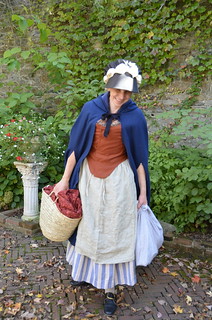
Yes, that’s my attempt at the “Ale House Door” jacket.  The fit is OK, the style a little late for RevWar, but it’s what I have in wool for now, made from a Wm Booth Draper remnant, and that’s the first wearing of the Sharon Burnston apron.

Sew 18th Century has a nice post on baskets, and where to get them, but wondered about the documentation of the market basket. What I can find is 1732, Plate 1 of Hogarth’s series, The Harlots’ Progress, based on Moll Flanders.


Would these have been out of use by 1770? Hard to say—I think I may have seen this form in catchpenny prints, but I have only a print source for those and it’s buried in one of the many stacks of books at home.

Still, I love my newly-arrived basket, ordered from Jeanne Beatrice for $24.

And there I am running away. Coventry, Connecticut, here I come!

History Dress-Tease

What Cheer! Day is a week away, and exactly a week from now, at 6:30 AM, I will get into my B&G guy’s truck and head into the site. We’ll measure and tape out camp sites, fire pit sites, and safety lines, bring wood and gear out from the woodshed and basement. We’ll put out the handicapped parking only sign in the parking lot, drop the orange cones (I love the thick flexible plastic of a traffic cone), and drink some coffee. I haven’t decided at what point I’ll start to fret in earnest that day, but the trick to not fretting will probably be to get dressed in 18th century clothes as soon as we are done carrying items upstairs, because then I will have to take off my watch. Watches lead to fretting: there’s administrator time, and re-enactor time, which is more like artists’ time. Better to take off the watch and get closer to the past.

Half-pleated skirt, sleeves in progress

At the School of Instruction, I thought the “People of the Brigade” program worked well; at OSV, I really appreciated  the Military Fashion Show (I did not make it to Runaway Runway). Using these models, and knowing about the School of Instruction’s Women’s Dress program, I thought we’d combine these ideas. I don’t have a good name for the program yet, but the reason I’m going so nuts about the dress from 1774 is that I plan a “History Dress-Tease:” starting in shift, stays, stockings and shoes, I’ll demonstrate all the layers my runaway wore: 2 petticoats, pockets, dress, stomacher, apron, cap, bonnet.

Any soldiers I can convince to get down to small clothes and layer up with waistcoat, coat or frock, canteen, cartridge box, bayonet scabbard, haversack, knapsack, hat and musket, will demonstrate the gear they carried. I thought about a weigh-in, to record how much it all weighs, but my scale is a pathological liar, and varies by 4 pounds from one side of the room to another.

All this work has an educational, and not merely sartorial, purpose. Now, if only the public will come…

What Table Manners?

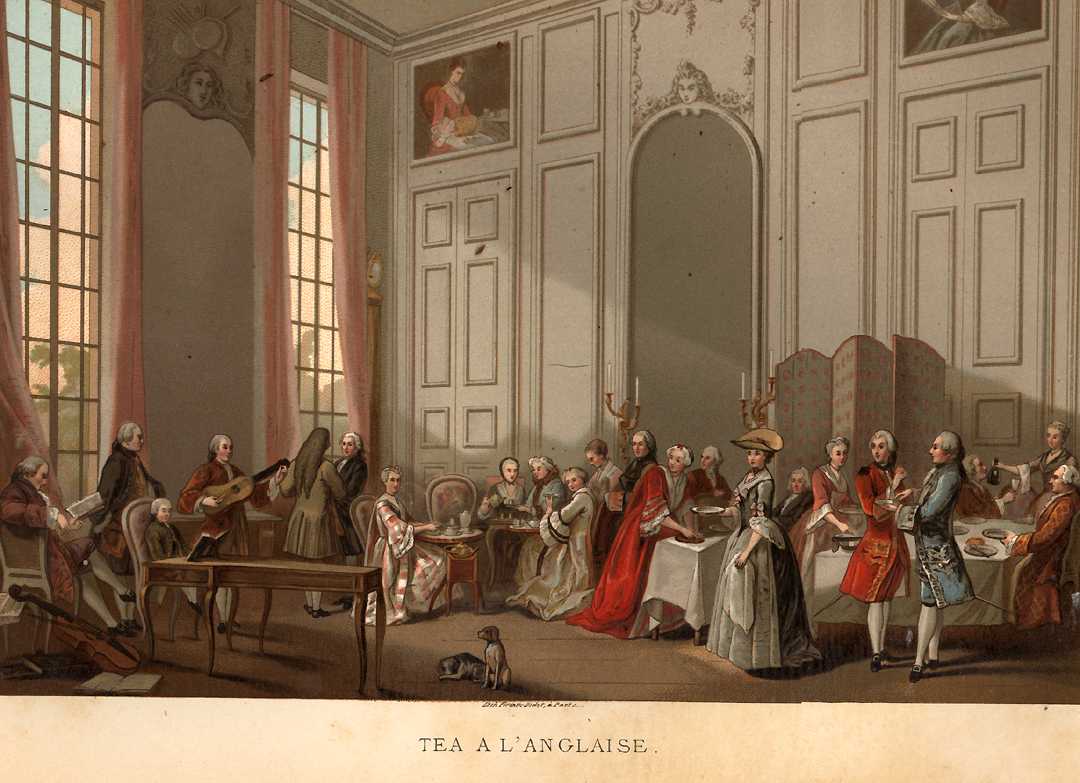
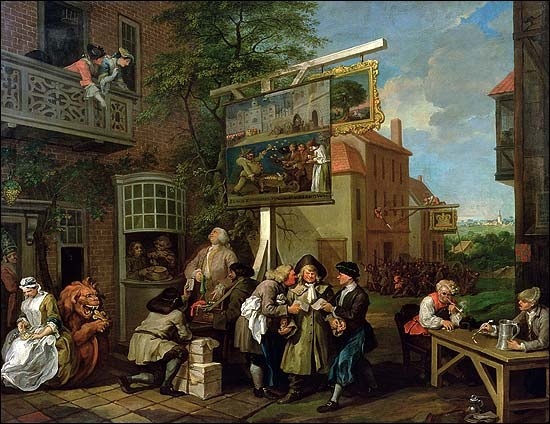
When you think of 18th century dining, which image comes to mind, tea on the left, or the sea captains to the right?

While I did not carouse with sea captains this weekend, at dinner today, I found myself deeply envious of someone’s skill in eating from a knife. I shoveled food onto my spoon yesterday with abandon. I coveted the last three pieces of quince tart today despite knowing that one of those pieces was for my husband. And I am not ashamed. Ok, not too ashamed.

The best part of living history is always what you learn, and I feel a separate blog post should deal with “the public, god love ’em.” What I learned this weekend was less about quilting and more about living old school. Ok, and maybe more about the public’s…breadth….than depth…

The most instructive thing was about being hungry and thirsty. Thirsty as in my lips are dry and I know I need to drink, which means being past thirsty and at dehydrated. Yesterday I went all day without peeing and that’s not right. Both yesterday and today I left the farm hungry, not because there was not food but because I ate mindful of leaving enough for those eating after me. The goose pie was delicious and seriously worth eating standing up in the kitchen. I’d fight for that pie.

Eating boiled dinner (ham, parsnips, carrots and turnips) along with a pudding, with 18th century utensils was challenging. Two-tine forks have great sticking ability but not much carrying ability.  Spoons are your friend. Knives may be better as trowels than cutting implements. No one really cares about your manners, they are too hungry to notice. Boiled pudding is this season’s smash hit.

Coggeshall Farm uses Amelia Simmon’s American Cookery, which I started reading last week. It is full of useful receipts based on American ingredients and I recommend it. Here is the receipt for the fantastic, sliceable pudding we had today:

A boiled Flour Pudding_.
One quart milk, 9 eggs, 7 spoons flour, a little salt, put into a
strong cloth and boiled three quarters of an hour.

There were hot words about those “7 spoons” from the kitchen staff and to be honest, I did not quiz them fully on the size of the spoons they used. But whatever magic they worked, it was truly delicious with and without the molasses cream sauce. Sliced and eaten with spoon or fingers (I snitched some later in the kitchen), it a consistency of solidity like the best parts of a Swedish rice pudding, though smooth.

It is hard to countenance how hungry people must have been much of the time in the past. More than the extreme hunger of the soldiers (like Greenman and Plumb Martin), I think common people experienced days of lacking, and accepted them, with the seasons. Food was not constant, but in flux, and even at harvest, I think, or hope, that one was mindful of the needs of others.

For more on seasonality and 18th century ways of thinking or seeing, read Circles and Lines: The Shape of Life in Early America. That’s what I’m going to pretend to do while I fall asleep.