Authenticity: Sources I

There he goes!

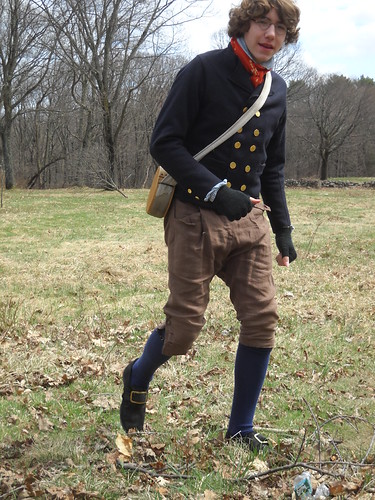
You know this guy: the reluctant drummer and avid ensign who wants to be in uniform but struggles with the fact that he might be seen by someone. (14 is complicated.) I’ve been mulling over several upcoming events and the comments that swirl around on the Interwebs after any large event, and, as I often do, find my clarity in writing. That means you’ll have to wait till the end of this post or a series to get “answers,” or what pass for them.

One of the things I struggle with is that the kid is not a mannequin. He has stated quite plainly that he feels like I fuss too much over his appearance, when he has nothing to do at events, which leads him to believe that I am fussing over nothing. There’s some truth in that, right: while God and authenticity may be in the details, all is for nought if there’s nothing to do or interpret.

This means I cannot simply dress him up as I see fit, I have to negotiate with him, and keep on eye on what he’ll be doing. And I don’t have the time to make all the lovely things I’d like to make (or not all at once, anyway) so it’s a matter of choosing.

June 21, 1774 Connecticut Courant
Connecticut Courant, June 21, 1774

Let’s start with what the kid has already: the blue jacket, checked shirt, neck cloth, breeches, stockings and shoes. I went to the newspapers (the lower sorts’ Vogue) looking for examples of runaways, and found some good ones. On June 21, 1774, an ad was published in the Connecticut Courant for a boy who had run away in a “check linen shirt, pair of striped linen trousers, one pair brown plain cloth breeches…” but the Young Mr wants no part of striped linen trousers, and his breeches are linen, not wool.

Essex Gazette, January 10, 1775

On January 3, 1775, the Essex Gazette ran an ad for a boy in a “short blue jacket, snuff colored breeches and long trousers.” Now that’s more like it!

Long trousers sound good to the kid, more “normal” than breeches,  but there’s a jacket in there that would satisfy my stripey love. For the short run, even if I don’t get the trousers made up in the next couple of weeks, he’s reasonably well documented, or at least within the realm of plausible appearances, even if he should be in wool and not linen, and even if one of the best reasons for making trousers is to replace the poorly-fitted breeches.

Kids shouldn’t just get a pass for inauthentic clothing, and children in what are really costumes do make me crazy–probably because I’m hand-sewing clothing for a wily teenager to grow out of, and looking for sources to make sure the choices I make have some form of documentation.

Monmouth Millinery

New hat!
New hat!

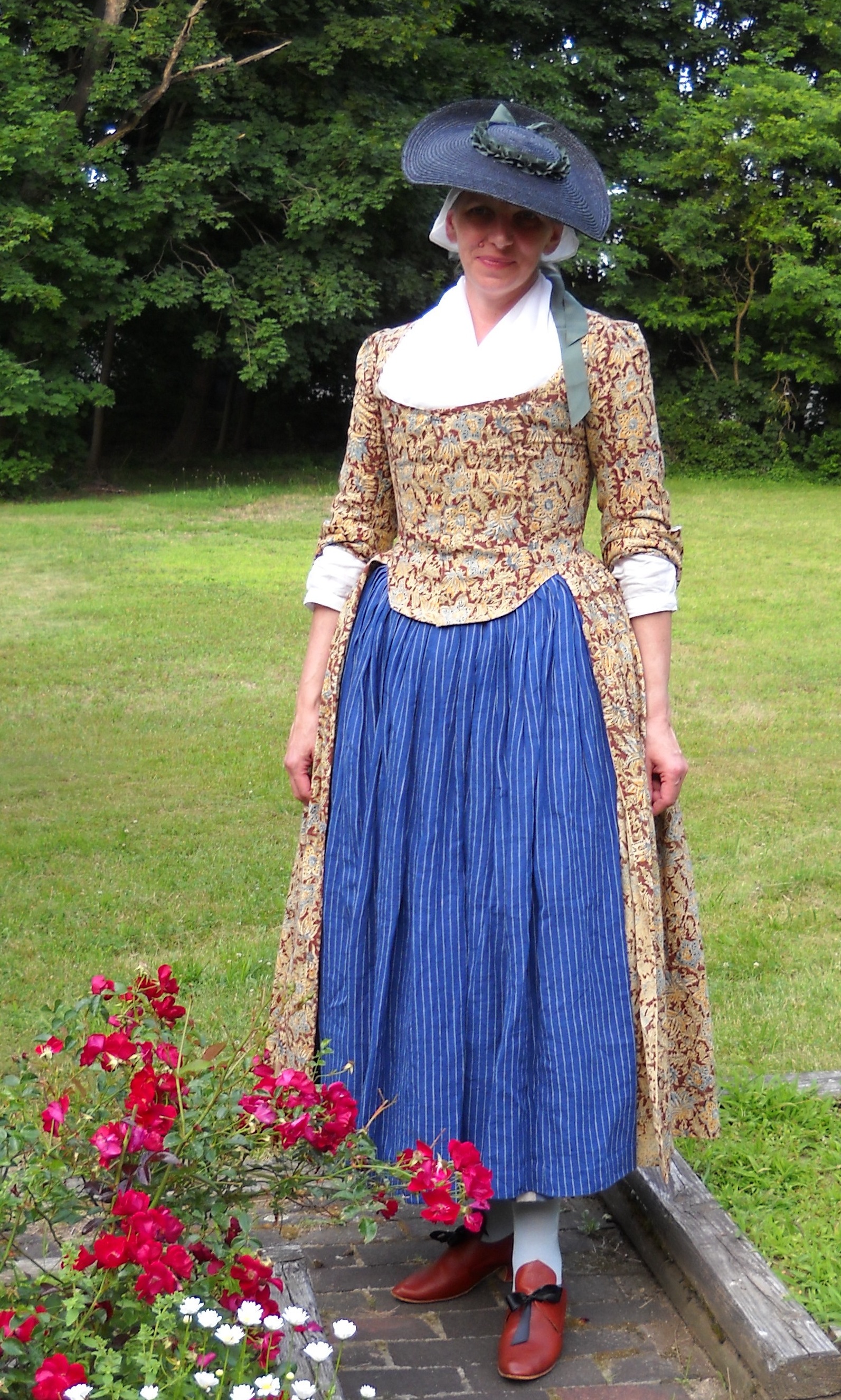
As Eloise or her Nanny might say, It is rawther warmer than I care for. Lucky for me, I have a new hat. It’s a black straw hat of a kind you might see called a bergère, along with 4 yards of silk ribbon, purchased at Burnley & Trowbridge’s tent at Monmouth. Jim and Angela and their assistants were very helpful, and this was rawther a splurge for me, as I mostly buy my ribbon from Wm Booth’s remnants, when they are available. (We are tenant farmers. Mostly.)

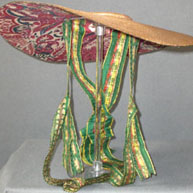
Coromandel Coast lined hat, from an auction.

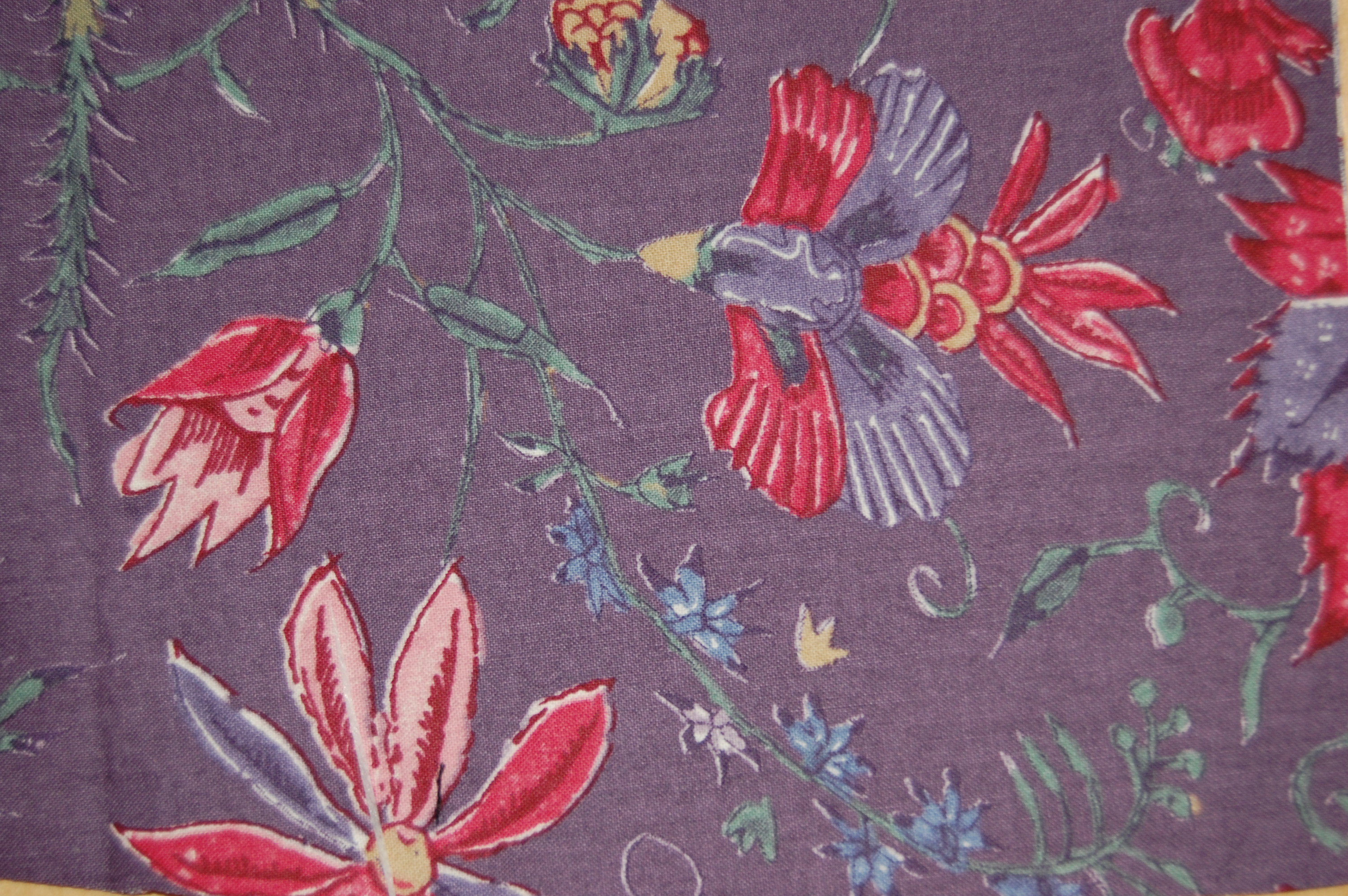
But in this instance, I wanted a lady’s hat, so I pleated up about two yards of green silk ribbon, and added a bow. To get the multi-vector bending effect, I stitched millinery wire from Abraham’s Lady around the brim. The inside of the brim is lined with pieced scraps of the purple “Fleurs d’Inde” I used for a jacket (also made from a Wm Booth remnant). It ties on with yet another yard or more of ribbon. This is really a frivolous hat, for me. There are extant examples of straw hats lined with chintz, as you can see.

As luck would have it, I got to wear it right off, the very day I made it. How often do you get the chance to do without panic and pain? We attended the Saturday version of the Rochambeau Tea on Joy Homestead, an event which has its dedicated fans.

First hat outing
First hat outing

I wore this same gown last year, and to Nathan Hale; to my delight, I am enjoying it more each time I wear it. I think this petticoat is the right one; madder was too close and black too contrasty. Since the Rochambeau Tea “year” is 1780, this dress passes (ahem) muster; for many of the events I attend, it is too fashion forward.

London Cries: the Fishmonger. Paul Sandby ca. 1759. YCBA B1975.3.210

This hat will, I think, also work for the 1763 event, as the woman in yellow here is wearing a similarly dual-plane twist hat. I’ll never have a yellow gown though: I look pretty horrid in yellow.

Chintz? Check!

Les Fleur d' Inde
Les Fleur d’ Inde: delicious!

Because I am prey to a pretty print as much as the next princess costume blogger tenant farmer’s wife, I thought I should go  looking for evidence before I launch into any cotton sacques, and to justify the use of the print remnant I’m stitching up into a jacket. (Apologies in advance to my friend who bought enough for a gown, because you know we’ll wear them to the same event…)

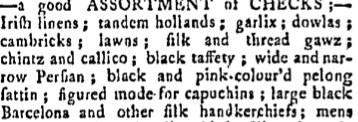
Providence Gazette and Country Journal, March 16, 1765

American Historical Newspapers to the rescue, once again. Here’s an ad for Alexander Black and Archibald Stewart, from the Providence Gazette and Country Journal of March 16, 1765.  Chintz and calico: it’s here in Providence in 1765. I knew there were merchants selling calicoes and chintzes in Providence in 1768 (including Samuel Young, who printed his broadside in red).

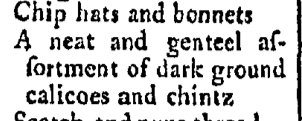
Chintz and chip hatsThree years later, Joseph and Wm. Russell at the sign of the Golden Eagle are selling (lately imported from London and Bristol) “A neat and genteel assortment of dark ground calicoes and chintz.” This ad runs to four columns in the Providence Gazette and Country Journal, 1768, April 9. It’s a tantalizing list, and no, I did not miss those chip hats and bonnets!

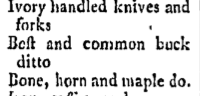
forks!

Digression: I was attracted to this bit about forks as I recall being told by a historic house tour guide once that “forks were not in common use until the Civil War.” It’s an early house, maybe he meant the English Civil War, but I think forks were here to stay and be bought for a variety of prices long before the American Civil War. How else to explain those archaeological finds that show forks of some kind at Rev War forts and camp sites? /Digression. New digression: OMG, knitting needles! /New digression.

William Eliot

Back to chintz: Here, in 1771, is William Eliot, selling chintzes in Providence, and advertising in the Providence Gazette and Country Journal of June 1, 1771. He also has “flowered and sprigged lawn in aprons,” and Kenting and check handkerchiefs.  (Kenting was a fine linen fabric)

In the limited search I ran (1754-1783 newspapers), plenty of references to chintz appear in Providence alone (there were 166 hits, but the ads repeat). This completely unscientific approach in which I stopped looking in 1771*, has turned up 5 merchants, if you count the RIHS Library’s broadside for Samuel Young. Chintzes and calicoes were everywhere. Dark grounds were “genteel,” checks and spots and stripes are popular and common.

Paul Sandby, London Cries: Black Heart cherries... ca. 1759. YCBA,  B1975.3.206
Paul Sandby, London Cries: Black Heart cherries… ca. 1759. YCBA, B1975.3.206

I begin to see 18th century Providence, if not all of the Colonies, as a variegated, kaleidoscopic place of pattern and color. I think there was more than we realize, even if only in small amounts.

Look again at the cherry seller: her petticoat is yellow and blue, if not yellow, blue, and white striped,  her apron is blue, her stockings brown or faded reddish, her cap is affixed with a pink or red ribbon, and she wears a checked kerchief. She’s poor and sort of faded, but she’s colorful–more colorful, perhaps, than we have credited.

*I do have to head out to work, but I can search again.

Sampler Resources

Sew 18th Century had a fun post recently about “Which State House is it?”

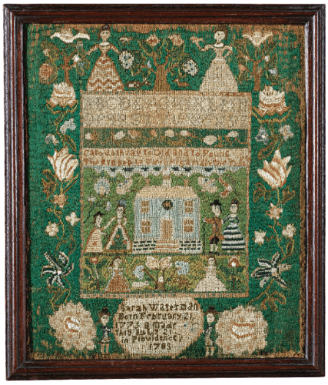
Sotheby's Sale N08832, Lot 563: The Sarah Waterman sampler
Sotheby’s Sale N08832, Lot 563: The Sarah Waterman sampler

I’m not usually a sampler fan (you know this is not an area in which I shine), but I have learned a lot more about samplers through work than I ever expected to. And what do you know? Some of it stuck!

I thought I would pass along some helpful resources for sampler fans. Last year, one of the (if not THE) premier sampler collections was sold at auction by Sotheby’s. Through the magic of the interwebs, you can see the catalog online:

Important American Schoolgirl Embroideries: The Landmark Collection of Betty Ring 

Even I say “Yum!” to all those pictures. I like color and texture, but sometimes samplers make me feel like all the air has been sucked out of the room. Walker Evans has the same effect. But when you look at them like this–or arrayed on a worktable–they turn into pictures, and those I enjoy. You page through the catalog and see what Betty Ring had, and whimper a little about these going in to private and not public hands. I know we whimpered…how I covet a green-background sampler!

But wait–there’s more! Be sure to check out  American Needlework Treasures, and Girlhood Embroidery Volumes I & Volume II which are available as full-text PDFs with images. In Girlhood Embroidery, you can read more about the Mary Balch School.

If you like samplers, and want to learn more or support sampler work, visit The Sampler Consortium website. You can become a lifetime member free of charge, and enjoy email updates with sampler news. The Consortium is connected to The Sampler Archive Project, which is funded by the NEH. We’re pleased to be part of the SAP’s first phase, and I am pleased to have learned so much just by cataloging.