‘Countryside at War’ Saturday

The Countryside at War, Hartwell Tavern, MMNHP, August 24, 2013

We came, we saw, we sewed, we ate cake. No, it was more than that, though there was any quantity of excellent cake on a lovely Saturday.

I had a chance to spend the whole day with people I really enjoy talking to, like Sharon Burnston and Sew18thCentury. (I love that silk gown. I really do.) We are all preparing for an event we will be part of in Providence in October, and I think and hope it will be great fun! But I’m getting several weeks and 25 years ahead of myself.

On Saturday, Sharon was a widow who had traveled from New Hampshire to visit her daughter, who was but one month from her confinement. She had a portmanteau of clothes for the soon to be born child, and food, as the blockade and closing of the city had made obtaining anything very difficult.

Before the jacket was applied

Visitors came and asked interesting questions, but there wasn’t much I could answer. Reader, I had not studied. I had sewn instead, vain woman that I am, laboring to produce new trousers and a new waistcoat for the Young Mr. He spent the day reading his school book, recovered in craft paper and blue check linen. Saving grace, that cover, and I plan to make many more. The Young Mr (after hauling carts and goods for people) found  some handy stones and settled in to get his work done.

His father plans to make him a full-size wooden musket from some mahogany that was left over from construction at work: there are no rules to prevent him learning to drill will a dummy musket. At events when he’s not trying to do his school work, he does enjoy being put to work. He likes to feel useful, and I am grateful to people who recognize that, and help me keep him in the hobby. This was all his idea in the first place…
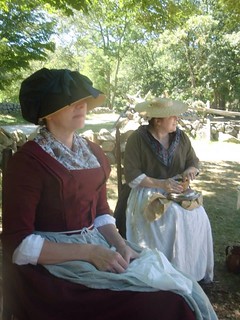
Sew18thCentury and I had a long walk on the bike path, which was mildly dangerous. Bonnets block a great deal of your vision, and change your hearing, so bicycles are particularly troubling. And when wearing a bonnet, one has to peer out from under it to see anything above you, or your lap, as you can see here.

Our clothing was documented, as you know from posts on this blog. I assembled sheets for each of us, and they can be found here: The Young Mr, Mr S and Kitty. I finished it all late on Friday night, so by the time I reached my own, well…there’s always next year to tidy that up. I still like the gown, and I really like the lightweight wool olive/brownish petticoat with the gown. Hooray! Clothing I like, in wool, that can be worn in summer. What’s not to like? (Well, pins, for one thing. They bend and pop out.)

Drilling in the shade, Shirley-style

The men were drilled for the September 28 event, which rolls forward, sort of. I expect or hope for a schedule this week, which will be helpful. Fingers crossed…though no matter what, I will have to hope a train back to Providence by 3 to make rehearsal for the event at work. That should be interesting…

Now it’s down to finishing and fixing projects in process, and deciding on fabric for a housekeeper’s gown from 1800. I think I’ve settled on a year and style, but the fabric eludes me still. I have to find it pretty soon, because on Saturday, I’ll start making coats for Saratoga. I’m a sucker for beauty, and the Adjutant got me with sea foam green and dark brown wool. The facings are false, so really, a button-hole-free, single-year, described in a letter, regimental coat? The artist in me won, and I am so making that.

Many, many thanks to Sharon Burnston and Friends of Minute Man National Park for the photos! I took none, except of the Young Mr in our yard.

Poetry in Papers

From the Newport Herald, 6/26/1788

It’s quite the poem, isn’t it? In October, I’ll be part of an 1800 event at work, and I will be portraying a housemaid, if not quite the housekeeper (we are still trying to sort out the domestic staff; what we can document is far too small a staff for the size of the house).

One of the things I will need is a name, and I thought perhaps I should check my instinct that “Kitty” was an acceptable name for women in the 18th century, and not just for sloops. So to the newspapers I turned, and among listings of the graduates of Philadelphia Seminaries for Girls, and ships cleared through the custom house, I found this poem. It reminded me of Mr S, and I recommend you read it aloud.

The early nineteenth-century maid. By William Brocas (1762-1837), pencil drawing c.1800 (National Library of Ireland)

So, a name: we’ll go with Kitty for now, and I can imagine building a complicated back story that pulls together all of the things I do, from running away outside Philadelphia to encountering soldiers and following them, to ending up a maid in a house in Providence. Except that what I believe about a life like that is this: It would be highly improbable, and I would look wa-a-a-y older than my actual years.

Instead of getting carried away with extreme historical fictions, let’s look at what we can know.

For one thing: clothing. Do you find yourself concerned, ever, that you focus so much upon your historic clothing? Well, you can stop. After a long and excellent conversation this week, think of this: the historical clothing you wear to events of any kind requires a lot of lead time. So you do have to think it through carefully, because every minute will count. It is also a visitor’s first impression of you, from a distance and up close. Getting it right matters, and since that takes so much time, you have to think a lot before you commit scissors to cloth. It does not necessarily mean that you’re a shallow, clothes-obsessed freak. There’s no 18th century mall to go hang out in and watch the leather-breeches boys  posing while they smoke clay pipes.

Benjamin West, Characters in the Streets of London, 1799, YCBA, Paul Mellon Collection, B1977.14.6314

I’ve just about convinced myself that the silhouette we’ve been wearing at the house and formerly at the farm is acceptable. I went looking through the turn-of-the century images I have on Pinterest and I think that a maid would have worn the fashionable silhouette. Another question is age (sigh); all the women in the Benjamin West are younger than I am.

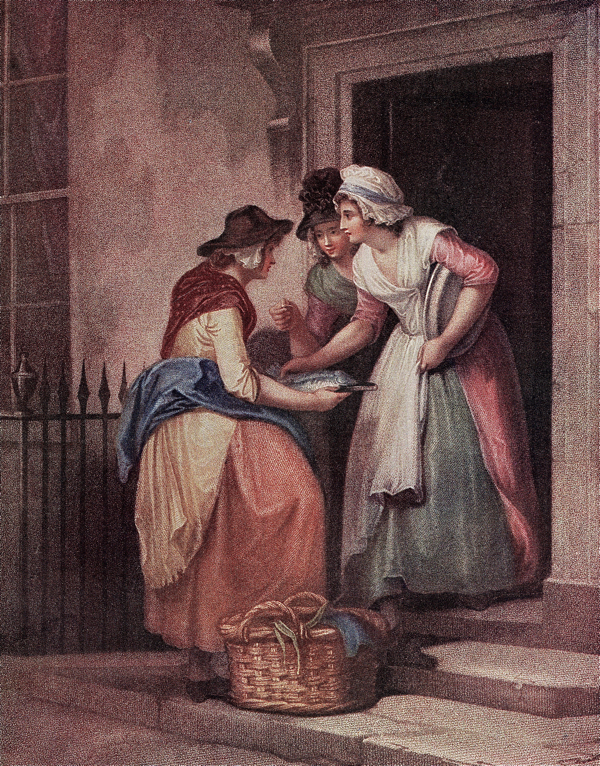
Francis Wheatley, Cries of London. New Mackerel, New Mackerel.

This print from a Wheatley (1792-1795) is useful, though he is such a genre painter and idealizes so much that I use him with caution. (Think of how much grittier–and funny–Sandby is: I trust Sandby more.) But, what can I learn from this? One thing is that I often think and dress more like the people in the street than the people in the houses. This will happen when you spend a lot of time outdoors, with soldiers: you are one of the people in the street. It can be a bit of a trap, historically speaking, and it’s good to challenge yourself to think about another class from time to time.

Back to the doorstep: what I learn here is that I need a white apron that I haven’t spilled on, a white kerchief, and a fancier cap. That cap will tie under my chin, because that’s the cap I see in Providence most often, and that’s the cap that will stay on. I’m not sure if these are maids–I think they are– but they’re women in a brownstone city house. And I can see from the clothes around me that they’ve been made for a woman who sells milk in the street, or works on a farm, or cooks over a fire. They’re not what the richest man in Providence would want his maid to wear answering the door.

You’ll have noticed, too, the different waistlines. The drawing from the National Library of Ireland and the Benjamin West have higher waistlines than the women in the Wheatley. Some of this will depend upon the available corsetry: I have stays that will work for the higher waistline, and I have stays for 1770.  I have a not-quite-right 1790s pair that need revision, but that’s not likely to happen: I have a brown and sea-green coat to make.

Strip it! Wait, maybe not?

For once, the MFA’s search engine trumps the Met’s (hat tip to Sharon for pointing out painted versions).

Brace-back Windsor side chairs, Providence, 1780-1810. MFA Boston, 1976.776

Providence, thank you very much, green over black paint. Here’s another chair, clearly green. (This is very interesting, as the ones in my museum are not painted. Clearly, there’s wide range and variation in chair finishes. Now to think about temporal and geographic distribution of those finishes…)

High fan-back Windsor armchair, Boston area. MFA Boston, 64.86

My first concern was location. All I can tell you right now about the one I found is that is seems to be from New England: much more looking to do to narrow this down to a state. (Most of my furniture time is spent looking at shells, feet, and splats, but I like the Windsor style better, so this will be fun.)

Once I figure out where the chair came from–if I can–then I can decide whether or not to strip it. The easiest thing is to clean it and then repaint it in proper colors (like green over black, happily documented to Providence).

If the preponderance of examples I find like this are not painted then I will have to look at the condition of the wood (hmm…might not be so great) and see what I think. Somewhere I even think I’ve seen a furniture check cover for a Windsor chair in a painting…always more to hunt for.

Authenticity: Sources II, or, Stripes!

In any decade, I love stripes.

Stripes. I love them, really, I do. Gowns, petticoats, cats. Why do I want to use them so much?

For the guys, because I can document what they’re wearing, at least based on their current state of residence and their current nominal “home” unit with the BAR.

Here’s why:

1777 Oct 22
An inventory of Searjeant George Babcock’s
Wearing Apparil who was Killed at fort Mercer
Octor 22d 1777 Belonging to Capt Thos Arnold’s Comp’y in Colo Green’s Regemt

Two Check Linen Shirts
one Pair of Striped Linen overalls
one Striped Cotton & linen Jacket without Sleeves
one flannel Jacket without Sleeves
one home spun Woolen Jacket without sleeves
one Linen & Worsted cotee
one Kersey outside Jacket Lined with flannel
one beaver Hat & one Pair of shoes
one Pair of blue worsted stockings
one pair of thread ditto
one pair of blue yarn Stockings
one Linnen Handkerchief
one knapsack

(Clothing inventory, Capt Thos. Arnold, Col. Christopher Greene, Rhode Island Regiment
RIHS MSS 673 SG 2, S1, SSA Box 1 Folder 13)

From RIHS MSS 72, Preserved Pearce papers,  Tailor's and Tavern account books, 1778-1781.
From RIHS MSS 72, Preserved Pearce papers, Tailor’s and Tavern account books, 1778-1781.

This inventory has formed the basis for many of the clothing choices I’ve made for Mr S and the Young Mr from their check linen shirts to their blue stockings. I was criticized for the size of the checks of their linen shirts (too small! I heard), but feel vindicated time and again by the extant garments I’ve found (aprons, mostly) in this period. The checks are small.

The best piece of evidence I found was serendipitous: whilst going through tailor’s books Thursday, looking for stays, I found a scrap of blue and white checked linen used as a binding. The biggest lesson from that scrap is that I need a deeper, more indigo-rich blue and white to begin with.

The “Striped Linen overalls” in the inventory are definitely on the list of things I’d love to make, along with the “Striped Cotton & linen Jacket without Sleeves.”

One of my favorite garments of all time. Boy's frock, ca. 1760-1770. RIHS 1959.6.1
One of my favorite garments of all time. Boy’s frock, ca. 1760-1770. RIHS 1959.6.1

There are extant Rhode Island garments from made of blue striped linen, documented to the period we interpret, and another one, recently acquired (coming soon to a database near you!) from which a pattern has been taken.

After a while, though, blue stockings and checked linen shirts seem…ordinary. Common. You might start to wonder if they’re just another re-enactorism, they’re so ubiquitous.

It’s worth checking again to see that these are, in fact, common garments, probably as prevalent then as they are now.