Some of you may recall that I am a recovering artist with a fairly constant need to keep my hands busy. To encourage industry and the domestic arts, and to keep me out of trouble generally, a thoughtful friend provided me with a start to furnishing an early nineteenth century-style paint box. They’re hard to come by, these paint boxes, and extant examples fetch far more than we can afford chez Calash, being in somewhat reduced circumstances of late.
Thomas Reeves & Son Artists watercolor paint box c. 1784 to 1794. Whimsie Virtual Museum of Watercolor Materials
Researching paint boxes and miniature painting in the early Federal era has been a happy fall down a deep rabbit hole. It’s clear that Reeves watercolors were being sold in Providence in the early 19th century; Peter Grinnell & Sons include “Reeves watercolor boxes” among the extensive list of items for sale in an 1809 newspaper ad. Frames and cases were also to be had; John Jenckes, gold and silver-smith and jeweler, advertised gold miniature cases in 1800.
Distraction is always easy to come by, tunnels leading from main entrance to the warren. Painting manuals, scholarly articles, and extant examples, which prove most distracting of all. SO shiny.
George Catlin byJohn Wood Dodge, 1835, MMA 26.47
Searching the Met’s collection, I found a portrait of George Catlin, remarkably similar in pose to an image of a friend I considered copying, but had thought too modern. My assumption has been proved wrong, and I am delighted. And then I found the HIDEOUS checked neck wear, always distracting. Historic New England provided super-tiny-bowtie man, and then I really had to focus, since I’m only enabling, not making, neck wear.
My real focus, of course, is on female miniaturists, especially in Rhode Island (gallery of RI miniatures can be found here.) From the scant number of women I’ve found advertising in the local papers, (okay, two: Miss Mary R. Smith, in 1820, and Mrs Partridge in 1829) I’ll have to expand my search geographically. Nantucket Historical Association had an image attributed to Anna Swain, and ten attributed to Sally Gardner.
The Met, repository of so many wonders, has works by six women miniaturists, including Sarah “Wowza” Goodridge and Anna Claypoole Peale. For all we know, some of the works by unidentified makers might be the work of female painters. The extant miniatures in all collections, range in quality from excellent to amateur, giving hope to those of us unpracticed in portraiture, and regaining our hand.
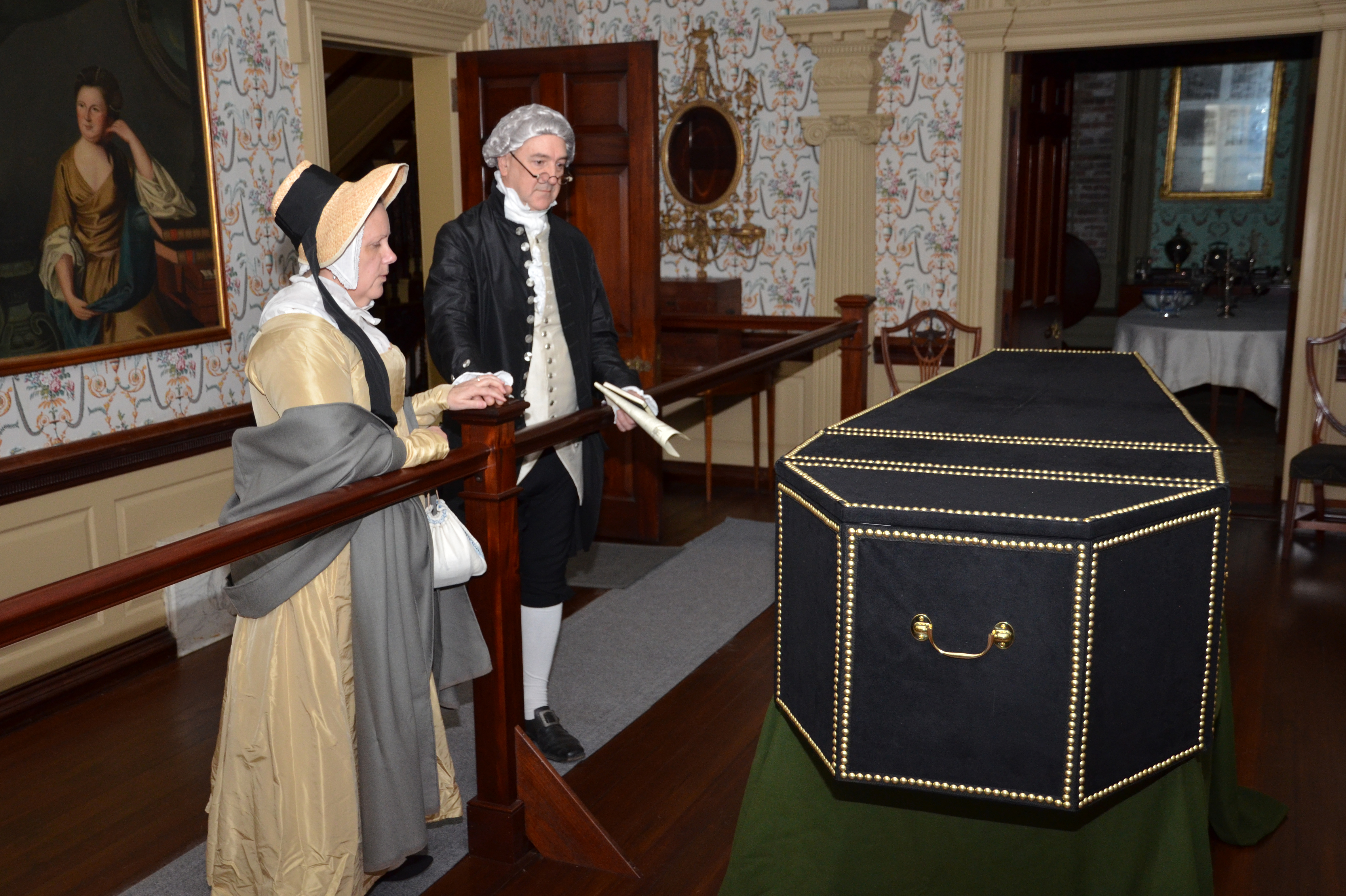
I had my doubts about this event, since we were interpreting the death and mourning of John Brown a full month after it actually happened, and initially resisted somewhat strenuously. But people change, and by the time I was operating a motor vehicle at high speed on I-90 six months later, I could be– and was– convinced. Knowing little, if anything, about early Federal mourning customs mattered not at all. There’s always time to learn, right? Well… if you read fast enough, you can do anything.
Esther and Kitty draping the mirrors
Despite the bustle, Esther and I found time to cover many of the mirrors with sheets, and the portraits with black crepe; this is a time of reflection, not vanity. It gave our rooms a gloomy mien, and reminded us of our short span on this earth.
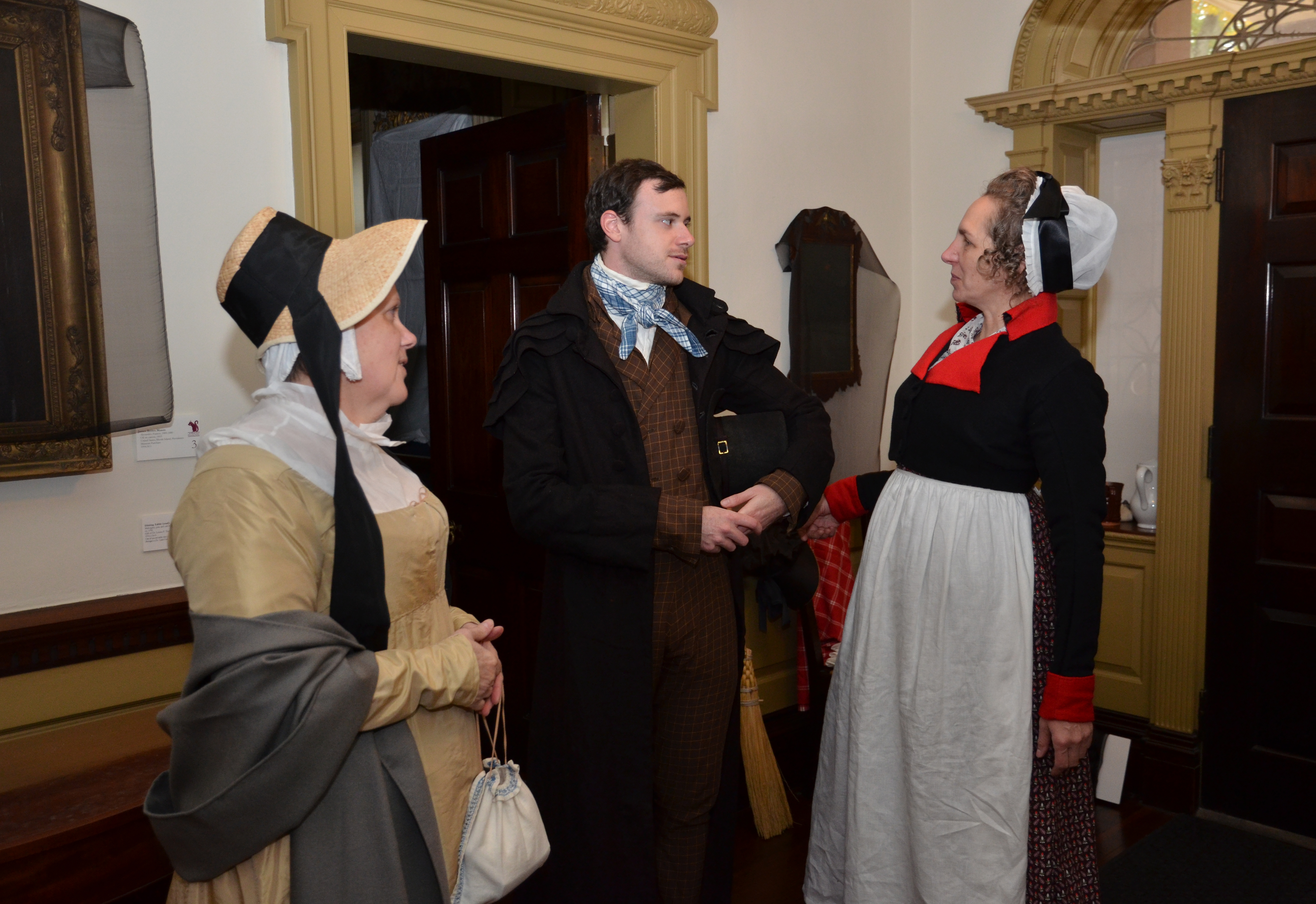
We had many callers
We did have many callers Saturday afternoon, as John Brown was such a significant figure in Providence. He accumulated significant wealth, as Mr and Mrs Thurber attested when they came to inquire about the profits from the voyage Mr T had invested in– $30,000!
Mr and Mrs Thurber pay their respects to Mr Brown
Thirty thousand is a fine sum indeed, though one wonders where Mrs Thurber might spend those proceeds. While a generally refined person, she made many inquiries about sherry, so I was relieved I’d had the foresight to lock away the decanters. So many people call during a time of grief that you cannot be too careful.
Considering mourning dress options
The mantua maker came to call, bringing black silks and plates for the ladies to choose from. We have had a mix of joy and sorrow in this house, and it is only of late that Mrs Francis (on the left, in blue), has left behind her more matronly garb following the death of her beloved husband John Francis in 1796. It was a crushing blow for her, but she does seem to have recovered now.
Mrs H and her darling daughter, Anna
Mrs Herreshoff was with us, visiting from Point Pleasant in Bristol, and her mother found baby Anna, now just more than five months old, a great consolation indeed. Anna was dressed in mourning for her grand-papa, though she will not remember him. Despite the many callers, baby Anna was truly an angel.
The Congregational minister called.
The ladies upstairs were a respite for us servants, though we were comforted by the visiting minister from the Congregational church. They cannot make up their minds to a new minister, now that their beloved Dr Hitchcock has left them for heaven. They try on new ones for size nearly every week, and while that is not my congregation, I do think the Reverend Cooke is an excellent choice, combining devotion with humor.
The sexton’s son came to inquire if Mrs B wished rent the hearse
A more troublesome caller was Mr Richard Hoppin, son of the sexton at First Baptist church. They do possess the sole hearse in our town, and kindly (for a fee) provide it in times of need. I’m not certain of Mr Hoppin’s stability, for he was inclined to– well, to hop!– in our hallway, a most inappropriate action. The widow did seem to cause him fright (she is a formidable personage, as one would be, after so many years married to Mr Brown), so perhaps he was merely addled by his encounter with her. She wisely inquired after the solidity and soundness of the hearse, for Mr Brown was a substantial figure.
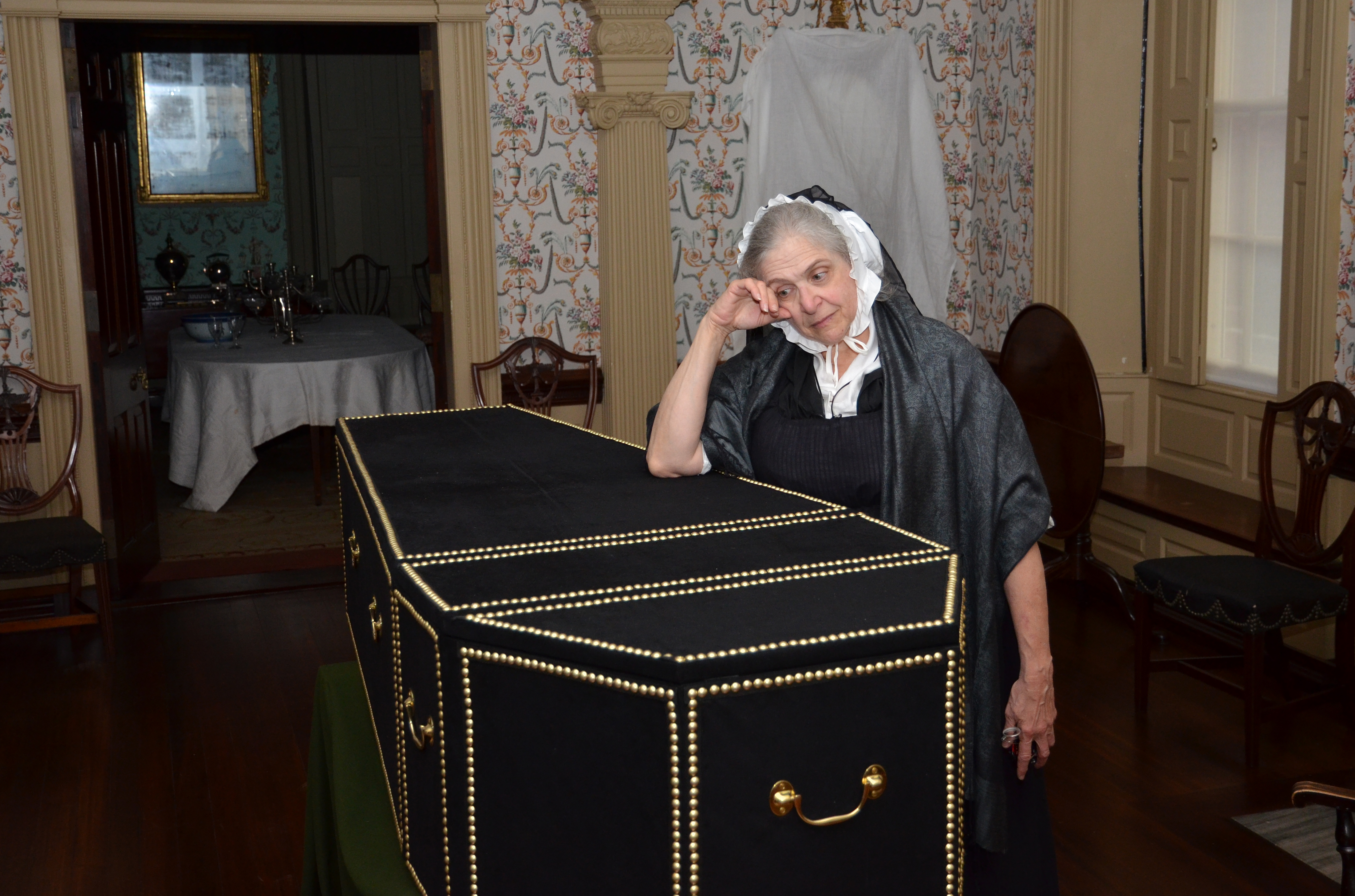
The widow Mrs Brown reflects upon her late husband
Mr Brown was a great support to us all, and his absence will truly be noted in our household and in our town. I do expect the house will feel empty without his presence, and that Esther, Goody and I will much remark upon the quiet as we go about our tasks.
The obligatory group photo finale.
From an administrative and managerial stance, this What Cheer Day was different: we cut the interpreted day in half, running the event from 1:00 till 4:00, but still saw about the same number of visitors as we had in a six-hour day. A shorter day meant interpreters were somewhat less exhausted by the close of the day (costumed staff who started their day at 5:00 AM excepted), and the schedule did not have to be as detailed as in previous years. We also reprised a “make your own miniature” activity from the August George Washington 1790 event, and brought in period musicians, who played in the Washington Wallpaper room while people colored miniatures. We also put out an exhibit of memorial art and mourning jewelry, to help contextualize the miniature activity. Since we’ll be leaving the coffin on display and the mirrors and portraits draped through next weekend, a small display (three cases, labels finally finished at 11 AM on the day of the event) seemed like a good idea and opportunity. Upsides: chance to show off the collection, engage people in a hands-on activity, multi-sensory experiences. Downsides: Slightly more to accomplish than hands to do the work, still short a servant, always a little rough the first time you change topics. Unexpected bonus: slightly bumpy transitions in personal life make a suitably sad housekeeper. Score!
On Saturday, we commemorated the 225th anniversary of President Washington’s visit to Providence after Rhode Island finally ratified the United States Constitution on May 29th, 1790. We like to take our time with these things, to be sure that we will have all the rights we’re accustomed to. Happily, we did decide to go along with this United States of America business, and as a reward, His Excellency President Washington made a formal visit in August, 1790. It rained then; this time, we had sultry summer weather.
Once again, the housekeeper spent the day running back and forth and up and down the stairs. Fortunately, I didn’t trip on the gown too much: it’s longer than I usually wear, but I did catch the hem on my shoe buckle, so some tweaking will be required.
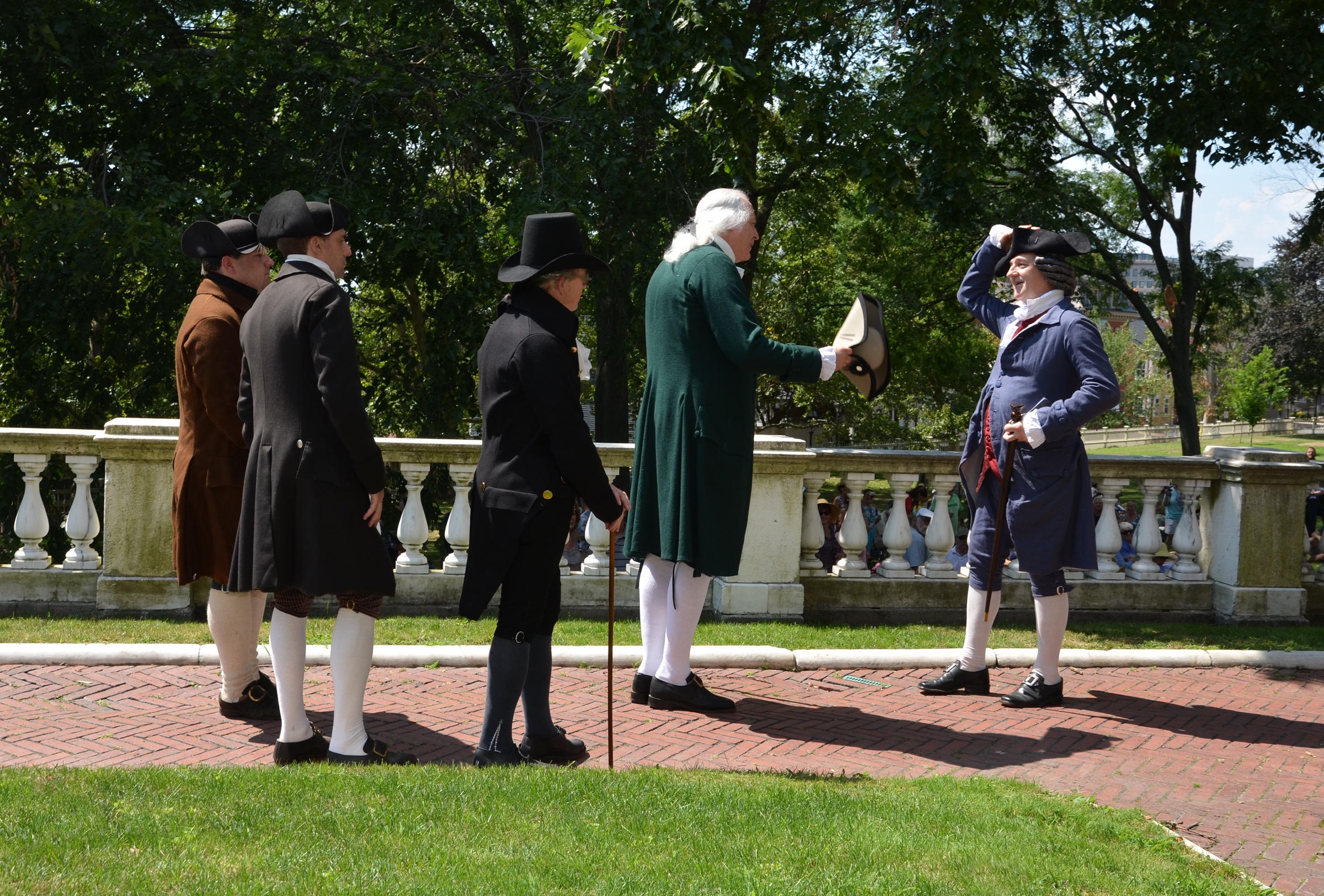
Mr Brown greets the President
There was the kind of ceremony and formality you would expect, with very little drama, which made for a simpler day than we often have. The afternoon was warm, the speeches were short, and the toasts were drunk.
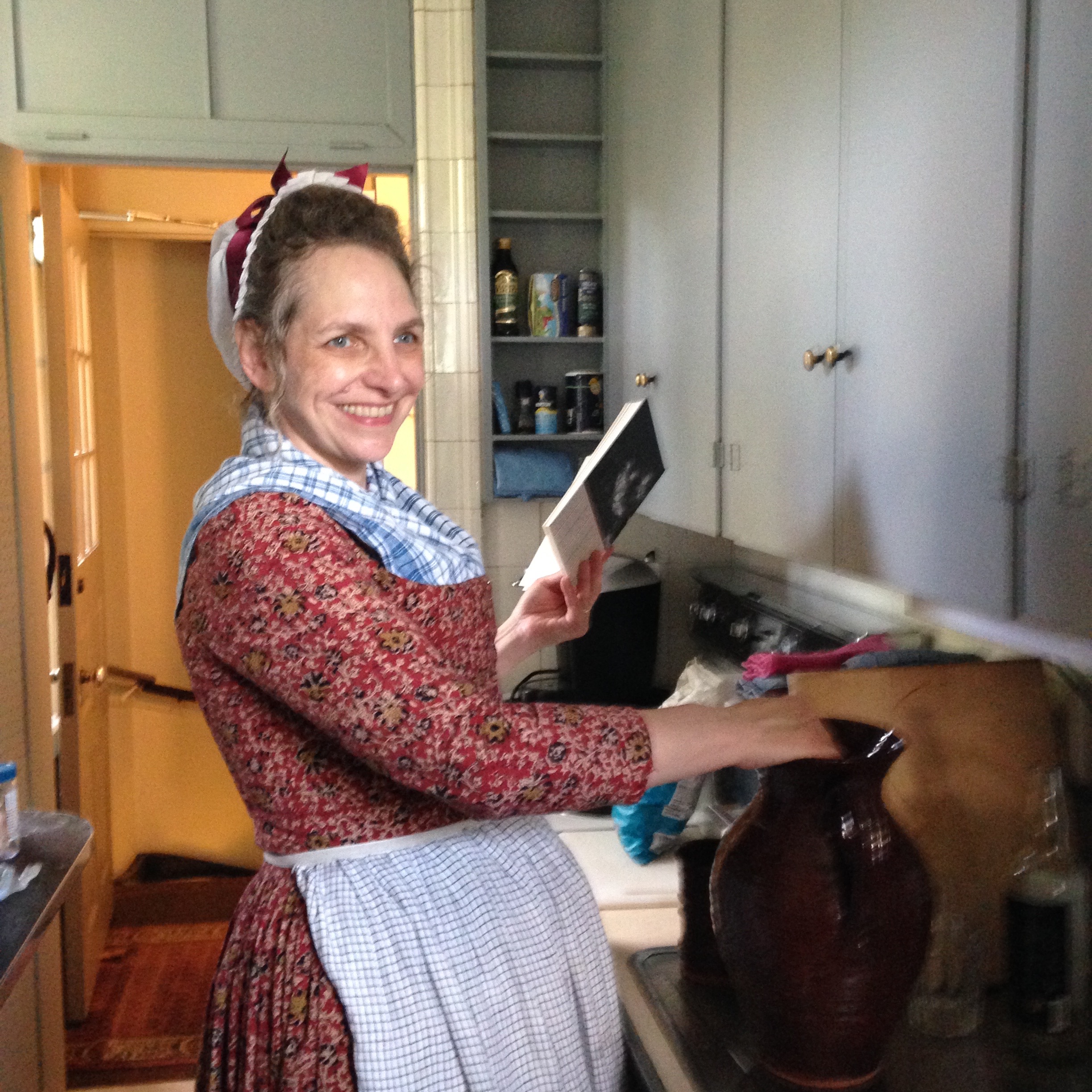
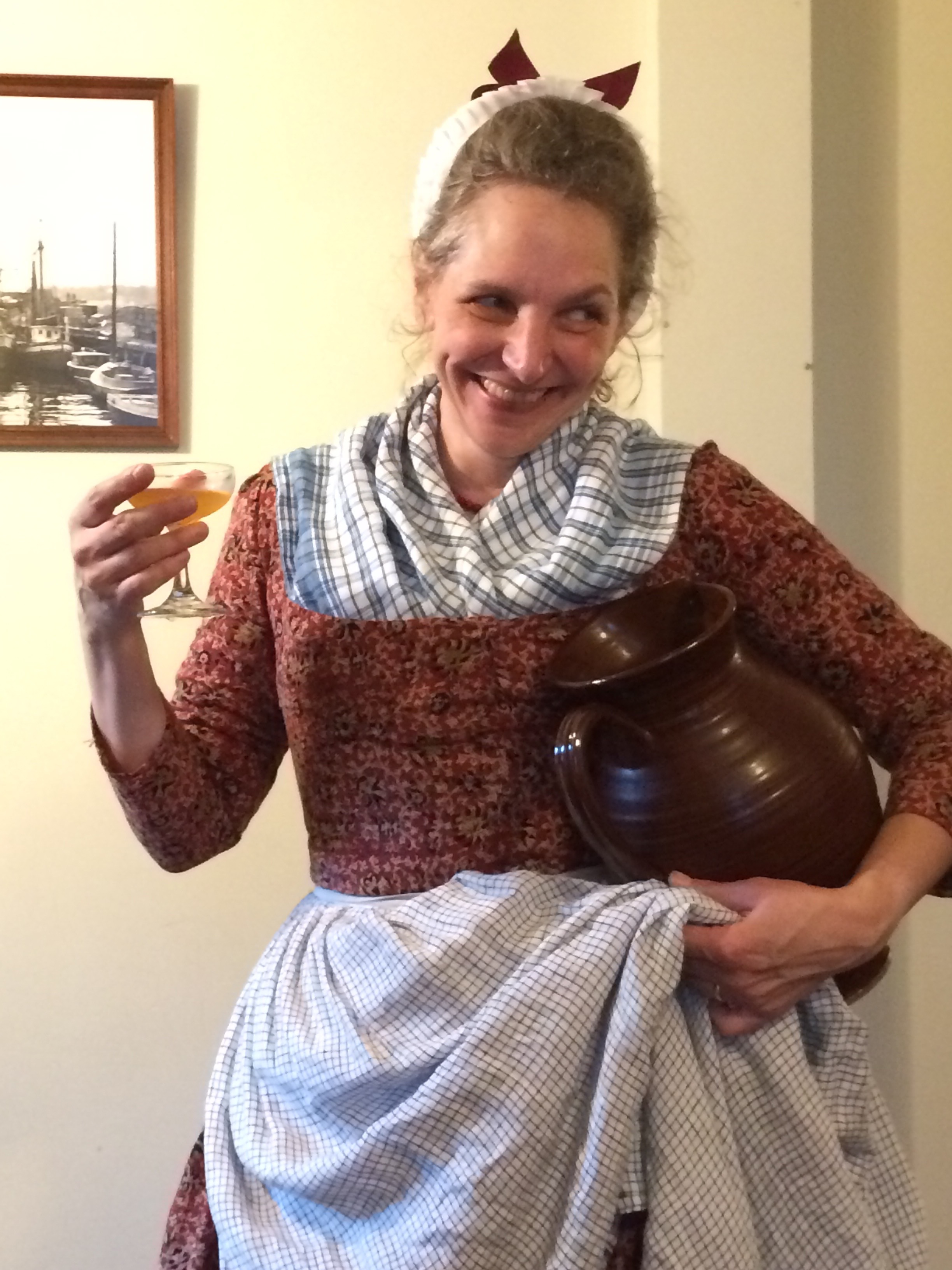
Of course, you have to look out for John Brown’s housekeeper, who is all too happy to spend her afternoon reading and making punch. Unlike a real 18th century person, I had no idea where to start with punch beyond the basic: rum. I turned to my friends for assistance, and got some solid advice, including a reference to Punch: The Delights and Dangers of the Flowing Bowl.Chapter VIII helpfully turns to “How to Make Punch, or the Four Pillars of Punch.”
Mmm, punch.
I don’t always manage to read all the way through the directions I am meant to be following, but the oleo-saccharum was relatively straightforward, since the instructions were entirely on one page. Lemon peels, sugar, mashing. These are simple things that you can handle even in a week when the workplace van has been stolen and recovered, and you’ve had conversations in which someone asks you to find a photograph for them, even though they don’t know where they saw it.
No, I won’t say how many cups I’ve had.
That went well enough, but I got distracted along the way by the excitement in the house, and added the correct ingredients in the wrong order. I don’t think it mattered. Water, black tea, lemon juice, and a bottle of Smith & Cross rum all went in to the redware pitcher and wafted up the back stairs, giving the servants’ quarters a festive ambience.
While the partakers did not know, the bowl from which they ladled punch had once been used in cleaning the Mr Brown’s house– but that only meant it was quite clean, and thus suitable for use. The bowl was nearly emptied and replenished once, by which time Mr Brown’s housekeeper had sampled quite enough of the concoction.
Ladd Observatory, 1898, back of the transit room. Brown University image
On Tuesday, after a long hiatus, the local observatory was, at last, able to open to the public. Between the Snow on Monday theme of this winter, and the tendency to clouds and rain in what New England calls Spring, Ladd had been closed, and sending plaintive and apologetic emails, for weeks.
We walked up shortly after the 8:00 PM opening to find long lines, and a crowd as large or larger than the Halloween open house nights, when the staff and students turned the Observatory into a haunted house, neighborhood naughties swiped too much candy, and the roof deck was open for star gazing. Being Tiny Town, the Young Mr’s middle school art teacher was in line ahead of us with her young son and wife. To his credit, he did acknowledge her.
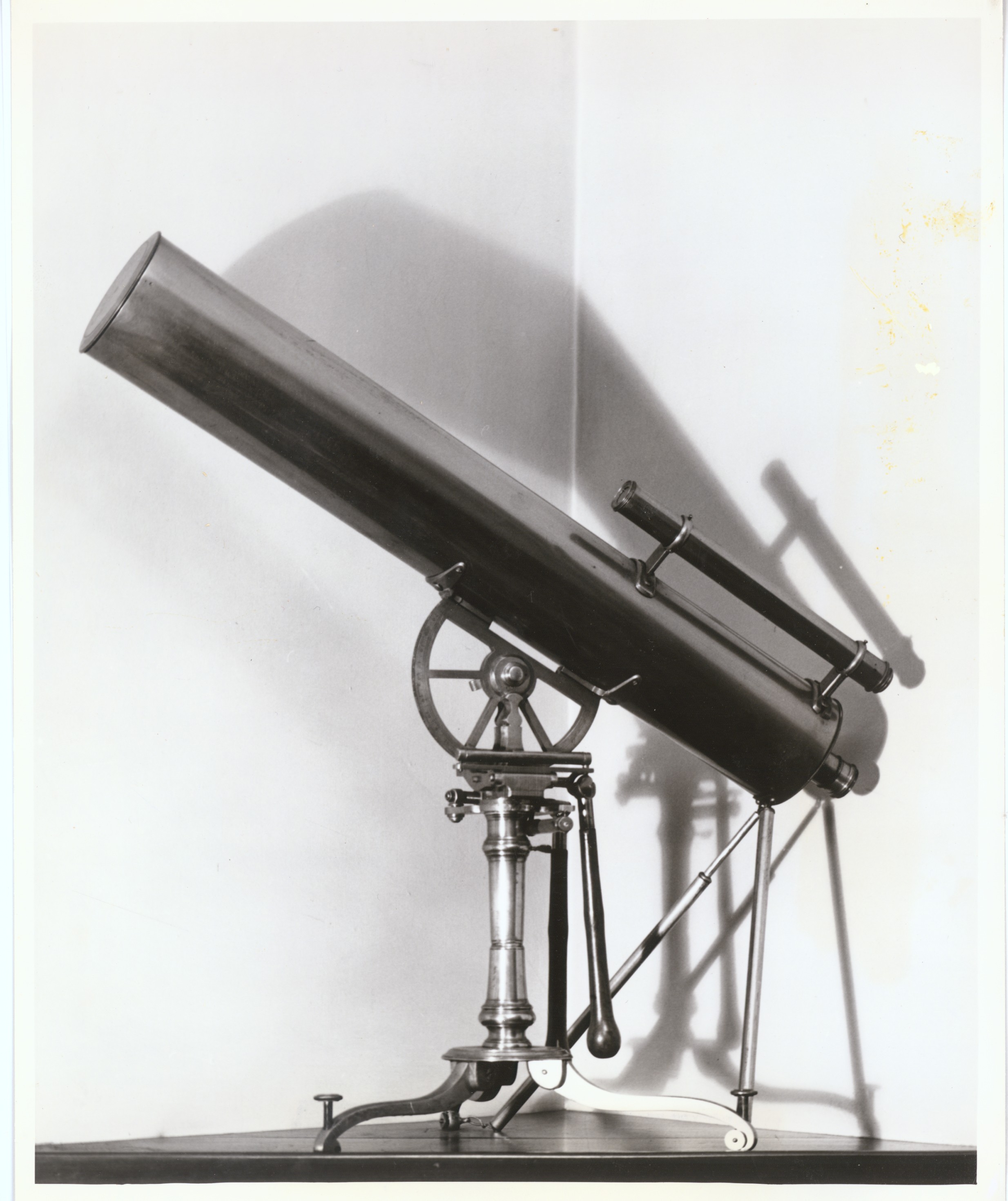
The telescope used by Benjamin West to observe the Transit of Venus, 1769. Brown University image.
There’s a long history of astronomical observation here, with a street named Transit for the 1769 Transit of Venus, observed by Benjamin West and other local notables.
It is really is a “wow!” moment, cooler even than the packages that make it here from India and astonish me. All that distance, light. How truly awesome the view through a telescope must have been in the 18th century, when we, collectively, knew less about the world and universe. How awesome it is now, to be able to see a world so far away, and to wonder what it is like.

 Some of you may recall that I am a recovering artist with a fairly constant need to keep my hands busy. To encourage industry and the domestic arts, and to keep me out of trouble generally, a thoughtful friend provided me with a start to furnishing an early nineteenth century-style paint box. They’re hard to come by, these paint boxes, and extant examples fetch far more than we can afford chez Calash, being in somewhat reduced circumstances of late.






 Kirsten Hammerstrom
You must be logged in to post a comment.