Tavern on the Green

[Not] Mrs Guernsey and Mrs Holstein
[Not] Mrs Guernsey and Mrs Holstein
The wags will quip and Mr M certainly did, to my delight, though I might more properly have been Mrs Fjäll, but that’s neither here nor there.

We offered games, beverages, and tavern food as best we could in the makeshift setting of Washington Square in Newport and served as the site of an impressment riot based on incidents involving sailors from the Maidstone in June, 1765. Custom had been brisk before the Royal Navy so rudely imposed upon our establishment, and dragged off some of our best patrons– leaving their debts unpaid, of course.

Barmaid. Bouncer. Bobby.

We resorted to more gaming, though even that was risky: a young, possibly motherless thief whose trousers barely contain his calves made off with our winnings, and had to be chased down. Fortunately, despite her propensity to smoke, the barmaid was able to apprehend him and, money restored and apology made to Mistress B, we allowed him at our table– I believe we are a better influence than the company he had been keeping, as our trade is honest even if modest.

Much was on offer in town on Saturday, and while Miss C had advertised Hogarth and Sandby throughout the morning, by late in the day, she still had no offers, and the pair were advertising themselves effectively. ‘Tis a pity, for with fish unsold, another day passes and Miss C’s gown remains in pawn, and her shiftless husband’s shoes as well– even the Navy did not want him, for he professes never to work and affects half-wittedness that conceals his natural wit.
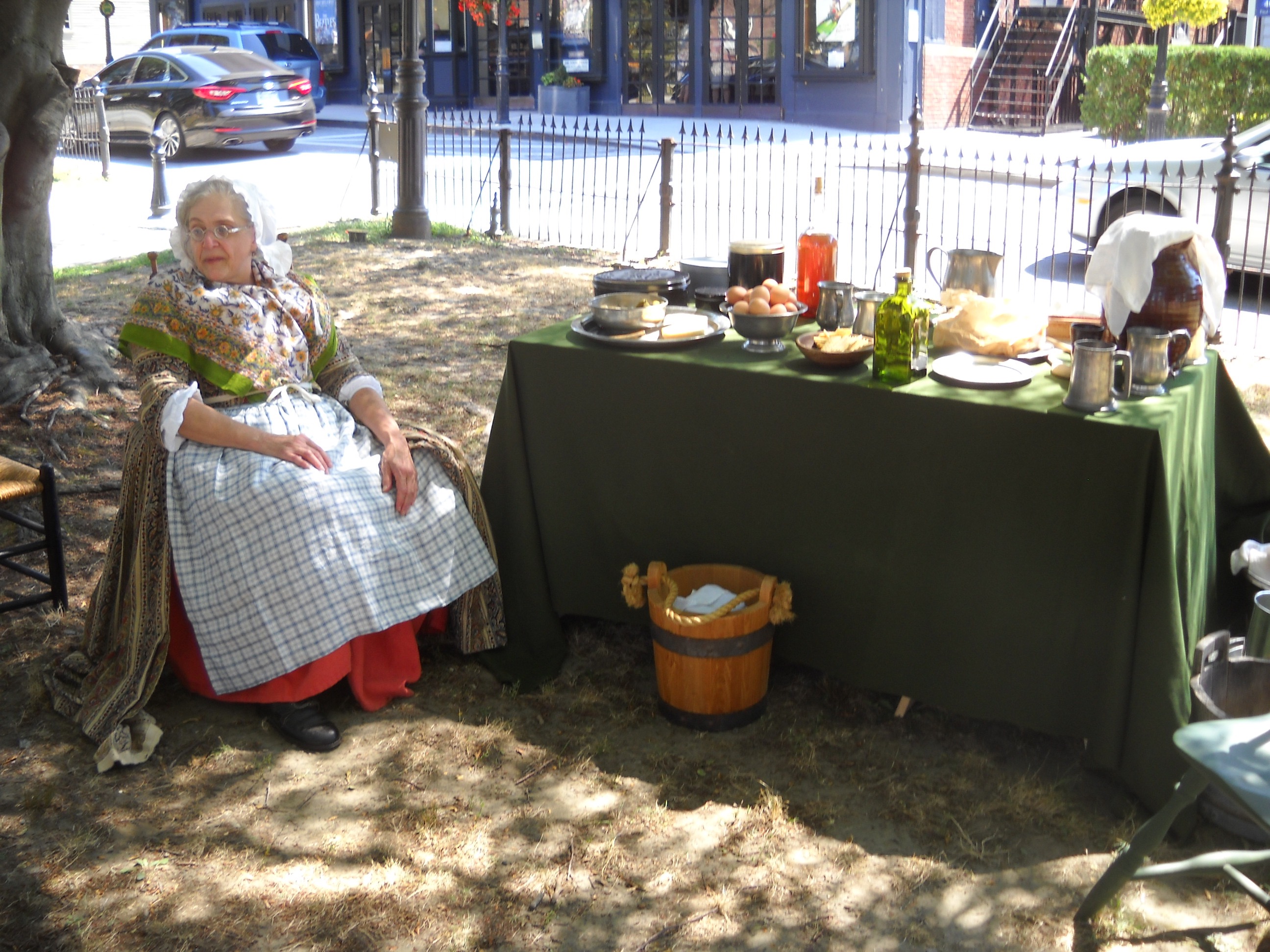
Despite hiccups along the way, setting up a tavern on the green, even in this kind of makeshift way, allowed us to do something I’m always excited about: interpret the history of working women. Serendipitously, one of my favorite books delves into the history of women and business both large and mostly small, and examines Newport. The Ties that Buy, by Eleanor Hartigan-O’Connor is one of the best books on 18th century women’s history that I’ve read, making clear that women, despite their restricted legal status, conducted business, had lines of credit, sued for non-payment of debts, and participated in expanding consumer networks. This book, in addition to research into punch, alcohol, Rhode Island taverns (and I’ve got ready access to tavern ledgers) grounded the interpretation of the Sign of the Two Old Cows. The best part of the intersection of living history and research is bringing actual people from the past to life, and reshaping the way the public understands and appreciates history. For Two Old Cows and a book, I think we did pretty well.

Forsaken Friday: a love letter from 1800

Once again, I begin to consider What Cheer Day, and, feeling uninspired, I turned to primary sources, thinking that reacquainting myself with the characters might prove useful. Among the documents I read today was this letter written by Carl F. Herrreshoff (late of Prussia, but now in New York) to Miss Sally Brown of Providence.

New York 17th June 1800

I hasten my dear Sally to answer three of your letters, two of which, one by Gideon and one by the mail, I received yesterday. I am glad to know you at your favourite place, and the more so as I am well convinced you will think of your absent friend on visiting those spots where we have been so happy. That moments like those should ever return, I thought it folly to hope until a few weeks since; a little lonely spot, where I would quietly reflect on what is past and love you with a pious resignation, was all I dare to wish for, but my love is too powerful for my reason, one beam of light was sufficient to give another turn to my imagination, and your last letter has compleated it. I begin already to see a chain of melancholy days in my solitude, I begin to think myself entitled to more happyness, what ever reason may say to the contrary; but taught by sad experience, like you my dear Sally, not to anticipate much happyness, I shall guard my heart from being to sanguine.One happyness I am not however determined to enjoy, let the consequences be what they will. I will see you, dear excellent girl, I will hear it confirmed from your lips that your heart is above the caprices of fortune, that it is as constant as my own. But though I feel now as much alacrity to obey your command as ever, it is not in my power to do it immediately. I have fixed to go to Philadelphia for a few days; I shall be as expeditious as possible, and on my return the first packet shall convey me to you. I rely on finding you at Point Pl. for I feel very averse to go to Providence. Ursus is in the same condition with your little mare, and I have sent him to the pasture, but I will try to get another horse.
Think of your promise: let me find you in good health and spirits; as for my own health, though never blooming, it is very strong, it have never been really affected from all my mind has suffered these ten months past, and since I have entertained the prospect of meeting you again, I feel as if there had been a great change in my fortune.
I lament that our pleasure will be chilled by the situation of poor A. Let us be ever so good we cannot escape our share of misery in the world, every one must have his turn.
As for your request regarding H I assure you, that if
I made a confident of him in matters which concerned you, it was of my own sentiments merely.
Adieu my charming little Sally, I expect a letter from you dated from Point Pl. forget not to direct all your letters in future to the care of John Murray & Son. Is Mr Coggeshall’s house still a tavern in Bristol? You shall soon hear again from

Your sincerest friend
Herreshoff

I think it proper to write to your father before I go to Providence, are you not of the same opinion & if I should write from here, before I receive your answer, I shall enclose my letter in yours.

Carl Herreshoff to Sally Brown, 17 June 1800.
MSS 487, Herreshoff-Lewis Family Papers
RIHS Manuscripts Collection

A month after this letter was written, “poor A.” gave birth to her first daughter, Abby Brown Mason, a day after marrying James Brown Mason, the child’s father. It was not until 1801 that Sally Brown married Carl Herreshoff, despite her father’s misgivings. John Brown never really liked his sons-in-law, and given his nickname of “Old Thunder,” you have to wonder how they felt about him.

For me, this letter full of longing and acquiescence to a powerful love, has resonance beyond its years. Distance is easier to overcome today, to a degree, but letters remain a poor substitute for a lover.

After Dark: Bedtime for Kitty

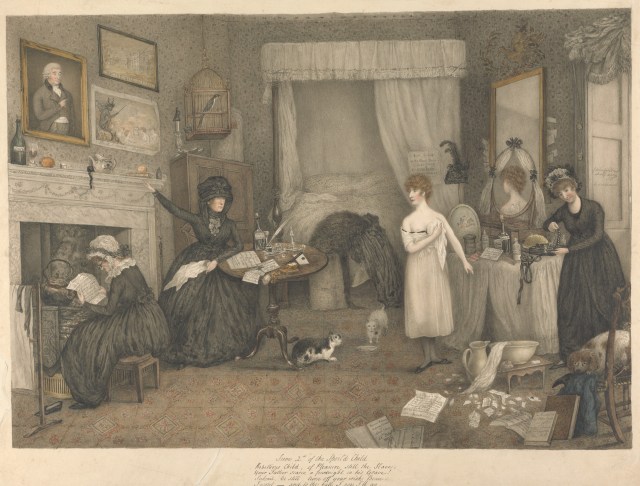
Lewis Vaslet, 1742–1808, The Spoiled Child, Scene II, ca. 1802, Watercolor with black ink and gray wash over graphite on moderately thick, slightly textured, cream wove paper, Yale Center for British Art, Paul Mellon Collection. B1977.14.4342

In just about a week, we’re running a pilot program in the historic house where I work (tickets available here). After Dark, or What Cheer Night, are programs we’ve wanted to do for a couple of years, but all good things take time.

Error
This video doesn’t exist

I’ve drawn the lot chosen to talk about getting ready for bed and sleeping: lighting devices, bedding, washing, chamber pots* and what people wore to bed. While already in possession of candles and candlesticks, and the proud new owner of exhibition and interpretation grant-funded LED candles, there are things I needed to make. Of course.

Print made by Guillaume Philippe Benoist, 1725–ca. 1770, French, Pamela Swooning, after having discovered Mr. B. in the closet, He (frighted) endeavouring to recover her, Mrs. Jervis wringing her hands, and screaming, 1745, Etching with stipple engraving on medium, slightly textured, cream laid paper, Yale Center for British Art, Yale Art Gallery Collection, Gift of the Library Associates.

A banyan, for one thing. And you know that will (one hopes) be followed in short order by a night cap. After all, you can’t talk about Pamela if you haven’t got a banyan and a cap in the house. That’s a simple and relatively fun project to tackle when brain capacity is somewhat limited: some piecing, straight seams, setting in facings and sleeve linings can all happen before I must assault the collar.

Collars are devilishly tricky for me sometimes– oddly, a pad-stitched collar set onto a tailored jacket seems easier to me than a bedgown collar– but I suspect the eventual recipient will manage to enjoy the garment no matter what minor construction errors a tipsy milliner or half-seas over housemaid might make (not, of course, that I am either of those things).

It’s been a fascinating exercise in having a staff-and-docent study group that has taken a decidedly feminist bent (calling Our Girl History!) as we explore what happened in Providence After Dark. Brothel riots in 1782. Warnings by the Baptist Church not to visit the “theatre, circus, or Green Cottage” on pain of punishment. No, I do not yet know what or where the Green Cottage is, but the best researchers I know are working on it. Is this the 18th century answer to the Green Door? We can but hope.

Reading The Coquette? Thomson’s The Seasons? Come experience an 18th century house on a night when people will know what you’re talking about! Or you can watch  that questionable housekeeper prepare a room for the night while she talks about sleep patterns and shares tips for 18th century pest control.


*Pro tip: put it on a chair. I fully expect to run an intimate workshop some evening called “Will Humiliate Self for History, or, Everything you ever wanted to know about the 18th century, but were too well brought up to ask.”

Writing for the Weekend

Johann Ender, Woman at her writing desk ca 1820

or, Women’s History at Washington’s Crossing

I haven’t dropped the peddling question, I promise! But I’m busy writing a paper for this coming weekend’s women’s history conference (yes, I know: but I’ve read that procrastination fuels creativity, so those digressions into the Canton voyage of the Ann and Hope were totally worth it).

Georg Friedrich Kersting: Briefschreibende Dame im Biedermeier Interieur, 1817
Georg Friedrich Kersting:
Briefschreibende Dame im Biedermeier Interieur, 1817

If you’re curious about the process I go through developing characters for living history programs, or best practices for women of the Revolutionary War-era armies, among other topics, there are some tickets left, and you can register online here.

But before I can compile what I’ve found about food markets in 18th century Boston, I have to go back to writing for this weekend.

Those Providence servants don’t research and describe themselves, and the housekeeper is particularly unreliable.