Gentlemen Prefer Blue

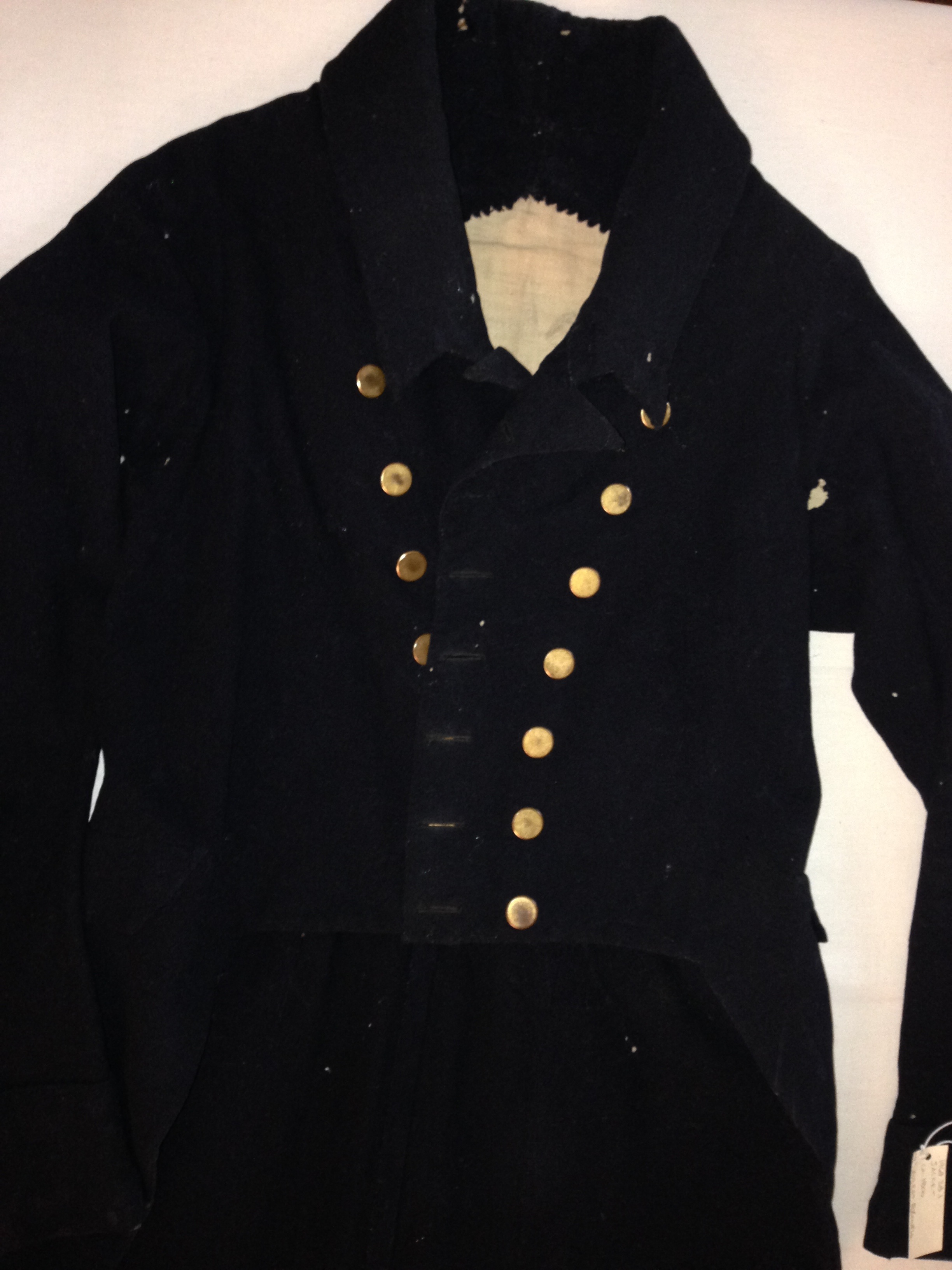
Blue wool coat c. 1800. RIHS Museum Collection 1968.38.1

Continuing the theme of wool coats that will make you itch in August, I present you with another Rhode Island coat. This coat has features I’m more familiar with: a smooth sleeve head, slightly fuller tail pleats, and tail pockets (I love secret pockets). The notched collar with its fine beak-like points makes me think this is later than 1790-1800, as the style heads in the direction of the white wool coat from yesterday’s post.

Slit cuff with two buttons, RIHS Museum Collections, 1968.38.1

There’s no waist seam, so we can be pretty certain that this coat is earlier than 1818, if not 1810. Another telling measure of age is cuff treatment. This slit cuff seems to start in the 1780s or 1790s and persist into the early 19th century, (and beyond: gentlemen, check your coat sleeves and you’ll see what I mean).

That’s an awfully long range, 1780s to forever, but the smooth sleeve head and lack of waist seam help narrow the time frame. I’d hazard– and this is a hazardous business– ca. 1805 date for this coat, which would give me leeway for a common man to wear this into 1812, though make it more difficult for him to wear it in 1799/1800. (You can look back in fashion, but high style on the lower sorts is a tricky business and requires a lot of thought.)

1925.11.1A, RIHS Museum Collection

For travel to 1790-1800, I have another coat in mind, though it will probably be a long time before I get it made. This, too, has classic markers of its time, though the collar’s stand-and-fall style makes me think it is closer to 1790 than to 1800.

The lining of this coat is a particular treat: every time I’m able to pull this out for viewing (and since it’s boxed right now, that’s not happening), that blue glazed wool is a treat. The wear mark on the left proper tail lining is intriguing, too: sometimes those start as moth holes and progress, and sometimes they’re wear that’s later found to be delicious and expands by chomping. (Wool and silk and protein, and delicious treats for pests.)

I find these coats really exciting, and often feel a little “Make All the Coats,” but of course I can’t, not quickly, anyway. And these two don’t really solve my August in 1812 problem, as the clock ticks on…but I think there is a solution, thanks to Sharon Burnston and Fitting & Proper.
Dating Mr Darcy…

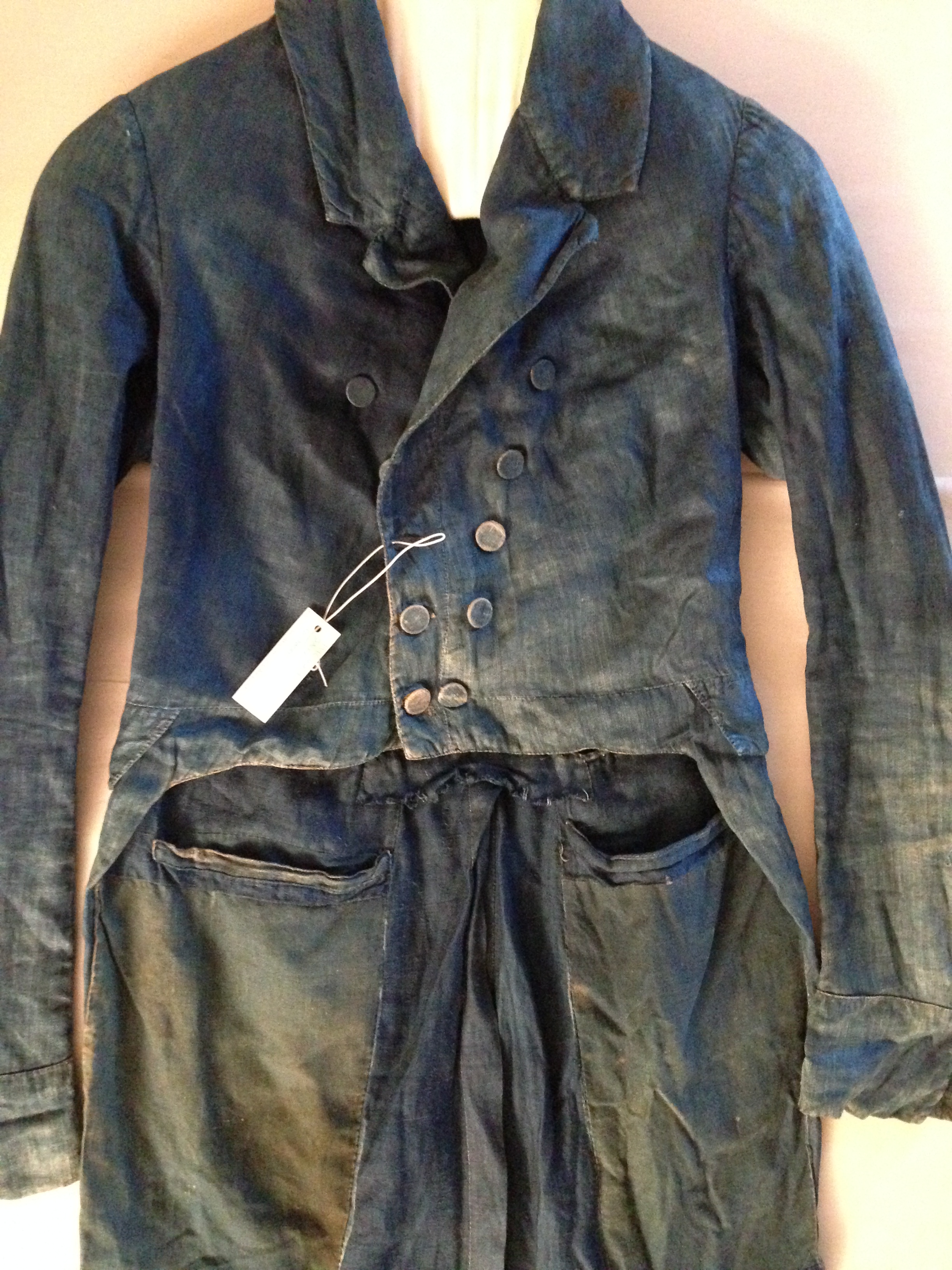
1996.66.4, RIHS Museum Collection

Or at least his coats.

I don’t know about you, but as the summer weather warms up, I like to think wool. I’ve got menswear to sew and desires beyond my knowledge, skills and abilities. Making a wool coat for an event in August seems like a patentable Bad Idea, so it’s a good thing that I have a nice piece of Italian linen-cotton denim-like fabric that I’ve set aside to make a summer-suitable coat for Mr S.

There is a Rhode Island coat, in a Rhode Island collection, of which I am particularly fond. I’ve had this coat in mind for some time now, and have inflicted it upon have shared it with experts several times.  It has a lot to recommend it: a soil mark on the collar, extensive damage and repairs to the left sleeve, fading and wear on the back, fragments of botanical material in the pocket lint, and the nicest linen fabric I’ve ever felt.

This is the coat I wanted to make for Mr S, but then I started thinking about that waist seam, which eliminates this from the style competition for 1812. Rats! But, OK, no reason that we can’t use this as inspiration and make a coat using the fabric but not the waist seam.

1956.9.3, RIHS Museum Collection

So I looked at another coat that just happened to be handy (I know, I am very lucky, and that’s part of why I’m sharing this with you). At first glance, I thought I was good. And by glance, I mean extended looking. But look again: there is a waist seam, it’s just harder to see. So much for the iPhone and lousy light, right? (I noticed the seam today, in even less light, so go figure.) This coat is made of a single twill off white wool can easily be mistaken for plain weave and that is rather light. Very summery, in a way.

Coat style found? Maybe. But I was wondering about the sleeves. I spend a great deal of time looking at sleeves and backs of much earlier coats, so I’m accustomed to a smooth sleeve head. That’s not what you’ll find on this garment, though. This one has gathers, and I thought that was pretty exciting. My closest expert probably had a weird twinge at that moment that he will soon learn to associate with an incoming email from me…

Sleeves, 1956.9.3 RIHS Museum Collection

This is a nice detail, but one I’m not familiar with. The fashion plates on Serendipitous Stitchery’s post do show increasingly full sleeves in the early years of the 19th century, but that detail didn’t fully register with me until I looked at this coat and processed what Mr C had told me about sleeves and shoulders. Seeing an extant example always makes principles more real.

So what next? At work, I’ve started updating the catalog records for these coats, and they’ll go live early next month. Every time we learn something new, we try to update and correct records so that everyone can benefit. That’s the easy part.

The hard part is reconciling style details for Mr S’s coat. In comparing these examples with fashion plates, I think it’s clear that they are both later than 1812 (waist seam) and nodding to but perhaps not fully embracing high style (see the gathers on the white coat, but the blue coat has only one gathered sleeve, which I attribute to maker error). Plausible dates for both might be 1818-1826, bearing in mind that these will be interpretations of styles, the way Old Navy knocks off adapts its sibling Banana Republic’s styles.

I may be back at that fabulous checked linen coat at the Met, with inspiration drawn from Providence’s plainest blue coat. The process always seems a compromise, in part because I do not think Mr S wants a checked coat, and in part because I’d like to use fabric I already have. Still, there is yet another coat to think about…but tomorrow is another day.

Use it Up, Wear it Out, Make it Do

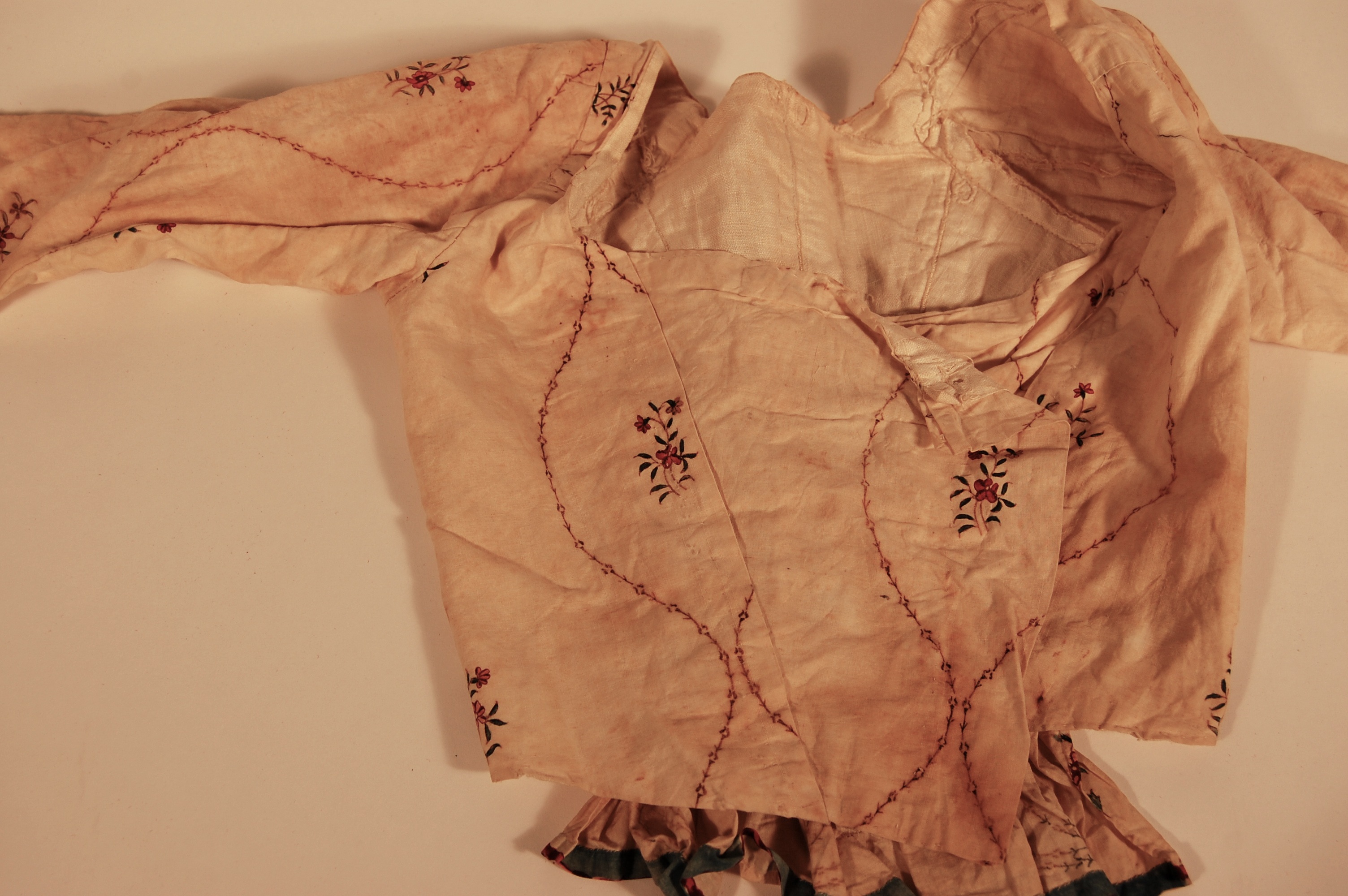
Bodice, painted Indian cotton, 1780-1795 RIHS 1990.36.27
Bodice, painted Indian cotton, 1780-1795
RIHS 1990.36.27

I’ve fallen behind again, as I spent considerable early morning time this past week working on a short presentation for a program in Worcester this past weekend. If you are among the people who do not wake at 4:00 AM panicking about the organization of your thoughts, or whom, exactly, might have worn a heavily-remade bodice, you are lucky indeed.

But I managed to present without falling all over myself, putting out someone’s eye, or causing mayhem and self-embarassment, so, phew! (I do this so much less often than I used to that my anticipatory anxiety is always high.)

Above you can see one of the items I talked about: a re-worked bodice from the collection of the Rhode Island Historical Society.

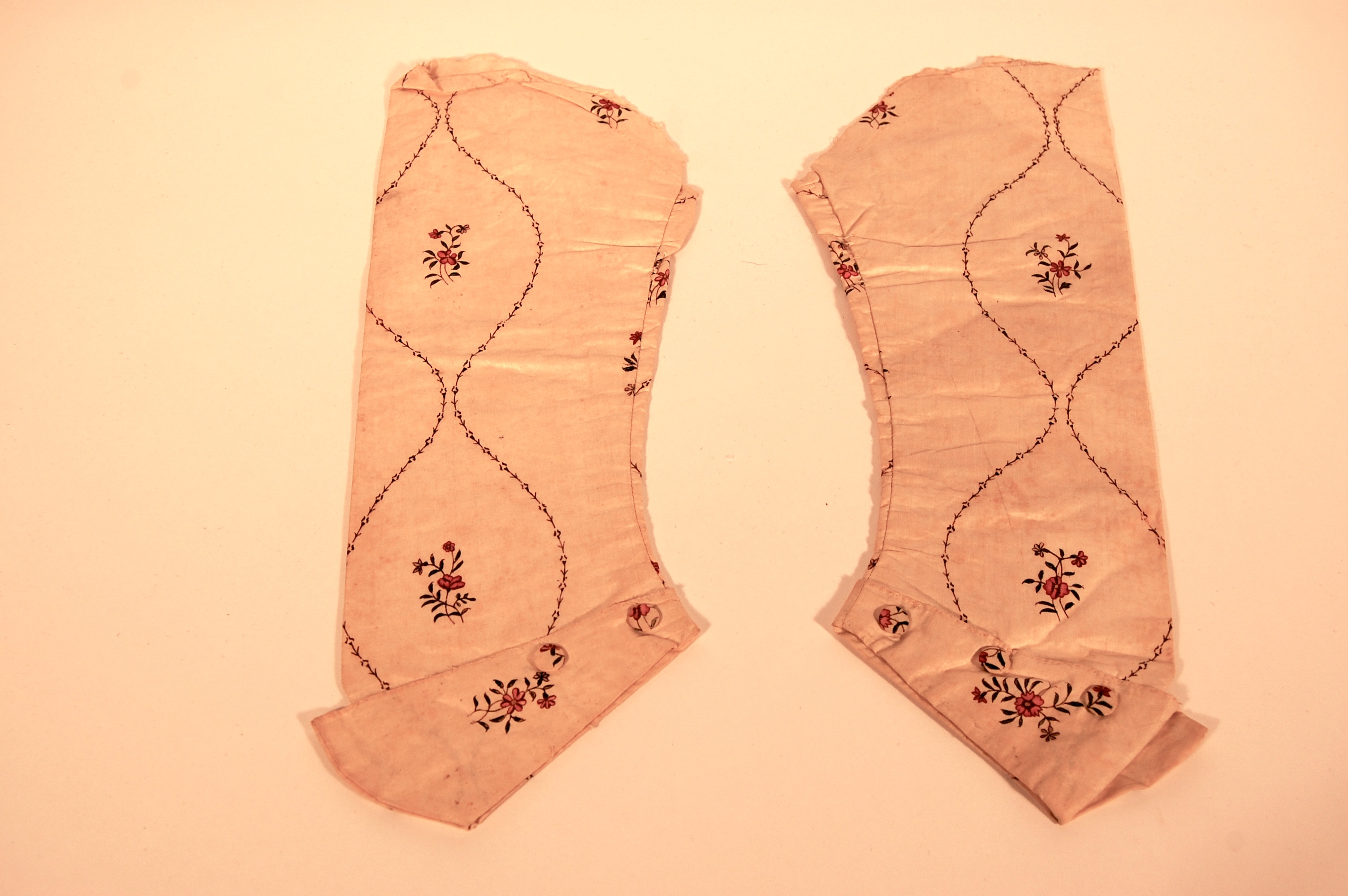
Sleeves, removed from bodice 1990.36.27. RIHS 1990.36.25A-B
Sleeves, removed from bodice 1990.36.27.
RIHS 1990.36.25A-B

I think, once upon a time, that bodice was part of a pieced-back closed-front gown with a matching petticoat.

And then I think someone decided (quite rightly) that the style was too passé for 1795, and altered the gown significantly.

Not only is there evidence of new sleeves being fitted into the gown’s armscyes, we have the sleeves-that-used-to-be. And my dear! No one is wearing sleeves like that this season!

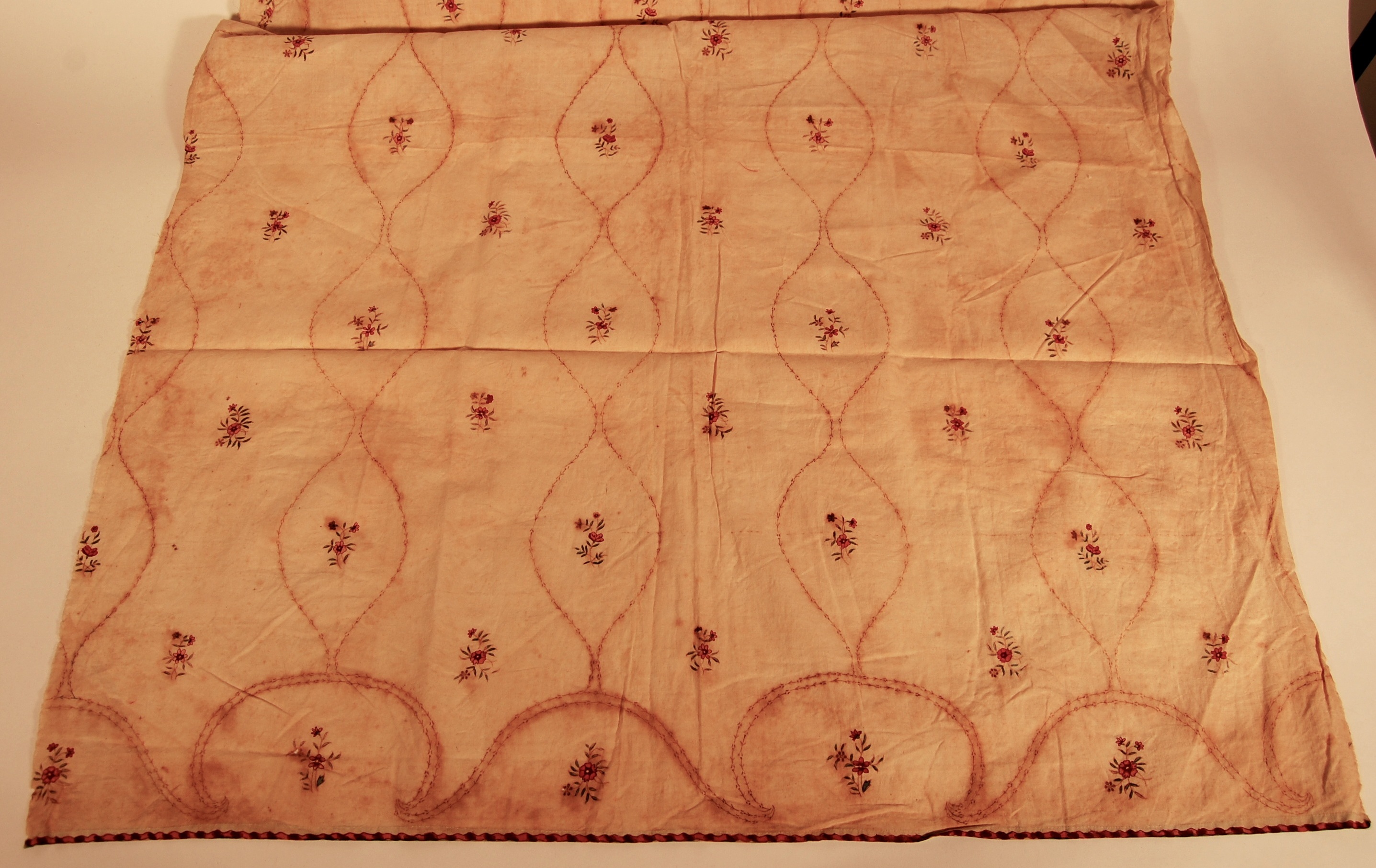
I find these garments in limbo really fascinating. Was that bodice finished and worn with a matching petticoat? (Yes, there’s a panel of that left, too; what a lovely hem!)

Skirt panel, painted Indian cotton. RIHS 1990.36.33
Skirt panel, painted Indian cotton.
RIHS 1990.36.33

Who wore the gown? Was the woman who wore it originally the same woman who wore it altered? I can only guess at this point, and may never find the smoking diary or mantua-maker’s bill. The alterations are not as finely done as the original gown, so I think there are two hands at work here– whose were those hands? There’s always more to think about and learn.

In case you’re wondering, thanks to the Met, we can see what the gown probably looked like in its first incarnation, and then what the alterations were meant to achieve. (Link to the gown on the left; link to the gown on the right.)

Pockets of Evidence

Or is it evidence of pockets?

Pocket, 1770-1780 Rhode Island Linen, cotton and silk RIHS 1985.1.9
Pocket, 1770-1780
Rhode Island
Linen, cotton and silk
RIHS 1985.1.9

In any case, I thought it time to upgrade my pockets, since I have given so much attention to the rest of Bridget’s clothing. I have also been talking with a colleague about a pocket game activity, similar to the process I’ve used in thinking about Bridget: what is in your pocket? If I’m going to try that out in public, then I’d like not to be embarrassed about my pockets.

The first pocket I made was based completely on one in the RIHS Collection, and it annoyed the daylights out of me as it had exactly the same loop on top and twisted around under my petticoats, making the opening hard to find. I also realized that it was too small to be really correct for a woman’s pocket: those tend to be larger. Sew 18th Century has a really nice article on pockets here.

Pocket, 1789 American  linen  Gift of Miss Blanche Vedder-Wood, 1940  MMA Costume Institute C.I.40.159.4
Pocket, 1789
American
linen
Gift of Miss Blanche Vedder-Wood, 1940
MMA Costume Institute C.I.40.159.4

So I made a larger pocket based on this one at the Met, and made of a grey and cream striped linen with the slit bound in red calico. It’s dated to 1789, and technically that’s too late for my uses.

Pocket 1720-1730 block printed cotton and linen
Pocket
England, 1720-1730
Cotton; Linen
Winterthur Museum Collection 1960.0248

But the next one is too early.

Well, it has survived this long, and Wm Booth has that lovely shell print cotton, so what’s a sister to do? Pockets don’t take much fabric, so making a matched pair of printed pockets seems the thing to do.

Now the question is, what should be in those pockets?