Mrs William (Jane) Pabodie. oil on canvas, 1813. RIHS 1970.60.2
Remember Mrs Pabodie? She appeared a week ago today in Providence after an intense sewing effort left your author with numb fingers. The process was as straightforward as these things ever are, manipulating fabrics to do your bidding once you think you have the right materials.
It took more rounds of white muslins from Burnley and Trowbridge than I care to count, and a variety of book muslins from Wm Booth Draper, just for the chemisette and cap. The laces came from Farmhouse Fabrics in the most expensive small package I’ve yet ordered that did not contain antique jewelry.
Mrs Pabodie attempts to remember when she was born (1771). Photo by J. D. Kay
The gown is a wool and silk blend remnant from Wm Booth Draper, just enough to make a gown (even at my height) though I admit the front hem will need some piecing or a ruffle to give it the proper length. Still, the thing more or less works, though as I compare the details to the original painting, I admit we’re still in beta.
Impressed from Newport– or nearly so– Low Spark makes his Providence debut. Photo by J.D. Kay
Reverend Hitchcock, hoping against hope that the tailor will one day finish his fine silk waistcoat. Photo by J. D. Kay
Sissieretta Jones extols the beauties of Paris– and pearls. Photo by J. D. Kay
I was joined by three friends from different eras (because you know me: if it’s not didactic, we’re not doing it): a sailor who on the run from a Newport press gang in 1765; Reverend Enos Hitchcock of the Beneficient Congregational Church in 1785; and Sissieretta Jones, soprano of Providence, around 1880. Each of the characters described their lives and their clothing, and I will admit that the Annual Meeting audience may not have been fully prepared for some of what they heard– I’m not certain they had ever considered how apt “balancing a sheep on my head” might be in describing Reverend Hitchcock’s wig.
Mrs Pabodie points out East Side landmarks to a visitor examining the theatre curtain backdrop painted around 1810. Photo by J. D. Kay
In the end, they were entertained, and may even have learned something, as we celebrated 2016’s interpretive theme, Fashioning Rhode Island.
Petulant Alice faces her first hurdle, Kitty and Goody Morris. Photograph by J. D. Kay
I think about three or four things most of the time: food, sex, museums, and clothes. That seems pretty adequate, but from time to time I am forced to consider intersections between these rather broad topics. The intersectionality of clothing and museums seems pretty obvious: from accurate costumed interpretation to proper packing and storage, easy. Food and museums will be much on my mind in the coming year, as we work on “Relishing Rhode Island,” and I’m continually harping on how eating locally and seasonally is the core of eating historically. Sex and museums is a little harder (yes, I know about the Museum of Sex), though one gets a chance even in a historic house museum, and really, it’s not just about the act: it’s about the feels.
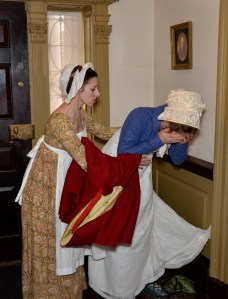
Mary assists Alice in the hallway as she prepares to face her mother. Photograph by J. D. Kay
In the main, I am not particularly good at the feels aside from some very hands-on experience with anxiety, but a number of things have coalesced recently to make me reconsider the intersection of emotions, museums, and history.
Hamilton is one, and if you read this, you probably watched the Hamilton’s America documentary on PBS last Friday. If you didn’t, go do it now. Really: I can wait. And here’s why:
In the thinking I’ve been doing for some time about Hamilton,* I’ve reached the conclusion that what makes it so damn good (aside from the brilliant writing) is how Lin-Manuel Miranda has captured the emotions. The quotes I wrote down from the documentary are about emotion and drama, because I’m looking for them (confirmation bias for the win) but here they are:
“Each piece of music is specific to an emotion and a character”
“I got into the history through the characters”
“Research is over and you write the character defined by history”
“Write the parts you think are a musical”
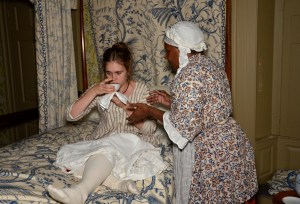
Goody Morris helps Alice drink lemon water to soothe her stomach. Photograph by J. D. Kay
What is a museum exhibit but “the parts you think are a musical?” While Our Girl History struggled with being Alice (I know a bit about the part where your ego gets connected to a character), she had to portray a character defined by history, but also by emotion. And in thinking about Hamilton, about What Cheer Day, and about the exhibits that give me pleasure, and art that brings me joy, I have reached a couple of conclusions.
I believe that museums, where we currently set educational and interpretive goals, and increasingly experiential goals, need to begin setting emotional goals for their programs and exhibitions. You could argue that experiential and emotional goals are the same, but I disagree: I believe that interpretation helps define the experiences that create emotional responses, and within the intersection of experience and emotion we will find the educational goal revealed, because we are always working within a content-driven context.
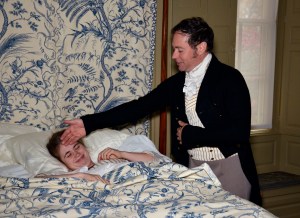
James checks on sister Alice. Photograph by J. D. Kay
I also believe the reason gun-based reenactments retain their popularity is their easy emotions. “Boom!” is exciting anywhere: there’s an immediate reaction of shock, surprise, a mild fear, and excitement. Traditional reenactments have those “boom!” emotions embedded within them, which is how they retain their potency. Until we locate the emotion within the everyday– and trust me, it’s there– we will not see the primacy of non-military reenactments and living history.
*Yes, I was aware of it when it was in previews at the Public Theatre. I am *that* kind of hipster, but really, it was because Oscar Eustis went from Trinity Rep here to the Public and there’s a PVD-NYC theatre connection.
What Cheer! Wednesday: that’s today, with a preview of What Cheer Day itself as props are distributed through the house, the display cases open for viewing and a talk and demonstration of early Federal-era fashion in Rhode Island at 2:30 today. Or not— since we have another program at 4:00. At least I found out before lunchtime.
It’s not the first time I’ve packed a day as full as possible– in fact, I know more is possible, because I’ve done it.
A maid and her mistress
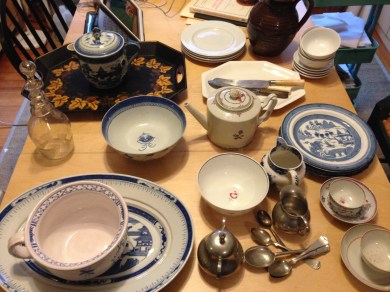
Yesterday, in addition to packing up a small household for use on Saturday, m’colleague and I dressed two mannequins– well, one and a half, since the mistress still needs some work. I don’t know how I forgot the second petticoat when it was right there on my list, but so it goes. Mannequin dressing will finish this morning for this afternoon’s free talk and demonstration.
Saturday, though: that’s the really exciting day, when Alice tries to sneak past her mother after staying out all night at a party. Julia Bowen may not be the good influence we thought she was, if her uncle is anything to judge by.
The fun starts at 1:00 PM and runs until 6:00, so we can take advantage of what we learned for After Dark. Extending the life of program research: is there anything better? Maybe a new Spencer, finally completed after more than a year. The weather promises to be chilly enough to make a Spencer necessary, not that I could resist flashing buttons anyway.
This look seemed achievable, once a few compromises were made. To begin with, I scrapped the notion of replicating a silk taffeta gown: too dear for so short a time. I felt some comfort in this decision as I think the sleeves indicate a rather later date than 1824, and I am, in fact, striving for an Arcade-opening-appropriate dress suitable for about 1826.
So, what to do? Well, thank goodnessmen like to shoot at plywood and win feathers. My plan is to wear the brown striped gown with the existing belt and accessorize with a new antique lace pelerine-collar type device, I also plan [hope to] make a new extreme jellyfish cap and possibly a new bonnet.
I have the supplies. Do I have the time and will power? Stay tuned for the next installment of, “Yes, I may be overbooked.”





 Kirsten Hammerstrom
You must be logged in to post a comment.