A Matter of Interpretation

On the way to Southbridge, Mr S and I were discussing the last “big” event for the year, and whether or not we wanted to go. It’s an annual event grounded in ceremony, and somewhat repetitive.

The landing of the British forces in the Jerseys on the 20th of November 1776 under the command of the Rt. Honl. Lieut. Genl. Earl Cornwallis. Watercolor, attributed to Thomas Davies. NYPL

Mr S would like to go if he had the proper wool coat– it will be easy enough to make, once he gets a kit– but which he does not now have. I find it’s usually a day alone wishing I was across the river in a museum or fabric shop. In the end, it’s a long drive to a day spent in the cold and wind followed by a dash home in the dark, with Sunday spent catching up on chores and cleaning muskets, and now with an added measure of homework stress.

I have painted this as a grimmer day than it usually is, but considering that it’s been 7 months since we had any non-medical time off from work, squeezing this into a busy and stressful schedule is not as appealing as it once was. In part, I think it is because there is a lost opportunity in the interpretation, which is surely limited by the size and nature of the site, and by the loss of the historic fabric of the area.

Nestled in a densely settled and very urban area, the park site has a block house, hut, and fortification as well as a museum. Sutlers and others set up in the museum for the day, including some demonstrations of women’s work…like spinning. Spending the day inside spinning is not for me: not only can I not spin, I cannot imagine fleeing the British with a spinning wheel, which is an annoying contraption to move even with assistance, plenty of time, and a Subaru.
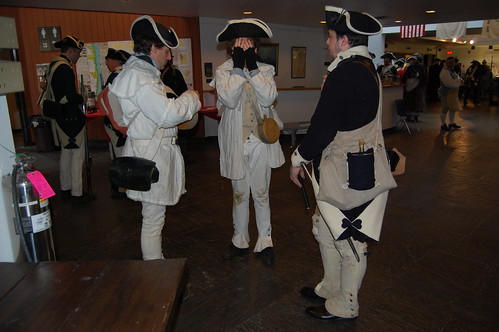
The Young Mr hides

But more than my impatience with Ye Olde Colonial Spinning Wheel at too many military camps this past year, I think what stops me from wanting to go is the repetitive formality of the interpretation, with the the march to the monument and the post-prandial “battle” for the blockhouse, with the Americans sometimes winning, despite the fact that the fall of this site marked the beginning of Washington’s retreat to Pennsylvania, and despite the fact that three days earlier, when the companion fort across the river fell to the British and Hessian troops, nearly 3,000 Americans were taken prisoner in 1776, and of those, only 800 survived. In what way is this ritualistic commemorative event remotely authentic? And if the only way people get the actual history and importance of the event is through the event narration or museum exhibit, hasn’t the reenactment or living history portion then failed?

Ritualistic, commemorative.

The more I think about interpretation and presentation, the more Ye Olde Colonial things annoy me and the more important I think it is to be accurate and correct.

Forcing a passage of the Hudson River, 9 October 1776. oil on canvas by Thomas Mitchell from an original by Dominic Serres the Elder. Royal Museums Greenwich

That does not mean that I expect a naval engagement (though a girl can dream) or a cross-Hudson rowing affair, but I do think it could be interesting to see troops at a fort packing up and evacuating the site, with the confusion that could result. But it’s not my circus, and not my monkeys, and in any event, I shall probably stay home to make sure that homework and housework alike are done in this current century.

“As much so as we can”

Captain Christopher Marshall Orderly Book, 1781. Society of the Cincinnati Library.

It’s been a tougher week than usual chez Calash, what with the AP Euro History and Honors English homework and struggles of the Young Mr, early mornings at work for window installation (finally, thank you!) and a round (lost) with an Orange Line Special virus brought home by Mr S.  The bright note came in the mail, though, and thank you USPS for your really reliable and right on (this) time delivery!

I have been working to get this book from the Society of the Cincinnati Library on behalf, and at the behest, of the 10th Massachusetts. The SoC have an pretty amazing collection, and they undertook a project to have their entire collection of British and Continental Orderly books conserved. These are incredibly fragile and almost ephemeral books: they’re the daily record of orders, courts martial, movements, complaints and requests for a regiment. It’s like the notes you might keep if you had to meet with your boss and other direct reports every day and keep track of many orders affecting the several hundred unruly, hungry, and possibly irritable guys under your command. But you’re taking notes with quill and ink, in longhand, and no one is going to email minutes out later that afternoon.

Bridget Connor turned up in an orderly book, so they can have a novelistic appeal (handy for those of us who approach military history from the social history world). So far, this book has produced no Bridgets, but it has not disappointed. Reader, I wept.

This book has moved me. Take this:

The disadvantage and difficulties which from inevitable Circumstances we labour under instead of depressing should inspirit us to surmount them. That we are involved in them is only our misfortune; not to make efforts to Conquer them will be our fault: and if we cannot be so well prepared as we ought at least let us be as much so as we can.

There are sketches of the “disposition of the New hampshire Massachusetts Rhode Island and Connecticut lines.” And, as I read to the Young Mr, there is unfinished business in nasty rooms.

Some part of the Camp and about the long Barracks in particular is relaxing into nastiness. Regimental QuarterMasters have been ordered to have them Clean and keep them so. An Officer of each Company has been ordered to visit the Barracks every day and to Confine & Report those who throw bones of meat Pot Liquor or filth of any kind near the Barracks. Yet all this has been done and no report has been made. it is hatefull to General Howe to Reitterate orders as it ought to be shamefull those who make it necessary.

Why, the Young Mr and I just had a similar talk last night…though, thankfully, there were no bones of meat involved.

This going to be a good read.

I know the SoC has a beautiful library and nice website, but folks, if you are into this history, throw them some love. I checked their 990s and they’re struggling just like everyone else. And if not them, please, support your favorite local historical site, organization, museum, whatever. Every place has something magical that will change your day. Your money– even a small donation– helps them do that work.

Camp Life

The Ks, Mr C, Mr McC, and the Ss in camp

When I don’t manage to write up the weekend quickly, I risk forgetting what happened, which is sad when you think how intense the time can be. This past weekend was a little different from others as there were more of us in camp than usual. I locked the camera in the car along with my car keys, and never remembered to ask Mr S for his key when he was present…so the images are all from other sources.

Last week I was party to the Great Oatmeal Debate by Text Message as I tried to determine whether or not oatmeal was correct in period, and if so, what kind.  Let’s call it Hannah Glasse’s “oatmeal flummery” and move on.

To make Oatmeal-Flummery. GET fome oatmeal, put it into a broad deep pan, then co ver it with water, stir it together, and let itftand twelve hours, then pour off that water clear, and put on a good deal of fresh water, shift it again in twelve hours, and fo orrin twelve more ; then pour off the water clear, and ftrain the oatmeal through a coarfe hair-fieve, and pour it into a fauce-pan, keeping it stir ring all the time with a stick till it boils and is very thick ; then pour it into difhes ; when cold turn it into plates, and eat it with what you pleafe, either wine and fugar, or beer and sugar, or milk. It eats very pretty with cyder and fugar.

We were very lucky to have hard wood for fires, and I was very lucky indeed to have Mr McC on hand to tend to the fire, especially on Sunday morning, when I did not get up and start dressing until 6:00 AM. He joined us early Saturday morning with a kettle of hot coffee in hand, proving long experience with the un-caffeinated reenactor in the wild.

We ate very well this past weekend, with contributions from Mr McC, Mr L, the family C, and purchases from the Georgian Kitchen and Sugar Loafe Baking Company.

The Georgian Kitchen and Sugar Loafe Baking Co at Walloomsac

The Young Mr eventually bought his own loaf of bread, stuffed it in his haversack, and ate from it fairly continually on Sunday. If there had been a ginger cookie as large as a loaf of bread, I expect he would have bought that instead, but bread was a reasonable choice (though I think it proven tricky to hold a musket and a loaf of bread simultaneously….)

18th century militia in small clothes
Militia in Small Clothes
18th century militia marching in New York countryside
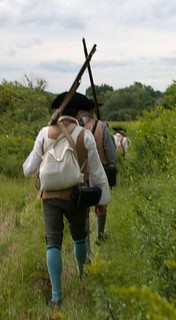
Mr S (left handed, as you can see) following MrMcC

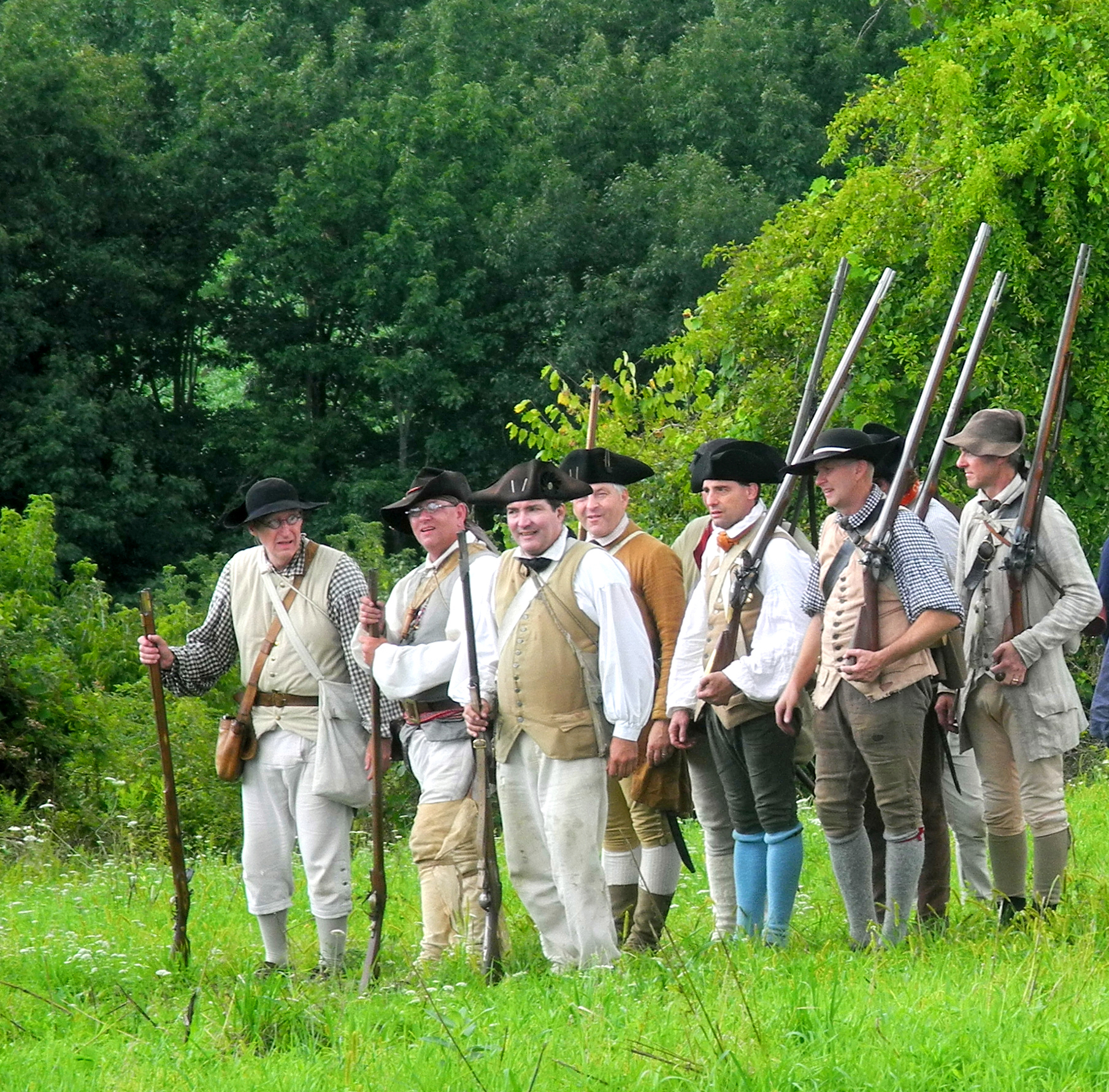
The 10th Massachusetts, fielding as militia, are in the second and third rows above; I was shocked–shocked!– to see them fielding in their small clothes, but it is documented, and as they said when they lay down and even left ranks before fielding, “We’re militia. We’re not listening.” (Left to right, that’s Mr FC, Mr S, Mr McC and, in the rear, Mr L.)

For me, the best part of the weekend was, as it always is, being outside of time. (I even had a nap on Saturday, when the gents were up at the battle: more delicious than stew or cookies or even quince cake.)

At Sunday’s divine service, I was reminded again of why I enjoy this, and why we keep doing this, even when it all seems ridiculous in the face of the larger world.

The old service from the Book of Common Prayer is not that different from what we used in church. The formal rhythm and familiar words always remind me of how different the 18th century was from our own time, and how small people could feel in the face of a world without electricity, internal combustion engines, and modern weapons of war. As we lined a psalm and recited the liturgy that hoped for peace, I thought of Ferguson again, and of the ways that people bind together in beliefs without regard to class or color, and had some hope (even as I recited om mani padme hum internally). A moment of grace is often more easily found stepping outside yourself, and stepping out of time and out of doors can help.

Speaking of stepping out…

woman undressing in stays and petticoats
Almost steppin’ out of the 18th century…

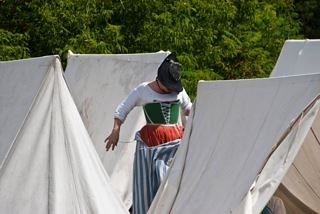
We had to pack up and flee back to the 21st century on Sunday afternoon, and I was caught getting partially undressed outside our tent (between my height and Natural Gace, I find outdoor dressing easier). No matter what you do, or when you do it, a healthy sense of humor about oneself is always useful.

Measure for Measure

or, a boiled Flour Pudding in two tries.

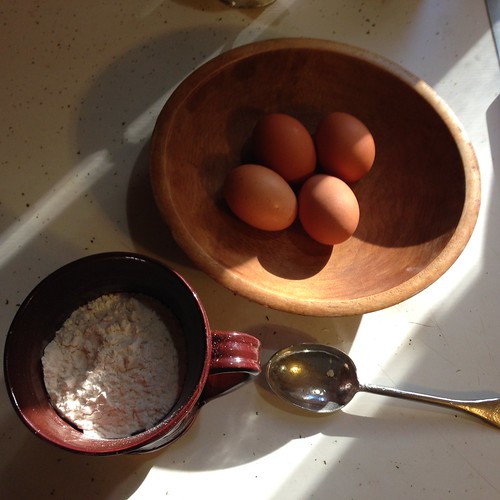
Alone in my Ossining ca. 1962 kitchen, I decided to tackle Amelia Simmons. The first task seemed to be to establish measurements, and then proportions, so I took stock of the tools and containers I would have in a typical camp. Spoon, mug, half-pint: these are plausible items, though we have tin cups that hold exactly 8 ounces, so the measure is unnecessary. The spoon was cast from a 1780 mold, so it seemed like a reasonable place to start for “how much is a spoon?” It will hold exactly one tablespoon if you scrape it flat across or are measuring liquid. Handy to know.

Next, I checked the recipe again.

A boiled Flour Pudding.
One quart milk, 9 eggs, 7 spoons flour, a little salt, put into a strong cloth and boiled three quarters of an hour.

This is not a popular receipt, so you won’t find it on History is Served, nor will you find this version on other popular sites; you can find a boiled pudding with suet, but that’s not what I’m after: I’m after a receipt that starts with a portion of the ration of flour soldiers received, and adds only eggs, milk, and available seasonings.

You have to remember that Simmons corrected the 7 spoons to 9 spoons of flour and increased the boiling time; you also have to remember that eggs were smaller then.

redware mug and wooden bowl with egggs
Halfsies.

I thought I’d try a half receipt first. There are no directions as we think of them– American Cookery sometimes has that “put your lips together and blow” feeling–but this is not too complex. The eggs and milk must be beaten together, and then combined with the flour. For this first attempt, I got it a bit backwards, adding the spices to the eggs, which I beat in the large wooden bowl.

That left me scooping the egg-and-milk with the measure into the flour, which I had in a smaller wooden bowl, remembering too late the method for scones.

egg and flour mixing in wooden bowls
Fuzzy photo, fuzzy logic.

And then it was really too late: I added just too much egg-and-milk, and it became more like batter than dough. This was not correct, and I knew it, but I didn’t dump it and I didn’t add more flour. Now it’s clear that 7:00 AM is not my best time for baking experiments (it was also quite early the day I made gingerbread without any eggs).

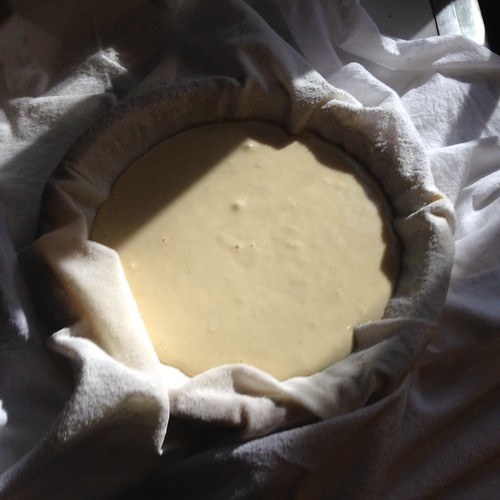
pudding mixture in cloth
Well, it took a decent photo.

I buttered and floured a cloth anyway, and poured the mixture into it. After tying the gathered neck of the cloth with string, I boiled the whole business for 45 minutes.

I did not take a photo of the mess I found when I unwrapped the bag. It wasn’t pretty, and it was clear that while some portions of the pudding were ‘done,’ they constituted about 5% of the whole, which otherwise resembled steaming cottage cheese. Really, truly, awful.

But from time to time I am undeterred by my failures, and instead of consigning the mess to the trash and sticking with store-bought bread*, I rinsed the cloth and regrouped.

This time, I went smaller: 1 cup of flour (about five spoons), two eggs, and a scant two spoons of milk. I also managed to put the flour, salt, and allspice in the regular sized wooden bowl, crack the eggs into the mug and beat them there with the milk. When I mixed the egg-and-milk into the flour, the mixture was far too stiff, so I added more milk, but kept the mixture stiff.

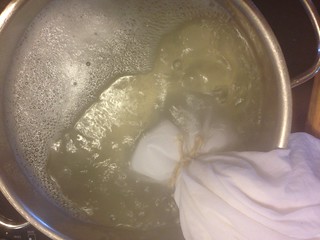
pudding bag in boiling water
Patience is required for pudding

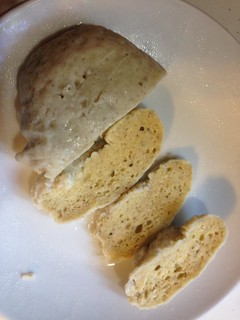
Once more into the buttered cloth, once more into the water, once more boiling for three-quarters of an hour. This time was better, though. The results actually looked and tasted much more like what I’ve had before.

sliced boiled flour pudding
A boiled Flour Pudding

So, where does this leave me? Knowing that I’m the only documented fan of this in the regiment, I’ll stick with the smaller receipt: five spoons flour; two eggs, beaten; and three or four spoons of milk.

My plan is to boil this in whatever stew or stew-like device we have for supper on Saturday, and then eat it sliced with the stew. The plain flour-egg-milk mixture will pick up some of the flavors of the stew (think dumplings), but these could also have been served with a sauce, if made at home.

I’m also going to go back to the Experienced English Housekeeper, and see what she has to say.

* Years in ceramics classes taught me to knead all the air out of plastic material, so my bread tends to be better for building than eating. Even the dog wouldn’t eat the biscuits I made while in grad school…