Peddling a Myth

Paul Sandby RA, 1731–1809, British, London Cries: Last Dying Speech and Confession, ca. 1759, Watercolor over graphite on medium, cream, slightly textured wove paper, Yale Center for British Art, Paul Mellon Collection

Every now and then, I reach the dammit! point of my research, where I am forced to realize that Everything I Assumed Was Wrong. I try to make those moments a cause for celebration, even though they’re often deeply frustrating. Do not pass GO, Do not collect $200, Go directly to the Library.

What now?

Well… Boston ain’t London. And the North American colonies ain’t Great Britain. The business structure, the size of the cities, is different. Distribution of goods is different, thanks to tariffs and non-import/export laws. Which means?

Peddling. It’s not a thing. Or it’s a very difficult thing to document.
Which means that all the things I’d thought about doing for the Massacre (day or night) are probably wrong. (Remember, this is when we celebrate!)

Hey, I’m not the only one rethinking my approach.

But there it is: I’ve looked in the Boston Selectmen’s Minutes for 1768-1771, and while there is plenty of small pox (yay!) and many lemons being imported (yay! punch!) and there are licenses being granted for selling strong drink in inns and houses, there are no peddlers licenses. There are no licenses for street vendors of any kind. Hmmmm….

I’ve also read the Dublin Seminar publications Itinerancy in New England and New York (1984) and Life on the Streets and Commons, 1600 to the Present (2005). Not looking good here for street vendors and hawkers pre-1800.

While I never particularly trust early 20th century monographs and articles without footnotes, the somewhat entertaining Hawkers & walkers in early America : strolling peddlers, preachers, lawyers, doctors, players, and others, from the beginning to the Civil War informed me that street vending was not common in North American British Colonies, and in fact, was not commonly seen until after 1800.

What the ever-loving heckers?

I found peddlers’ licenses in Philadelphia for 1770: all men. But so far, nothing in Providence, Boston, or Newport (or Connecticut). The theory is that itinerant sales people didn’t pay taxes the way merchants did, and that merchants therefore lobbied against them. In Providence, the earliest mention I’ve found thus far is a lobster and fish man at the Great Bridge in 1818.

Just as the watch of Boston differed from the watch in London, so too, it seems, did the petty retailers. I still can’t quite believe there were no street peddlers and hawkers in colonial cities, but I’ll need a new way to approach this question.

Contextualize This*

Right on, Mr. Hiwell: The music of the Army being in general very bad is a post I could never write, because I lack the detailed knowledge, or the desire to acquire music-specific knowledge (just as Mr Hiwell could give two rats’ about stay-making details, or the subtleties of stew). But here’s the gist of his post, on which I wish to elaborate, and which has been touched on elsewhere: You’re Doing It Wrong.

Let’s take this:

I’m tired of going to events, knowing all the camp duties fifers and drummers played from sunrise to sunset and never playing a single one of them besides Drummer’s Call and Assembly.

One of my favorite hobby horses: lack of discipline and camps that look like that Infamous Catalog just puked on a field. Why on earth can we not see tents are set up properly, in rows, with appropriate numbers of kitchens instead of wobbly lines, marquee tents that disgorge giggling teenage girls in bodices, and enough iron to make the scrap man sing with joy? 

But even then, even if people are too lazy or stubborn to leave stuff at home, why can’t a camp run the way it would’ve? There’s ample documentation on which to draw. Quite aside from the voluminous papers of General Washington and General Greene, and the massive archives in Britain, every regiment had orderly books, of which many survive. They’re hilarious reading and full of things to do.

Most reenactments are boring. Well, so was army life. The 10th Massachusetts was constantly in trouble up on the Hudson late in war, and the Marshall book at the Society of the Cincinnati contains the proof.

Here’s something fun to do: inspection. Huts, cabins, tents: they all needed to be kept neat., and apparently weren’t.

Some part of the Camp and about the long Barracks in particular is relaxing into nastiness. Regimental QuarterMasters have been ordered to have them Clean and keep them so. An Officer of each Company has been ordered to visit the Barracks every day and to Confine & Report those who throw bones of meat Pot Liquor or filth of any kind near the Barracks. Yet all this has been done and no report has been made. it is hatefull to General Howe to Reitterate orders as it ought to be shamefull those who make it necessary.

Don’t like to clean, prefer cooking? Marching?

Regimnl Orders June 6th 1782

the Regiment will turn out to Morrow Morning at the Beating of the Revelee and to March By Six oClock they are to pack there clothing and kook there provisions this Evening when they have arivd on the Ground for Encamping the officer commanding on the Spot will order a partry if Forty men from the Regiment a Capt and two Sub’s to Command them to Return to the Encampment in order to asist in Bringin on the Baggage the Soldiers are to Carry there kittles in there hands and are to Leave there arms and pakes &c at the New Encampment any Soldier who is found Plundering another pack is to be tyd up and punished with out Trial..

Tyd up and punished without Trial. You know there’s a guy who’s up for that in every unit.

And lest you think that there’s nothing for women in these books, let me assure you, there is:

Regimental Orders, July 23rd 1782

At a Regimental Court Martial whereof Capt Francis is president, Briget Conner a Woman Belonging to the 10th Massachusetts Regiment was tried for purchesing a publick Shurt from a Soldier in Sd. Regiment found Guilty and Sentanced to Return the Shurt to the person from whom she purshest it and loos what She gav for the Shurt.

The Colo approves the opinion of the Court and orders it to take place Immediately

Regimental orders July 25th 1782

Bridget Conner a woman Belonging to the 10th Massachusetts Regiment is Directed to Leave Camp Between this and to Morrow Morning at Roal Call for her Insolence to the officers of sd Regiment on pane of Being Treated with Severity

This is easy, people. Authenticity, accuracy, and Stuff to Do increases exponentially if you use documentation to recreate a “normal” day in either army.  There’s Cuthbertson, for example.

cuthbertson.png

There’s Lochee, if you want to get in tents. And orderly book after orderly book. And if I, a mere woman, can find these things, there is no excuse for you men not to read, absorb, and use these sources well.

Inspections. Returns. Reports. There’s so much to do in a day, and running a camp or a barracks by the regulations would give everyone so much more to interpret, and begin to present real history instead of merely heritage. This is where the real splits are going to come, and sooner than you think. It won’t be about uniform details, or stitch and thread counts, but about actually engaging historical interpretation. If interpreters aren’t engaged, the public won’t be either.


*If you know me, you know what the next word is.

Rumours of Bore

Detail, The Letter. Pietro Longhi, 1746. Metropolitan Museum of Art, 14.32.1

My time-travel was cut short this weekend after a trip to eight-nine-teen-something in Salem, as I had a trip to the Central Fly Over* for work instead. Still, through the magic of telephony and the interwebs, I heard about the Sunday OSV Experience and the Great Drawn Sabre of Saturday. (Caution: Strong language) One presumes and hopes that aside from whatever disciplinary action OSV will take– and they will–the CL commanders will address this clear safety violation.

The news photos show the usual collection of baggy menswear (are those painters’ pants? is this 1812?) and the Bodice of Myth and Legend (St. Pauli, anyone?) along with obligatory musket firing and “gotcha” shots of fallen soldiers sneaking peeks at the action. I don’t even have to say what we all think when we see those images.

But the Sunday report that struck me the most was this: The tactical went on for 45 minutes, very few soldiers fell, and the public began to leave before it was over. Got that? They got bored. As the teller of this tale said, The magic is gone. You can consider that a public endorsement of either more civilian events or a re-imagined tactical. I prefer the former, you may prefer the latter. But either way, if you’re going to use The Public as your justification for playing armed dress up on a hot day, you’d better engage that public. What that could mean will have to wait for another time, but when people head for the exits, the show won’t last.

* More on that later

Afternoon in Cambridge

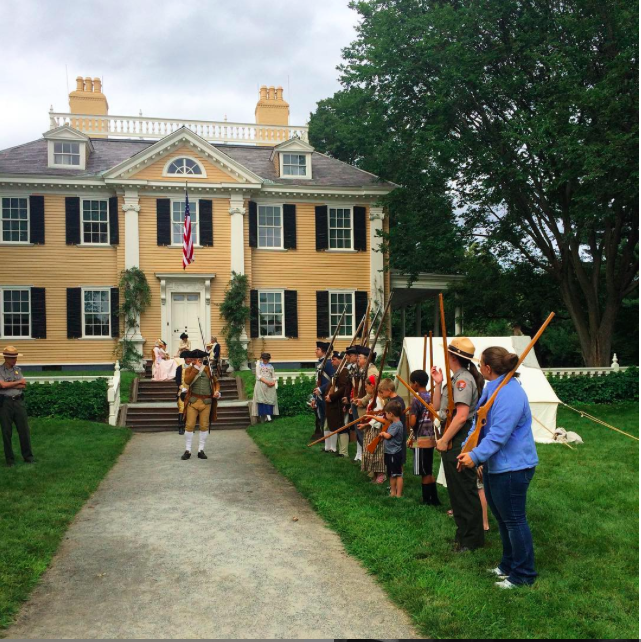
Cambridge. We’ve been there before to cause some mild lawn-based havoc and this year was much the same. We were on our own on the lower level, with just the six-plus-me of some abbreviated form of Soper’s company. Longfellow House is a very lovely site, and the lawn is large enough for a wall tent, drilling, eating, and general mischief.

Longfellow House, Cambridge. Photo from @longnps on Instagram

I packed our lunch in a series of linen bags in the wallet, and stuffed a gown skirt and sewing box in the other end, with a bowl and a mug. I brought the small pitcher and a glass, with the intent of selling ‘gin’ to the militia, but had only one taker. They got into enough trouble themselves with filthy faces, pilfering, and stealing the captain’s books.

unknown artist, 18th century, The Encampment in the Museum Garden, 1783, Aquatint, hand-colored, Yale Center for British Art, Paul Mellon Collection

It’s no immersion event, what with traffic on the street and tourists dressing in Mr Townsend’s best* but there are moments at any gathering when you become so engrossed in what you are doing that you forget where you are. This time was no different: I don’t recall how it started, but we took off down Brattle Street with Sergeant Cooke crossing the yard in hot pursuit– only to be stopped by the wall. He turned the stone barricade into a large and angry goose, neaatly solving solving the problem of not being able to scale the wall.

James Sowerby, 1756–1822, A Goose, undated, Watercolor and graphite on moderately thick, slightly textured, cream wove paper, Yale Center for British Art, Paul Mellon Collection

I don’t think I’ve ever bolted that fast in stays before, and it wasn’t the best idea I’ve ever had, but who cares? It can be done, running in stays, at least for short bursts.

There was much discussion of the filth of the troops, and their need to bathe; despite our best efforts, we could not quite get a satisfactory rise out of the officers, though some soldiers had clearly rolled in dirt. (It’s of a much better quality in Cambridge, you know, where you can wear the Harvard Yard.) There was an attempt at bathing at the Great Bridge, but in the end, one private’s face was washed with an apron corner dipped in ‘gin.’

Benjamin West, 1738–1820, American, active in Britain (from 1763), The Bathing Place at Ramsgate, ca. 1788, Oil on canvas, Yale Center for British Art, Paul Mellon Collection

Satisfying all around, really, from the recitation of Mr Pickering’s manual with its endless repetition of ‘butt,’ meaning musket, entertaining the simpler, uncivil soldiers, to the meal of bread, cheese and cherries, to the chasing. The audience was small, but well entertained if they were paying any attention.

*Oh, NPS, what were you thinking?