What to eat in the field in August? Redcoats & Rebels approaches, and food must be prepared. This time, we are camping over. That means that pretty much everything must be ready by 1:30 on August 3, and there is nothing like a deadline to focus attention.
To start with, I turned to The Compleat Housewife: or Accomplished Gentlewoman’s Companion, published in 1739. The author presents seasonal menus, because one important thing to remember is that historical eating was seasonal and local. (This concept may sound familiar to fans of Alice Waters or Mark Bittman.)
The suggestions are, of course, beyond the realm of soldiers’ rations.
Westphalia Ham & Chicken.
Bisque of Fish.
Haunch of Venison, roasted.
Venison Pasty.
Roasted fowls a la daube.
White fricassee of Chicken.
Roasted Turkeys Larded.
Beef a la Mode.
Roasted Lobsters.
Rock of Snow and Syllabub.
But take a closer look: beef a la mode is a kind of pot roast, so beef in a kettle with water and veg cooked over a fire ought to do. It’s what we call “officer chow,” and what the boys ate at Fort Lee. I was mostly looking for vegetables in season, or fruits, but the farmers’ market will provide that limitation.
So here’s what I think:
Pasties made Thursday night or Friday morning for supper on Friday.
Gingerbread cake for treats.
Oatmeal and fruit for breakfast Saturday morning, or else boiled eggs, bread, and fruit.
Bread, cheese, fruit and sliced ham for lunch on Saturday.
Tea, shrub, and gingerbread cake for Saturday tea.
Beef stew for supper on Saturday.
Breakfast and lunch will be the same for Sunday, and we pack up and leave on Sunday afternoon, so I won’t need to make Sunday supper in camp.
It’s reasonably authentic to the 18th century, though not to common soldiers’ rations. But the guys won’t want to eat firecake and water.
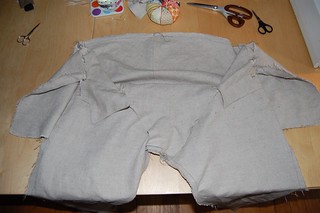
Overalls: the devil’s clothing item, even more evil than the worst multi-part replica sleeve (that’s right sleeves, I mean you!). First there are the fiddly fall bits. Then there is the question of overall inseam length, then the shape of the leg must match the contours of the wearer, and lest we forget, the evil tongue. All of this is followed by 15-20 buttonholes.
Why did Mr. S not join a kilted regiment? Pleats and hems, easy-peasy. Overalls, not so much. The current overall score is Overalls 1, KittyCalash, 0, Draw, 1. The current pair have conquered me, but I may yet prevail but turning them into breeches with a swift amputation of the lower extremity. The first pair I made were finally overcome last fall with a new tongue piece, but they are too baggy to be correct. We’ll call that a draw.
Many moving parts
Fitting the beasts is awful, because so much sewing has to be done up at the waist, but somehow I will have to come up with a muslin and drape the legs to the subject. Once that is done, I can make a more permanent pattern that accounts for shorter than average femurs, larger than average calves, long shins, high arches, and small feet. (Most of the 2nd Helping Regiment guys have very small feet. The Young Mr is the exception, with his 12s. Obviously, his shoes will be the first to be eaten on a march to Quebec: more leather, better broth.)
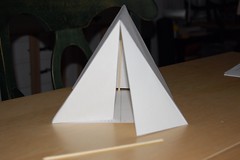
Then there is the question of a tent. Locally, a very fine hemp linen “other ranks” tent has been made, with ash tent pegs and hewn tent poles. The Young Mr and I made up a scale model last night (sans bell) to test the dimensions we worked out using math, Once school is out, all math must be real-world tested. From this, I began calculating yardage requirements, based on 57″ wide hemp linen available from a few sources. At $17/yard, it looks like $187 for a tent without a floor or mudflaps or a bell. 11 yards! That is a lot of fabric, and a lot of sewing.
Tiny little tent!
Perhaps tonight we’ll try out a slightly smaller version, with a bell. If we start this fall, we might have a tent done for next season…if the guys would only learn to sew!
When in doubt, hand sew: it’s good for the brain and the soul.
Thinking about reenacting in terms of mission worked in sorting out my Trouble with Ticonderoga. The Fort’s Defiance and Independence event is meant to further their mission to “ensure that present and future generations learn from the struggles, sacrifices and victories that shaped the nations of North America,” and the BAR’s mission is to recreate the life of the common soldier of the AWI, and my family’s mission is to have fun while recreating the life of the common soldier of the AWI, if some part of an event doesn’t seem like fun, it doesn’t further our mission. And if it doesn’t seem like fun, don’t do it. It’s just that simple.
Another way of looking at this is to recognize that not every event is for every reenactor. Obviously you don’t take a Charleville to Gettysburg, but more importantly, if an event is primarily to recreate a military action, but you and your family are looking for a shared reenacting experience, you are likely to be disappointed.
I also thought about it all in terms of priorities: family first, then Regiment, and so on up the line. Better by far to hone what we have to interpret the Regiment’s history first, and to get ready for Redcoats & Rebels at Old Sturbridge Village.
This event has more tangled into it than you’d think. Last year was not so great. The Captain didn’t seem happy, Mr. S’s overalls did not pass muster in foot-related fit, the Young Mr. pouted for a half a day, and I was stuck in camp with a blowsy woman talking about babies while the public tramped across our blankets. This year, we’ll camp over and entertain Mr. S’s parents, who are determined to see one of the reenactments. OSV offers the most opportunities for them and for us. There’s the Village itself to entertain and feed them, and surrounding areas with antiques and sight-seeing. We will be “stuck” minding camp and won’t be free to entertain or feed them in the evenings, and if they stay for the twilight camp tours, there will be a curfew. There is much to like about this arrangement for us.
So in preparation, I’m making new overalls for Mr. S, who has lost enough weight that last year’s are just too big. For myself, I’m cruising bedgown images like The Provider. Chardin is a favorite painter, and while I can’t have a pinner apron, I have a blue and white striped petticoat. The white concerns me, though it would definitely get dirty fast, and there’s a lot to like about that, too.
No matter what we choose to do in the future, the sewing helps now.
Warning: Heavy Re-enactor/Museum Management/Philosophical-type Content
Battle Road, with photographers
Who is this authenticity for?
I think that is the core of the question. I spent much of yesterday (when not banging head here at work) banging my thoughts on the question of Fort Ticonderoga’s standards, and the relative abilities of my family to meet them. Somehow, out of that and previous thoughts about bullying, research, cattiness, and the general meaning of “living history,” “reenacting,” and “The Hobby,” I reached a simplistic conclusion, or perhaps it was a question:
Who is the “good enough” for? Moving past that wretched verbal construct, think about this:
Each event, each unit, each individual is like a museum or historic site in microcosm. The unit I belong has a mission: to re-enact the 2nd Rhode Island Regiment of the Revolutionary War. The regiment and its members belong to the Brigade of the American Revolution (BAR), which has a mission, “The Brigade is a non-profit living history association dedicated to recreating the life and times of the common soldier of the American War for Independence, 1775-1783.”
Clear enough, right? Following from the mission would be standards. And those standards would, in an organization’s strategic plan, be goals. (The vision statements or values statements would be different–and I don’t know what they would be for the BAR. For my unit, I can only guess but I think one of our value statements would be “Tolerance, kindness, patience.”)
So, let us consider the nexus of the BAR and Fort Ticonderoga from the mission and standards point of view. They clearly overlap where the recreation of the life and times of the common soldier are considered in the context of 1777’s assault by the Continentals on the Fort. Excellent. Because everything you do as an organization should point toward, or be derived from, or further your mission. The BAR, in fulfilling its mission to recreate the life of the common soldier, creates an event that fulfills Fort Ti’s mission “to ensure that present and future generations learn from the struggles, sacrifices and victories that shaped the nations of North America and changed world history. They serve this mission by:
“Preserving and enhancing our historic structures, collections, gardens and landscapes.
Educating and inspiring our visitors about the history of Fort Ticonderoga and the diverse peoples who met here in war and peace.”
The BAR event would fall under the “educating and inspiring” part of “how” the Fort fulfills its mission.
Clear enough so far, I think, how the BAR and the Fort overlap. Now comes the tricky part: the people part.
Looking at the Fort Ticonderoga event, my first thought weeks ago was, “We can’t do that; no Rhode Island troops were there.” I’m not just a stitch counter—I’m a troop counter too. Then I realized that there aren’t necessarily enough MA and NH re-enacted troops to make the event possible without “reinforcements” from other states.
Conquering that, I began to consider the standards, and as previously stated, I’m a stitch counter so I have to follow them or be a hypocrite. And that’s when I started thinking about “who is this good enough for?” What’s my mission? Is it aligned with my unit’s mission, the BAR mission, or even my own family’s mission?
Because the place of overlap, given that this is a hobby, is in the conjunction of my desire to have fun, and the mission of the BAR: If I think it is fun to “recreate the life and times of the common soldier,” then we’re good. I love to sew, the challenge of creating 18th century garments for the three of us is fun the way art school was fun, but it’s not any fun to be all dressed up with no place to go.

 What to eat in the field in August? Redcoats & Rebels approaches, and food must be prepared. This time, we are camping over. That means that pretty much everything must be ready by 1:30 on August 3, and there is nothing like a deadline to focus attention.
 The suggestions are, of course, beyond the realm of soldiers’ rations.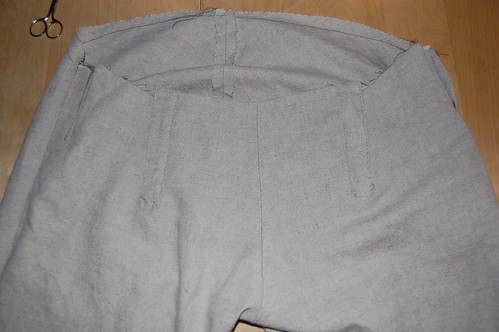


 Kirsten Hammerstrom
You must be logged in to post a comment.